The Hardest A Math Topics (and How to Master Them) — 2026
By the Math Academy Team — NUS-trained, ex-MOE tutors · Updated June 2026
Every A Math student hits a few topics that feel like a wall. The good news: the hardest A Math topics are
predictable, and each has a known route through it. This guide ranks the five that trip up the most students,
explains exactly why each is hard, and gives a practical way to master it — so the wall becomes a step.
- The hardest A Math topics are usually calculus, trigonometric identities, the binomial theorem, partial fractions, and “show that” proofs.
- Almost every one is hard for the same underlying reason: weak algebra showing through.
- Each topic has a reliable method — master the basics on simple cases first, then build up.
- Consistent, spaced practice beats last-minute cramming for every one of these topics.
The hardest A Math topics, ranked
Based on where students most often lose marks, these five topics are the usual suspects. None is beyond a
prepared student — but each rewards a specific approach rather than brute-force practice.
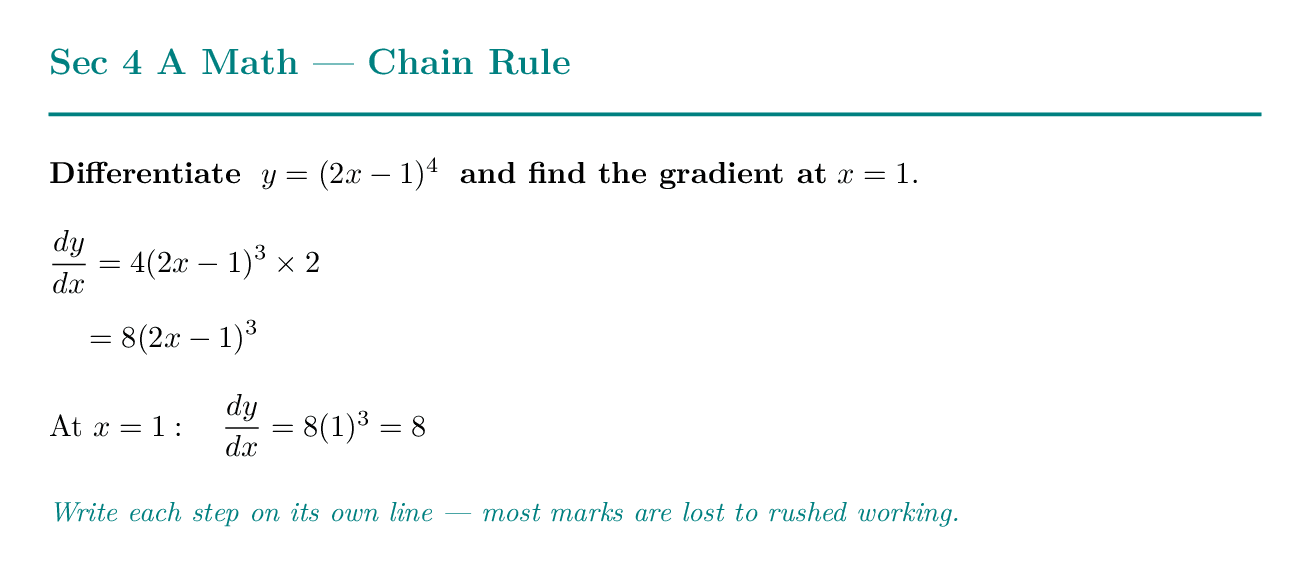
1. Calculus (differentiation and integration)
Why it’s hard: calculus is a genuinely new way of thinking — rates of change and areas
under curves — with no equivalent in E Math. The rules (chain, product, quotient) are easy to confuse, and
integration adds the extra demand of working backwards.
How to master it: learn the rules on the simplest functions until they are automatic,
then layer in complexity one step at a time. Always write each differentiation or integration step on its own
line — most calculus marks are lost to rushed, compressed working rather than to not knowing the method.
2. Trigonometric identities and equations
Why it’s hard: there are many identities, and students must choose which to
apply — there’s rarely one obvious path. Equations add the trap of losing solutions or missing the given
range.
How to master it: commit the core identities to memory through spaced repetition so recall
is instant, then practise recognising “trigger” patterns that suggest a particular identity. For equations,
always state the range first and check every solution against it.
3. The binomial theorem
Why it’s hard: the formula looks intimidating, and questions often ask for a specific
term or coefficient rather than the full expansion, which trips up students who only know how to expand
everything.
How to master it: learn the general-term formula and practise extracting a single term
from it. Most binomial questions are really one careful substitution — slow down on the powers and signs.
4. Partial fractions and polynomials
Why it’s hard: it’s procedurally fiddly, with several setup steps where a small algebra
slip quietly ruins everything downstream. Long division and the factor/remainder theorems add more places to
go wrong.
How to master it: follow a fixed routine every time — factor the denominator, set up the
fractions, solve for the constants — and check by recombining. The reliability comes from the routine, not
from cleverness.
5. Proofs and “show that” questions
Why it’s hard: these reward rigour and clear reasoning, not just a correct final number.
Students used to “getting the answer” often skip the logical steps an examiner is actually marking.
How to master it: work from one side to the other, justify each step, and never assume what
you’re trying to prove. Writing proofs out in full, then comparing against worked solutions, builds the habit
fastest.
The common thread — and how to prepare
Notice the pattern: in nearly every hard topic, the real difficulty is weak algebra surfacing
under pressure. Calculus, trig and partial fractions all assume fluent factorising and rearranging.
That’s why the most effective preparation isn’t grinding each topic in isolation — it’s shoring up the algebra
underneath while drilling each method to automaticity. This combination is exactly what structured
A Math tuition provides: targeted work on the
foundation plus guided practice on the topics students fear most.
Master these five and the rest of A Math falls into place — and the same calculus and trigonometry reappear
in JC, so the effort pays off twice. If you’re still deciding whether A Math is the right move, see our guide
to E Math vs A Math; otherwise, the route through the hard topics is the same
one our A Math tuition is built around.
Frequently asked questions
What is the hardest topic in A Math?
For most students, calculus — it’s an entirely new way of thinking and there’s a lot of it. Trigonometric
identities run a close second because they require choosing the right approach, not just applying a formula.
Why do students find A Math so hard?
Usually because of weak underlying algebra. A Math assumes fluent factorising and rearranging, so any gap
there surfaces across calculus, trigonometry and partial fractions at once.
How do I get better at A Math calculus?
Master the differentiation and integration rules on simple functions until they’re automatic, build up
complexity gradually, and write each step on its own line to avoid careless slips.
How many identities do I need to memorise for A Math trigonometry?
A manageable core set, but they must be recalled instantly. Use spaced repetition so recall is automatic,
then practise spotting which identity a question is steering you toward.
Is it possible to do well in A Math if I find it hard now?
Yes. These topics are predictable and method-driven. Shoring up algebra and drilling each method with
consistent, spaced practice turns the hardest topics into reliable marks.
Do the hard A Math topics matter for JC?
Very much — calculus and trigonometry from A Math reappear and extend in JC H2 Mathematics, so mastering
them now makes the JC transition far smoother.