
JC2 · A Level Preparation · H2 Mathematics
JC2 H2 Math Crash Course and Revision Workshop
2 hours a week. Every A Level topic. Every exam question type. Conducted weekly by Mr Ian Ang — starting 13 June 2026.
Programme at a Glance
Lessons
Topics — every chapter on the H2 Mathematics A Level syllabus, from Complex Numbers to Hypothesis Testing.
Duration
Per lesson, every week. Structured, focused, and exam-oriented — so every minute is used well.
Programme
Starts 13 June 2026. 19 weekly lessons through to the A Levels, plus a bonus Hypothesis Testing recording provided before the exam.
Class Size
Maximum per class. Same small-group standard as all Math Academy programmes — every student gets attention.
For JC2 Students
JC2 H2 Math Crash Course — 2 Hours a Week, Every Topic Covered
JC2 students have very little time. Between lectures, tutorials, CCAs and school tests, finding time to revise H2 Math thoroughly feels impossible.
Math Academy’s JC2 H2 Math crash course is designed specifically for JC2 students in the final stretch before A Levels — 2 structured hours a week, every topic covered systematically, every common exam question type taught and practised. You don’t need to find extra time. You just need to use 2 hours well.
Whether you have been consistent all year or are looking for a final push, you will gain the insights, techniques, and confidence to tackle even the most challenging A Level questions. Don’t leave your results to chance.
Already in regular JC H2 Math tuition with us? See our weekly JC1 & JC2 H2 Maths classes here.
What You Get
Topical. Focused. Exam-Ready.
- Every chapter covered — 20 lessons from June to November 2026
- Concise summary of key formulae for each chapter
- Exam-focused practice — relevant questions tied to each formula
- Diverse question formats — every type the A Levels may throw at you
- Mr Ian’s copyrighted notes — refined over years of A Level teaching
- Fits your existing schedule — conducted during regular weekly class slots
- WhatsApp access to Mr Ian throughout the week
Each student receives Mr Ian’s complete set of copyrighted notes — 20 chapters, written and refined over years of A Level teaching. See the notes ↓
What JC2 Students Say About Math Academy’s A Level Revision
These are students who went through the A Levels with Mr Ian Ang. In their own words.

“The notes are organised into different sections, and Mr Ang takes the time to explain each concept in chunks — walking us through practice questions before moving on. The materials classify different question types and outline key answering techniques.”
Read full review
I joined Math Academy four months before my As, which was right around the final stretch of revision for various topics and chapters. Initially, I felt short on time with the exam approaching quickly, but Math Academy’s materials, particularly the math notes, were incredibly concise and well-structured, making it easier to grasp complicated concepts.
The notes are organized into different sections, and Mr Ang takes the time to explain each concept in chunks, walking us through practice questions in class before moving on to the next concept. He also makes sure to circulate around the room, offering guidance and helping anyone who gets stuck.
The materials also classify different question types and outline key answering techniques and keywords to focus on, helping students understand how to apply the correct concepts to various problems. Mr Ang is a dedicated and patient tutor who is committed to ensuring that the right concepts are instilled. Thanks to Mr Ang’s support, I now feel much more confident in math.

“His material is very thorough, with multiple question types and practice questions for each — many of which came out in the paper.”
Read full review
Was a student here from J1 till the end of my A Levels, and Mr Ang has been an amazing teacher. His material is very thorough, with multiple question types and practice questions for each (many of which came out in the paper). He is also very patient and thorough when answering questions. The relatively smaller class size also facilitates easy questioning. Overall a very positive experience going to tuition here and am very happy!
“I learnt 5% from school and 95% from Mr Ang! Mr Ang will go through EVERY SINGLE question type — more than your school will. During my A Levels, there was a particular question the majority of students did not know how to do. I could finish it swiftly because I remembered the method from Mr Ang’s notes.”
Read full review
Graduated in 2023 and I must say Mr Ang is very knowledgeable and experienced in Maths. Mr Ang will go through EVERY SINGLE question type (more than your school will) and give practice for each.
During my A Levels, there was a particular question that the majority of students did not know how to do as it wasn’t covered in school — but I could finish it swiftly because I remembered the method that was in Mr Ang’s notes. Felt so grateful for having such good notes where not even a single thing is missed.
Mr Ang always replies promptly on WhatsApp within a few hours. If you do everything taught diligently I would say you are very secure and have covered all ground (that even school hasn’t covered). Thank you Mr Ang for guiding me for 2 years!
The Notes Every Crash Course Student Receives
Mr Ian’s copyrighted JC H2 Math notes — authored in-house, refined every year, structured around exactly what the A Levels examine.
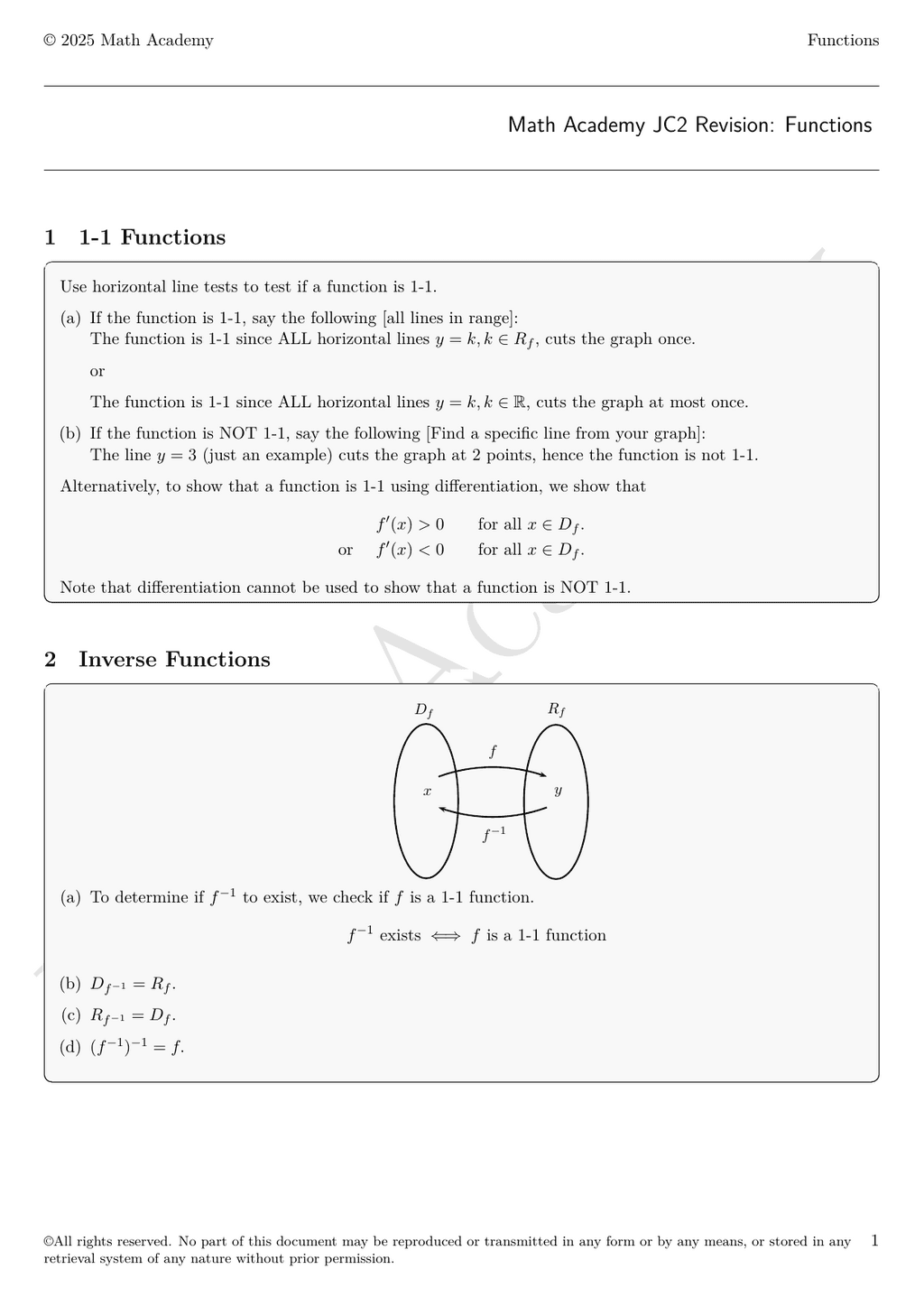 Functions
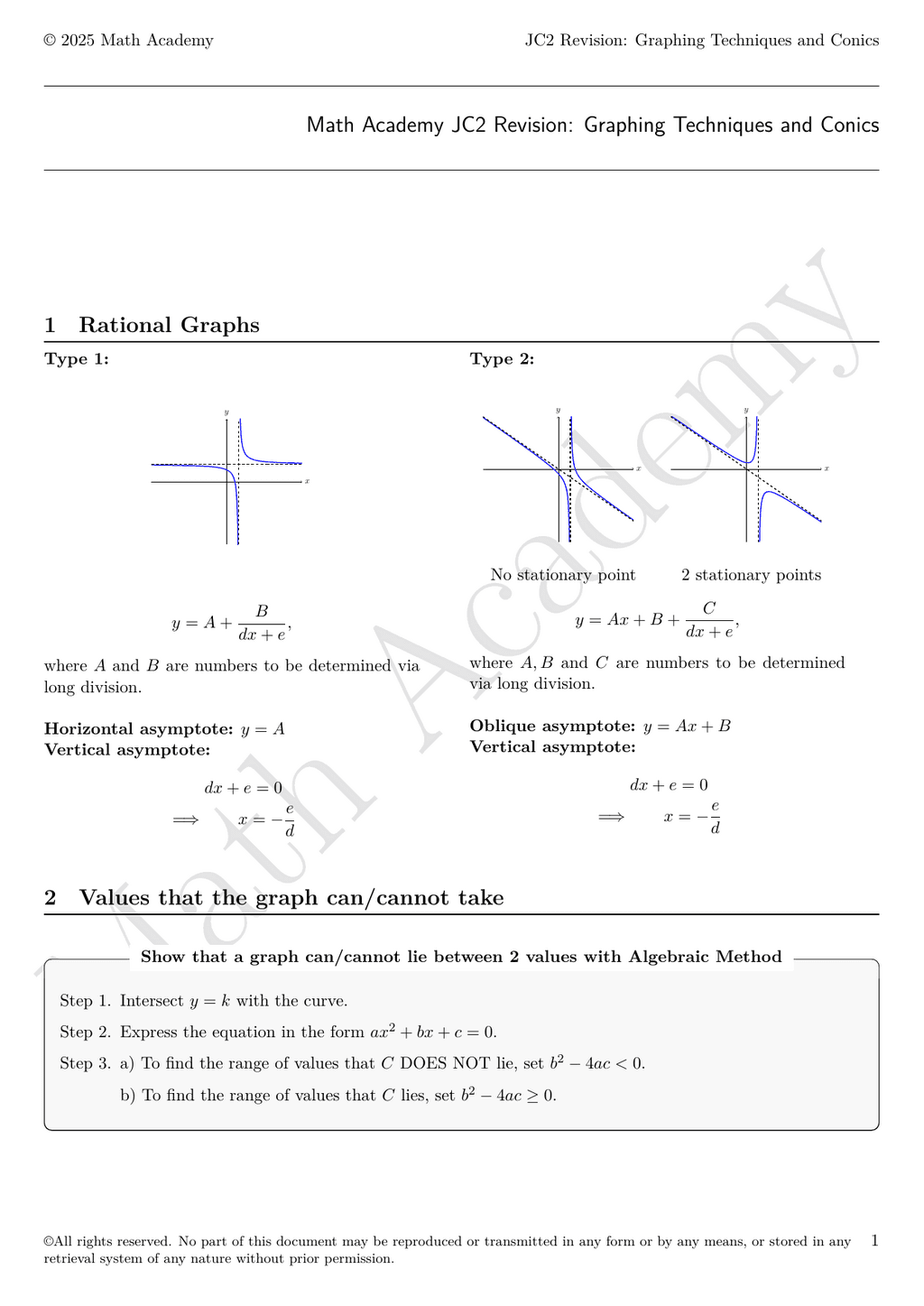 Graphing Techniques
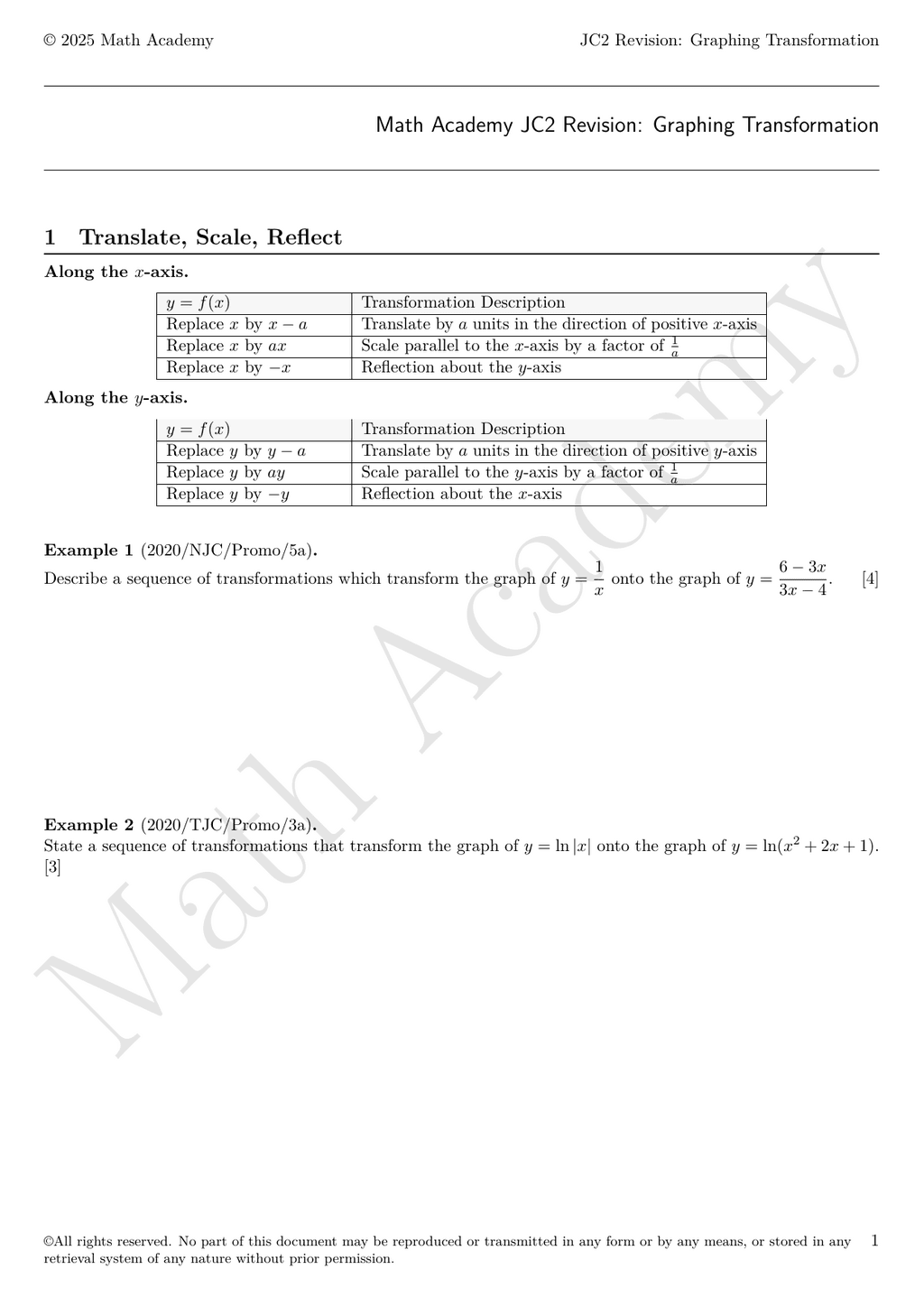 Transformation
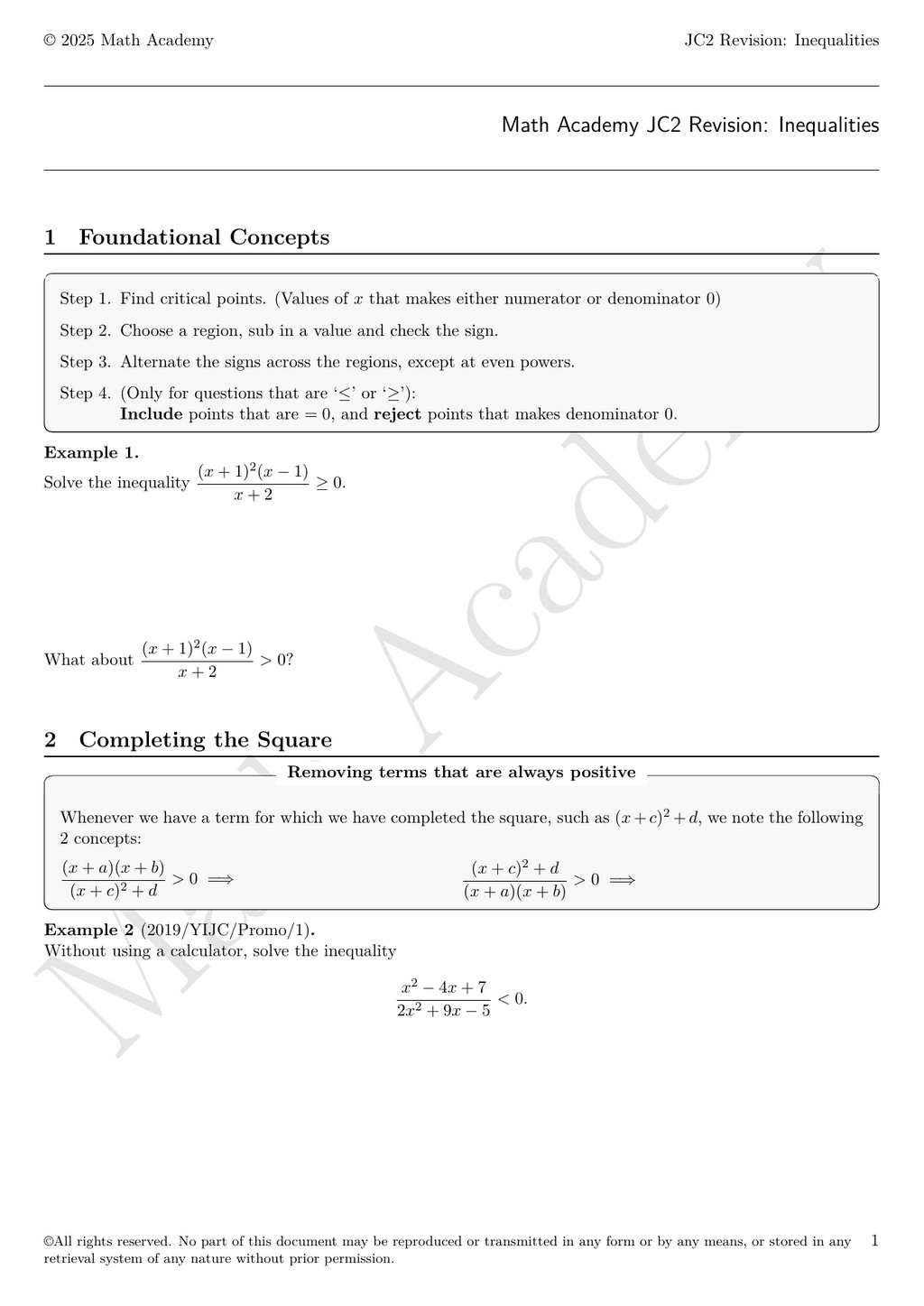 Inequalities
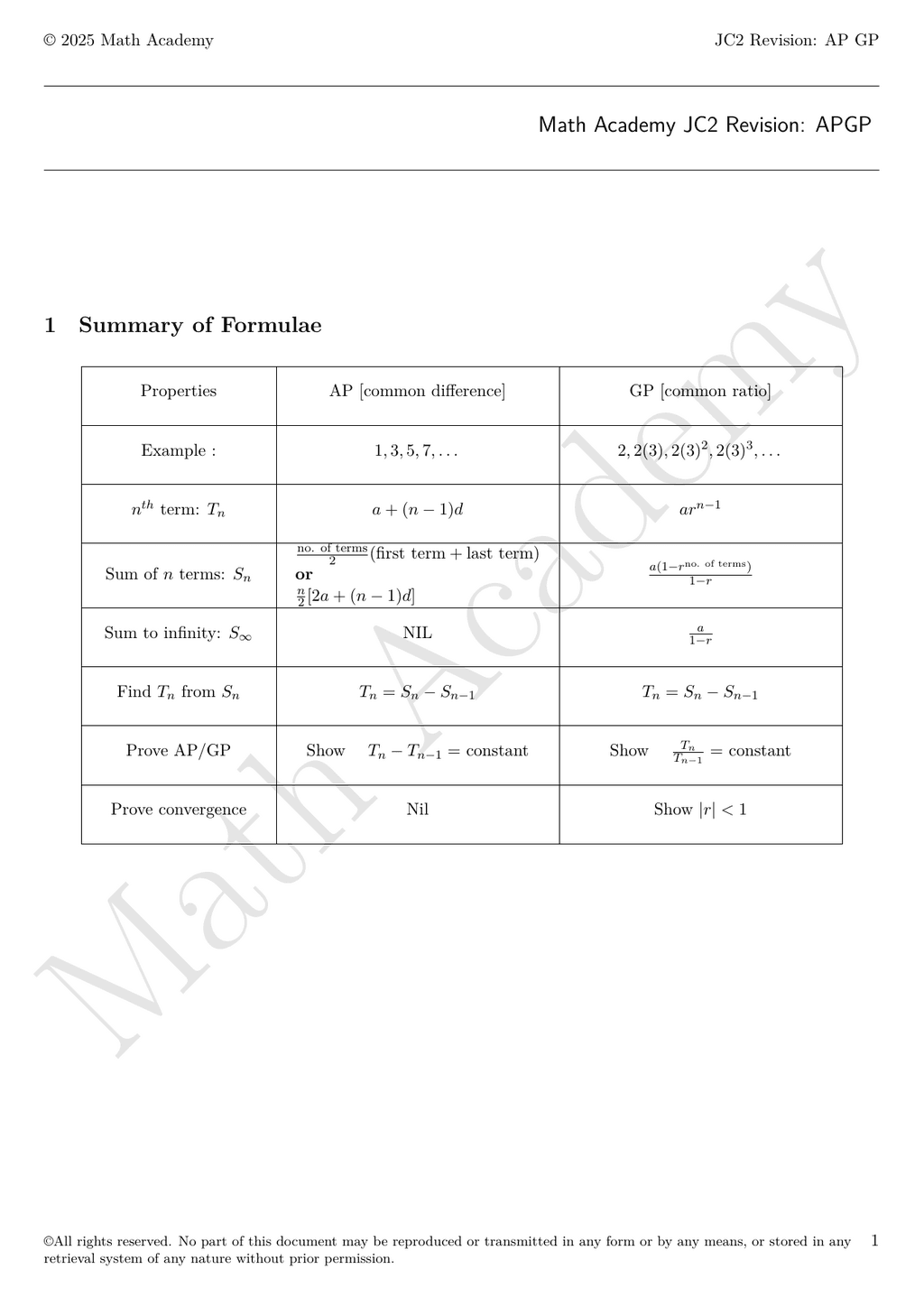 AP GP
AP GP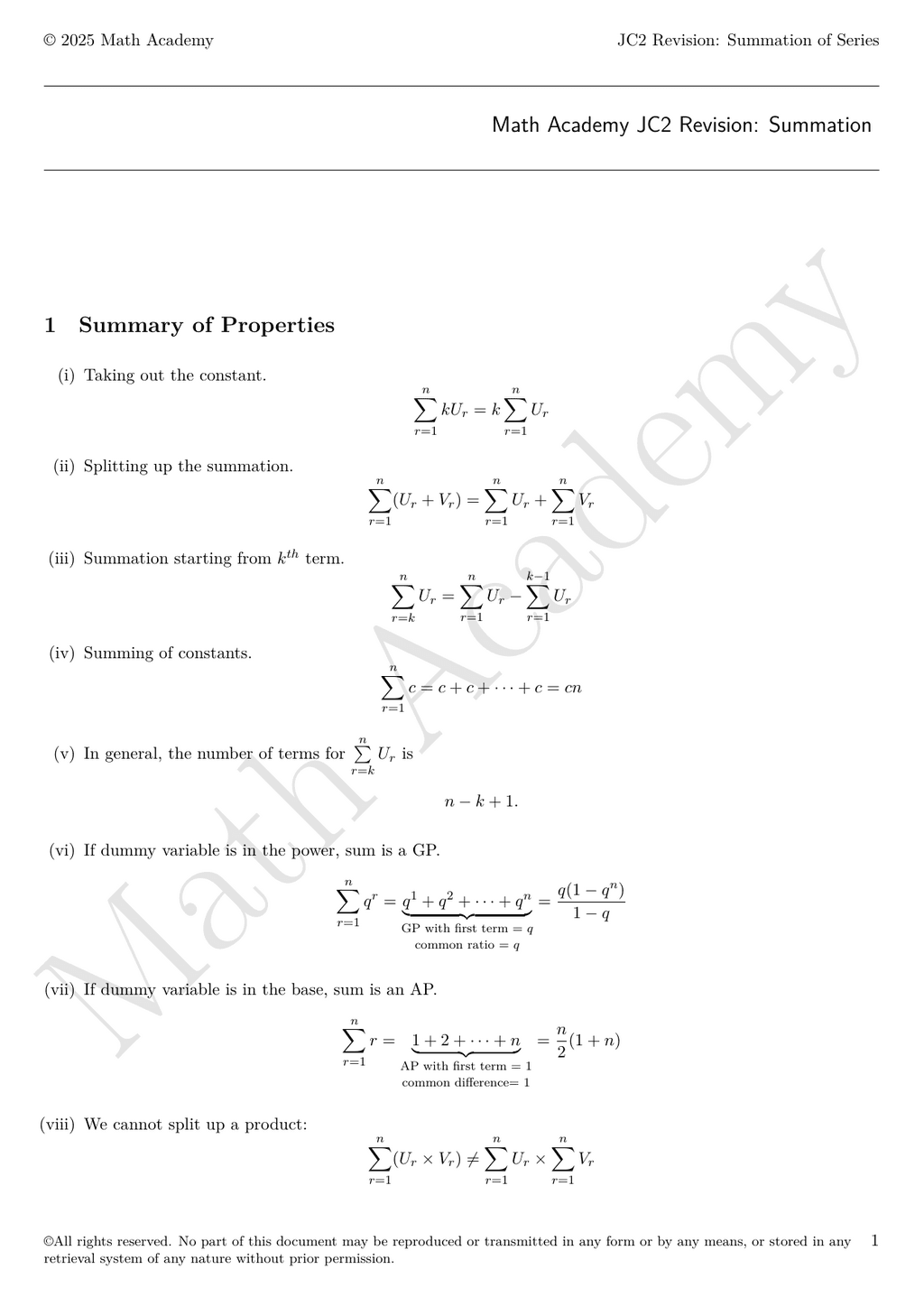 Summation
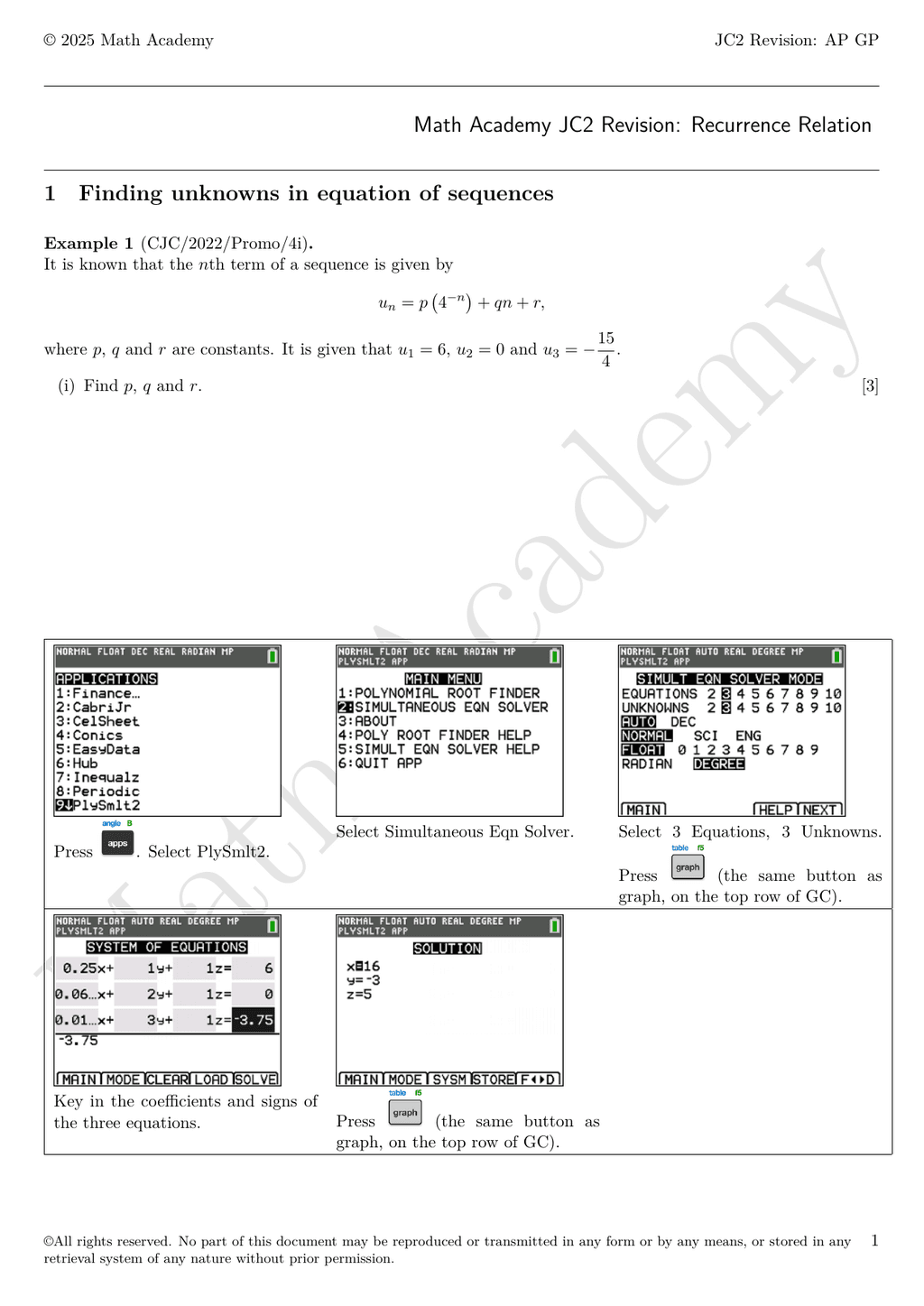 Recurrence
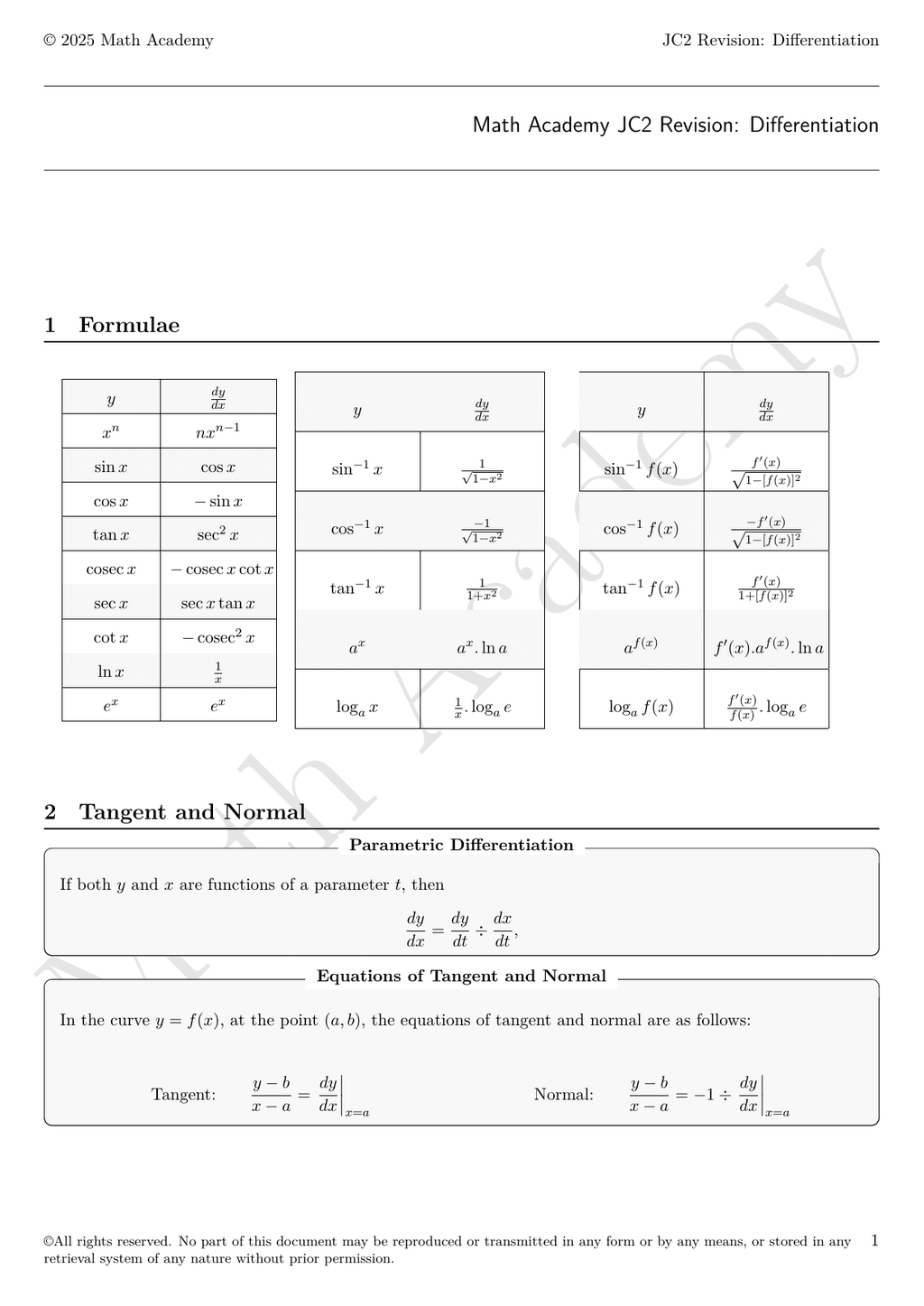 Differentiation
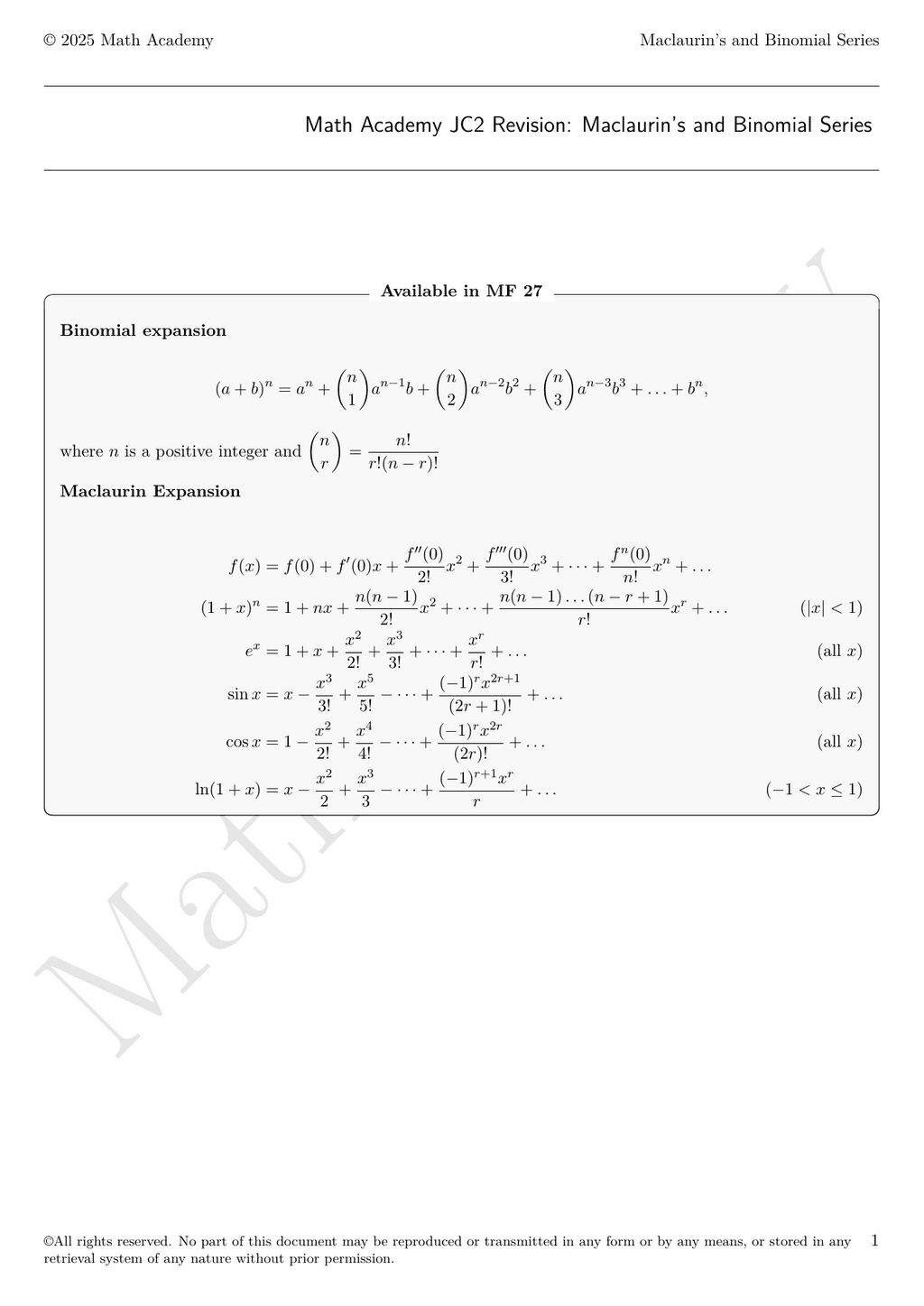 Maclaurin Series
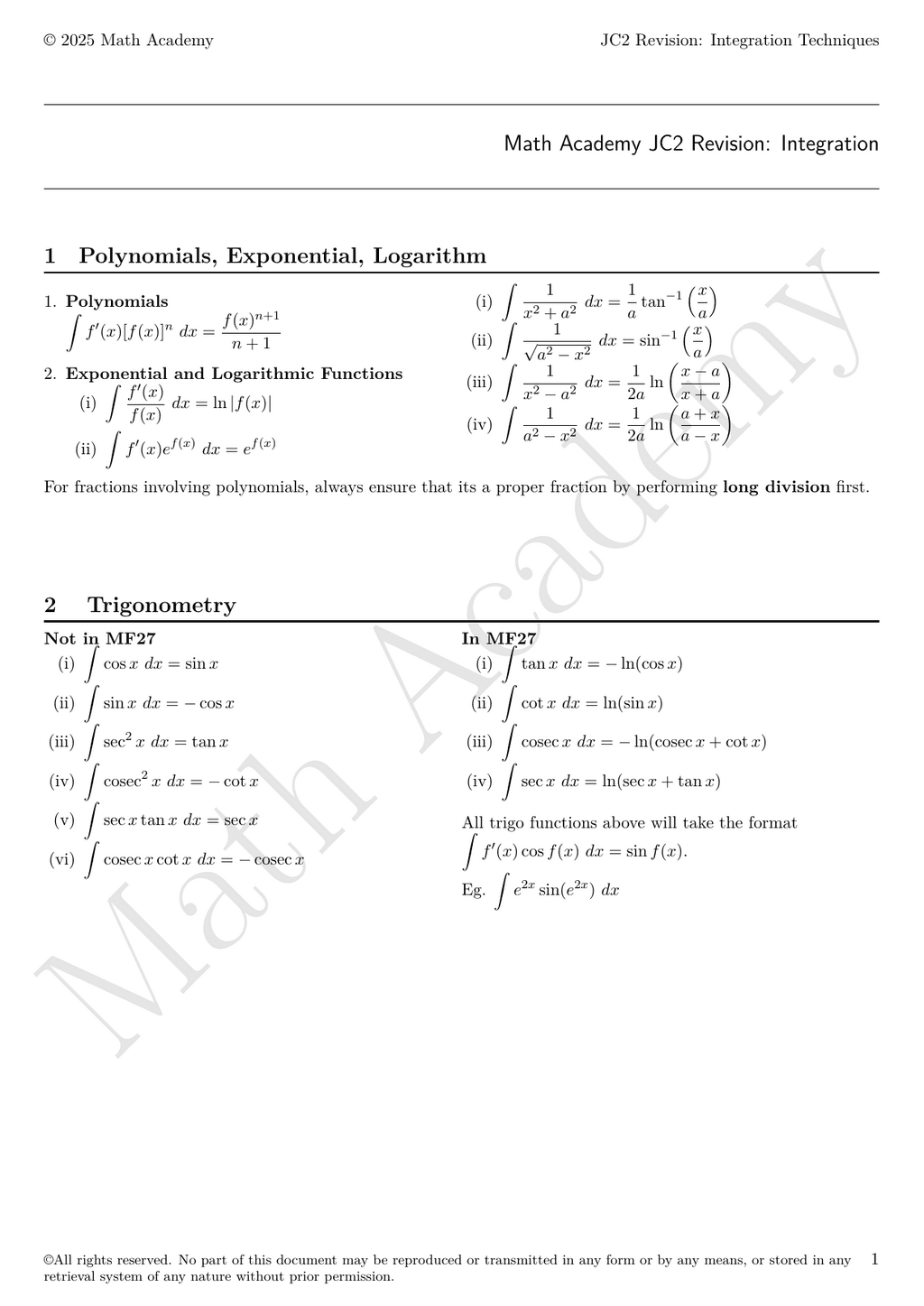 Integration
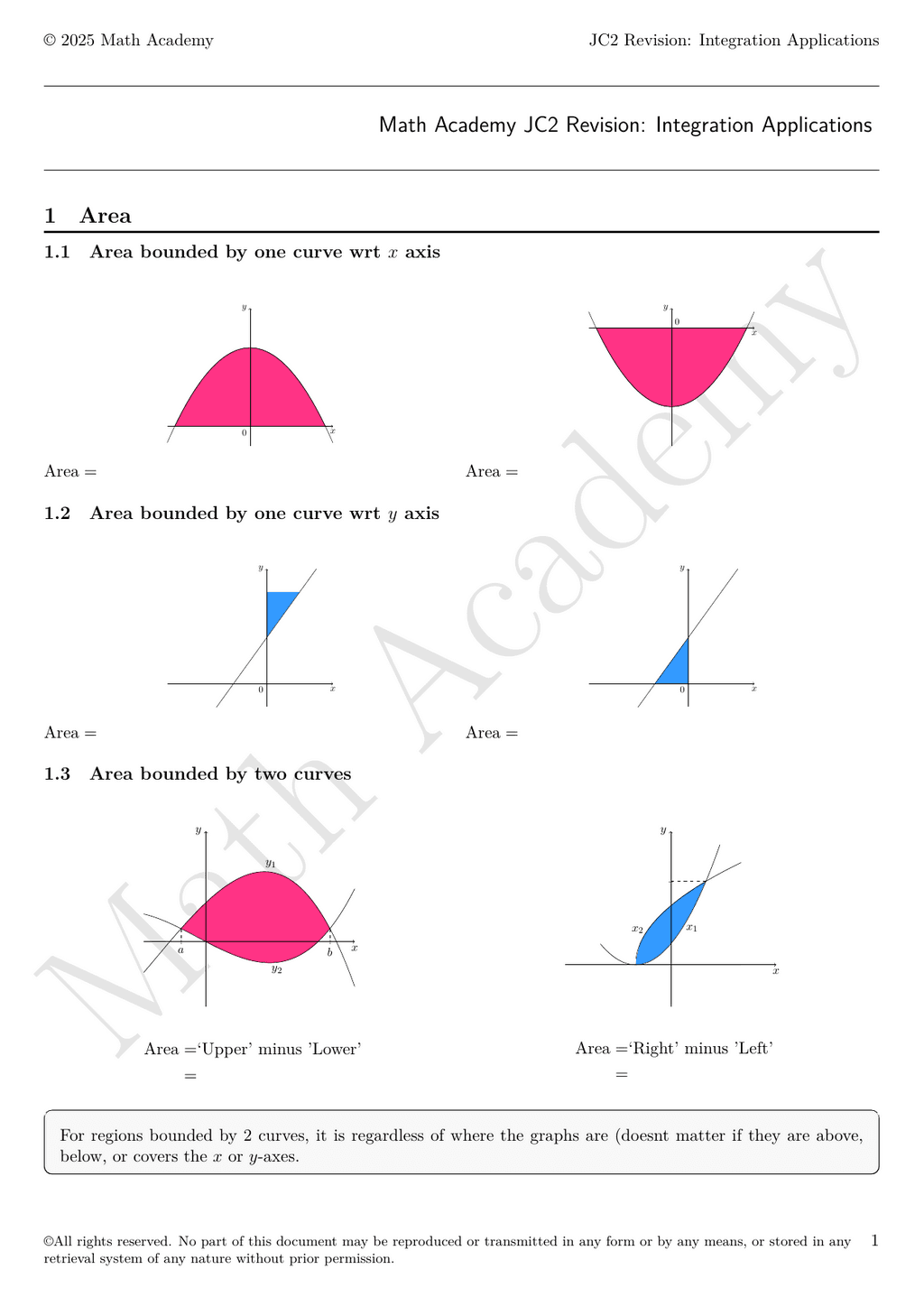 Integration Applications
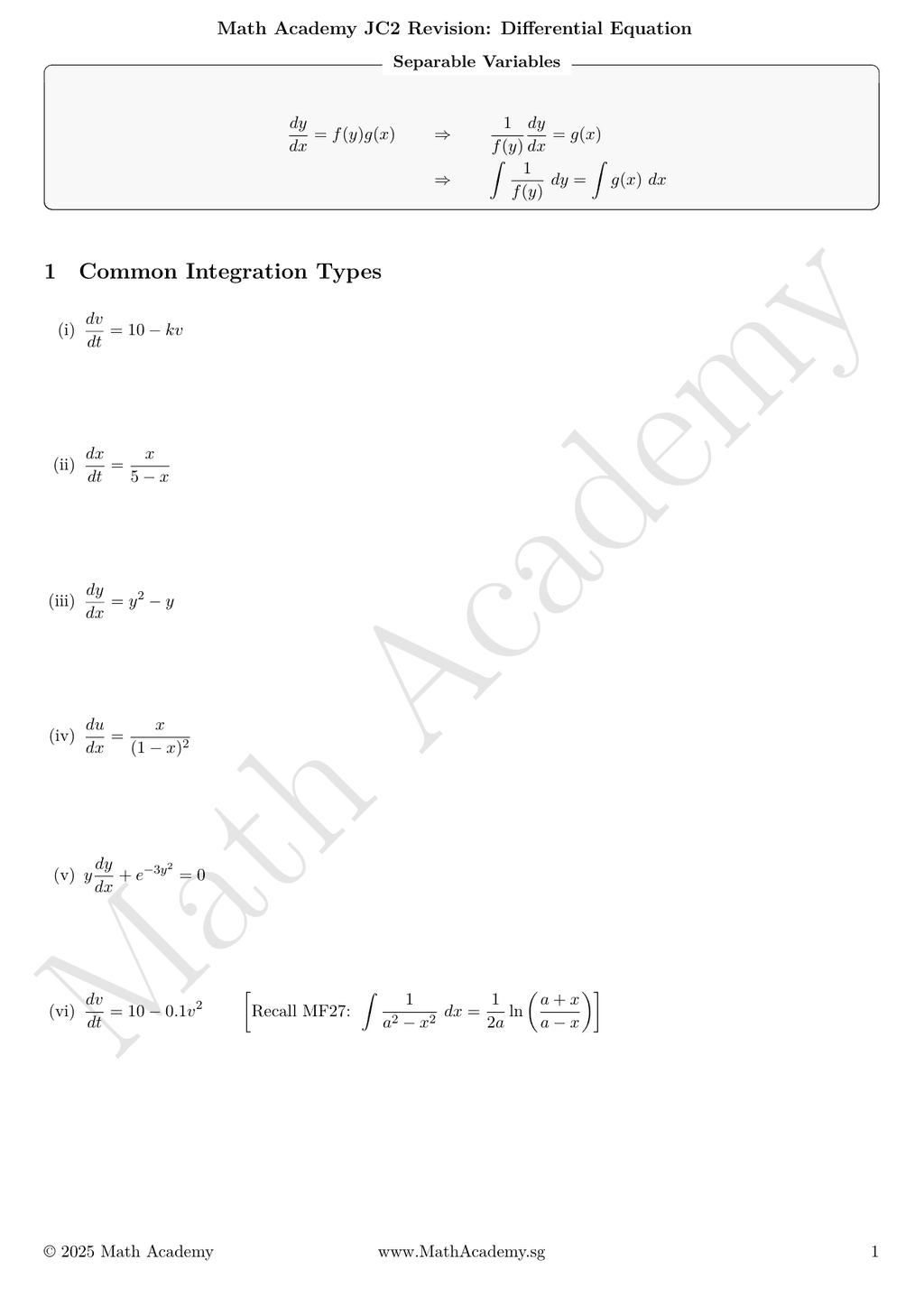 Differential Equations
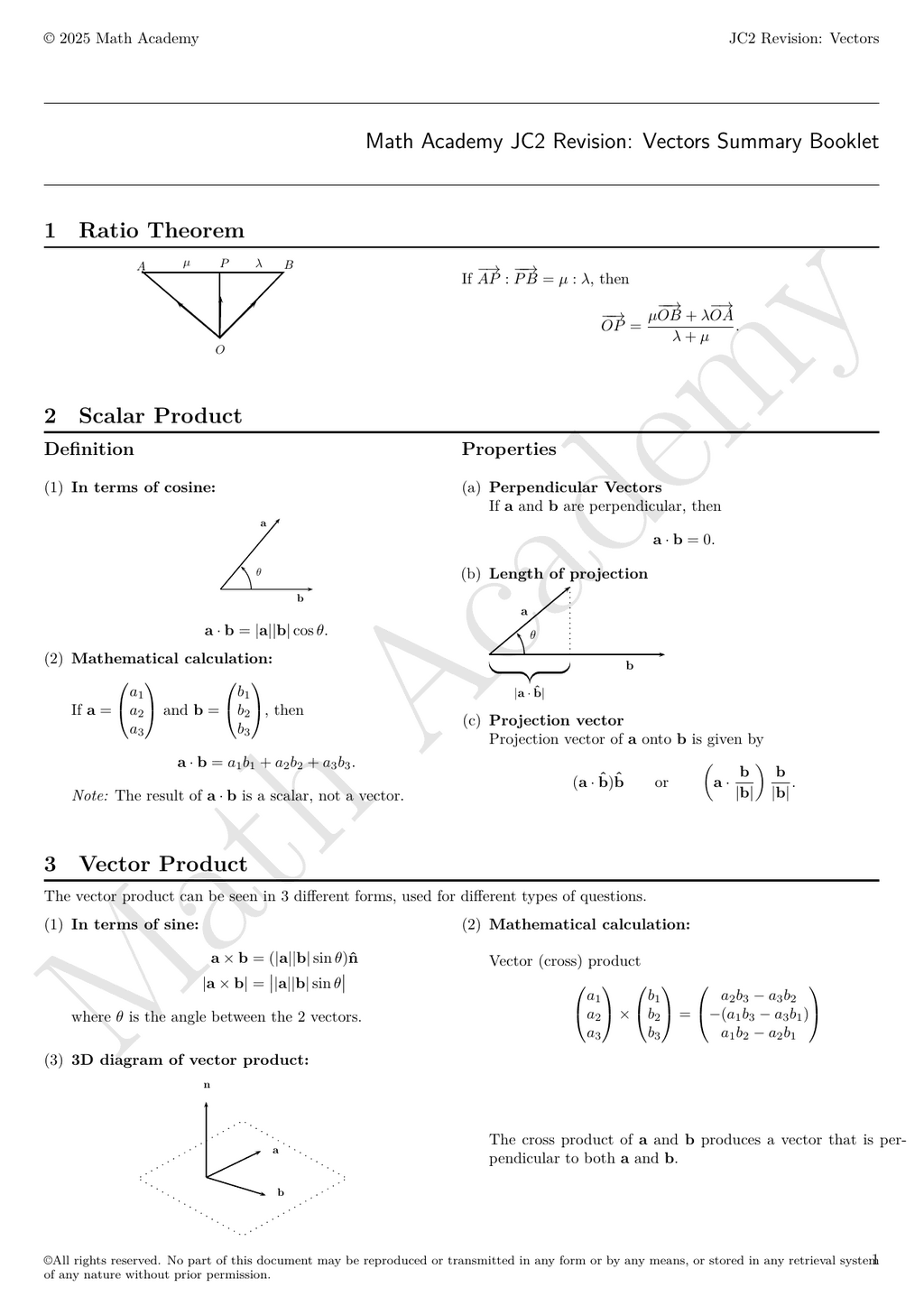 Vectors
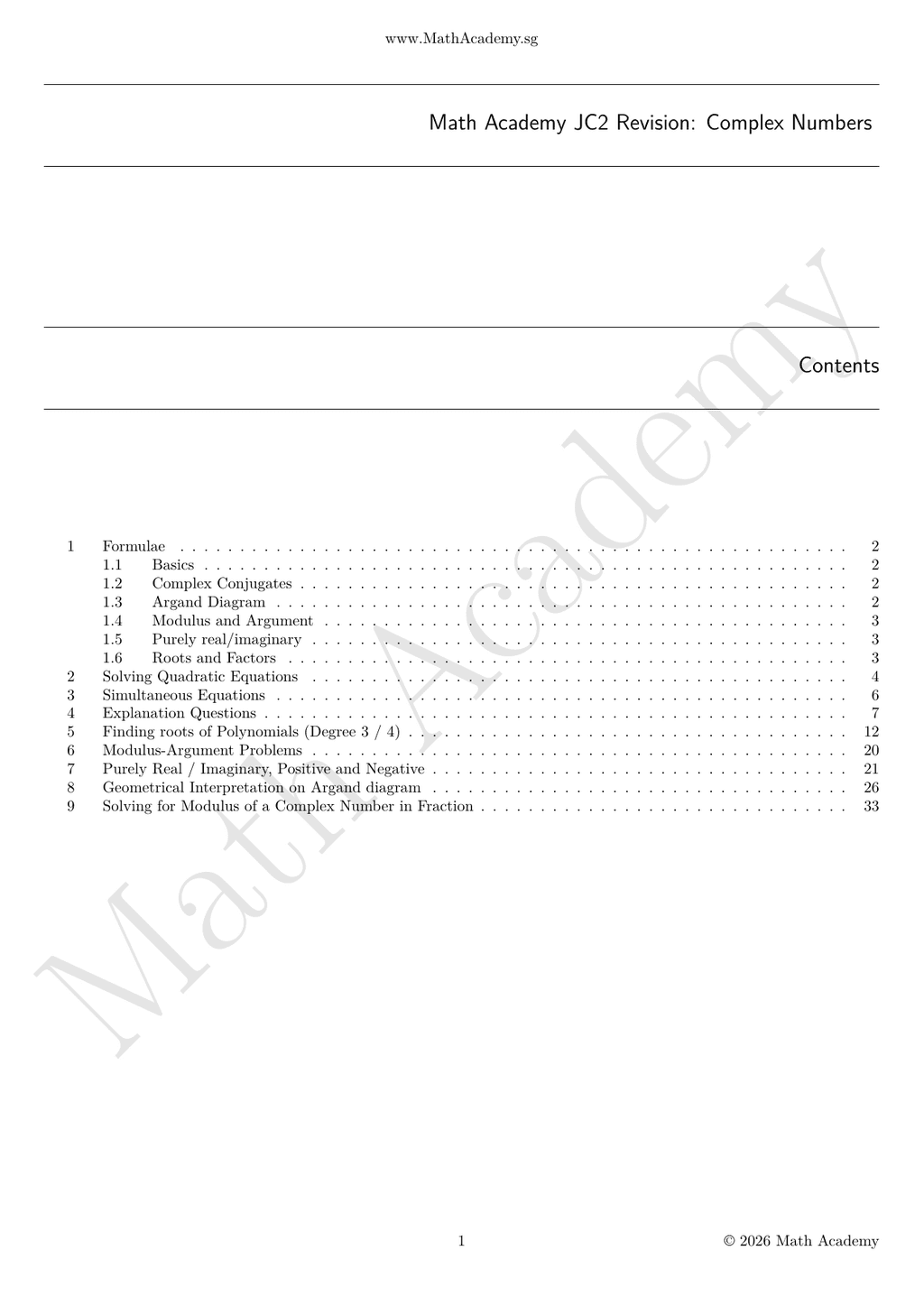 Complex Numbers
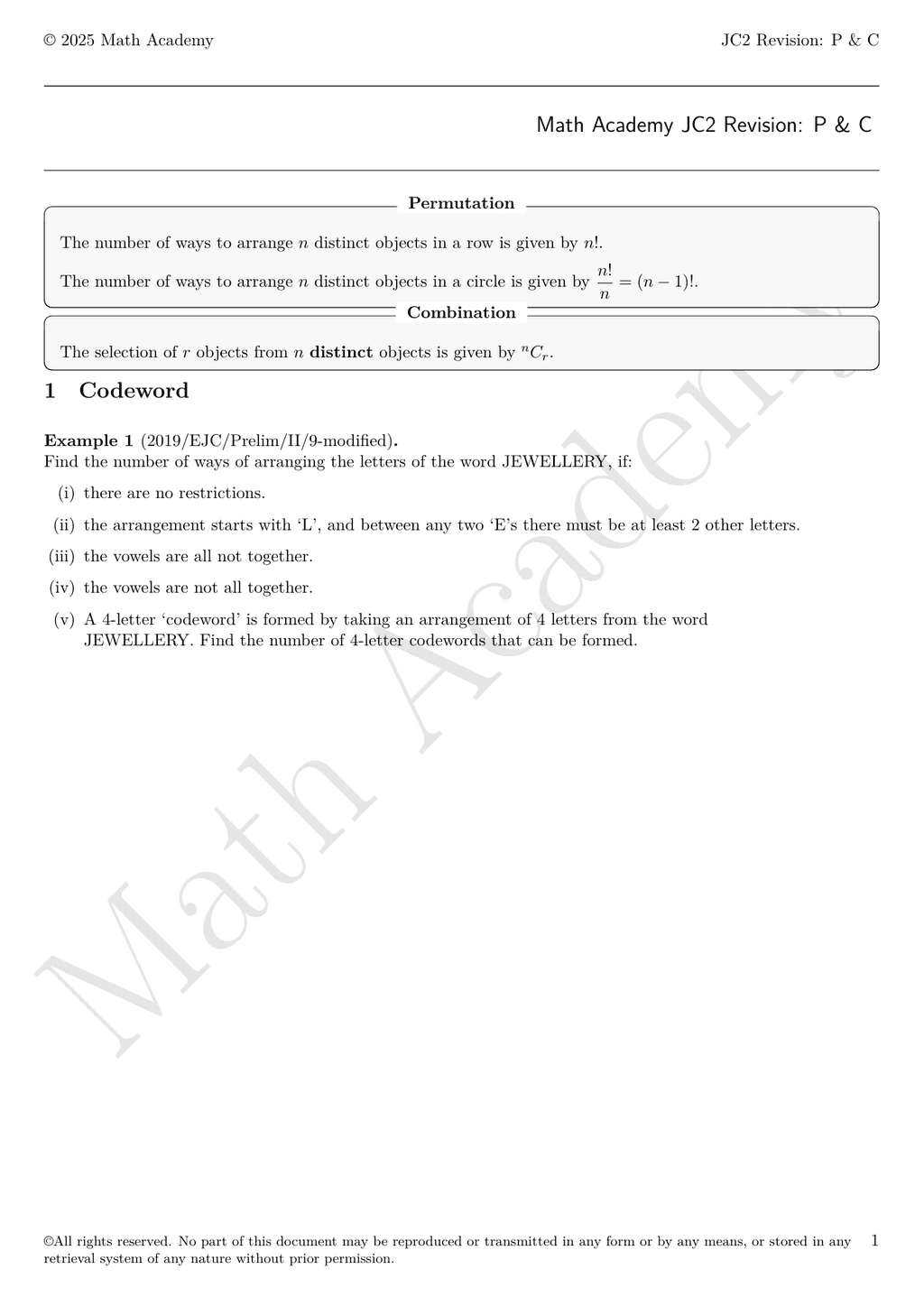 Permutation & Combination
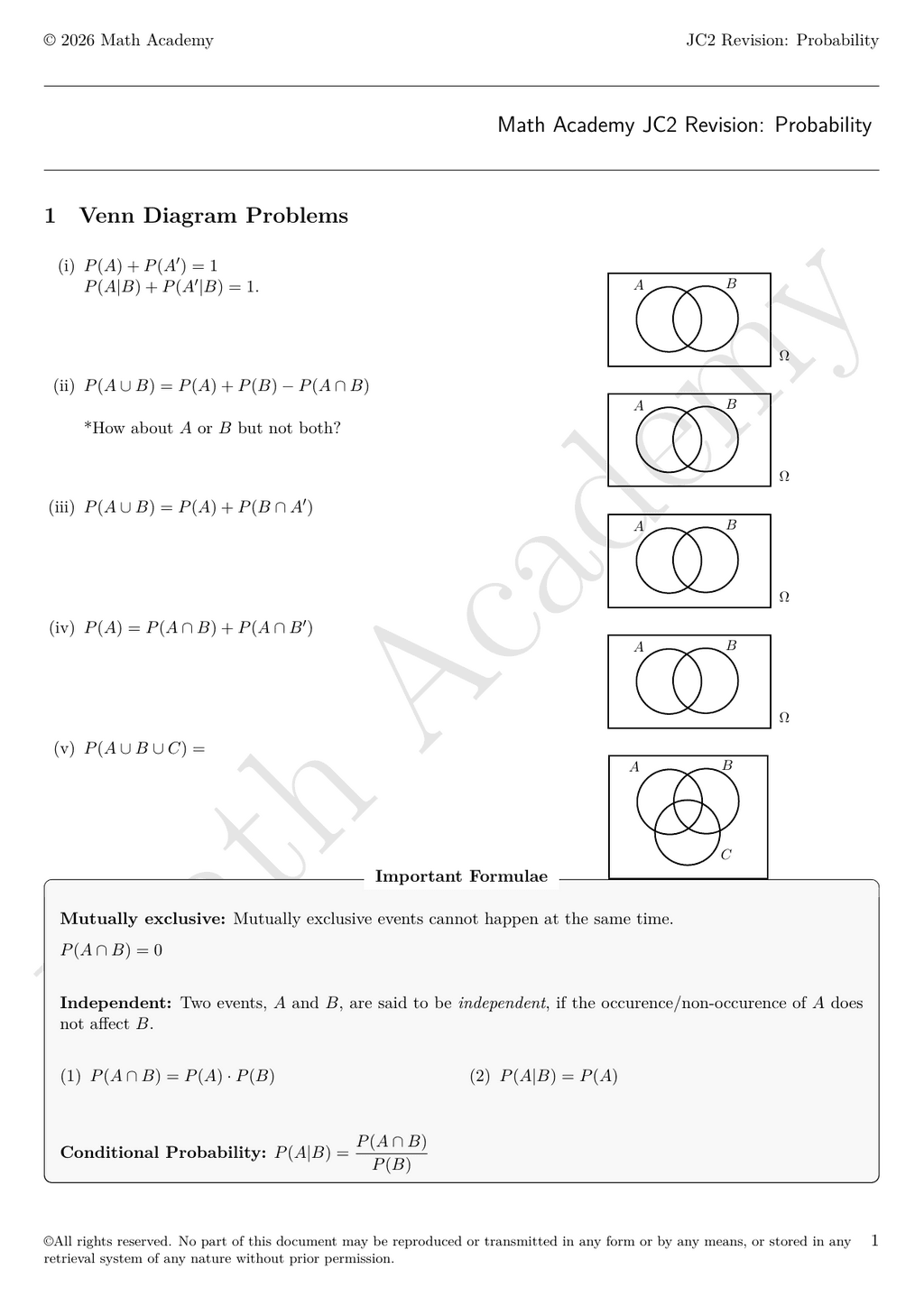 Probability
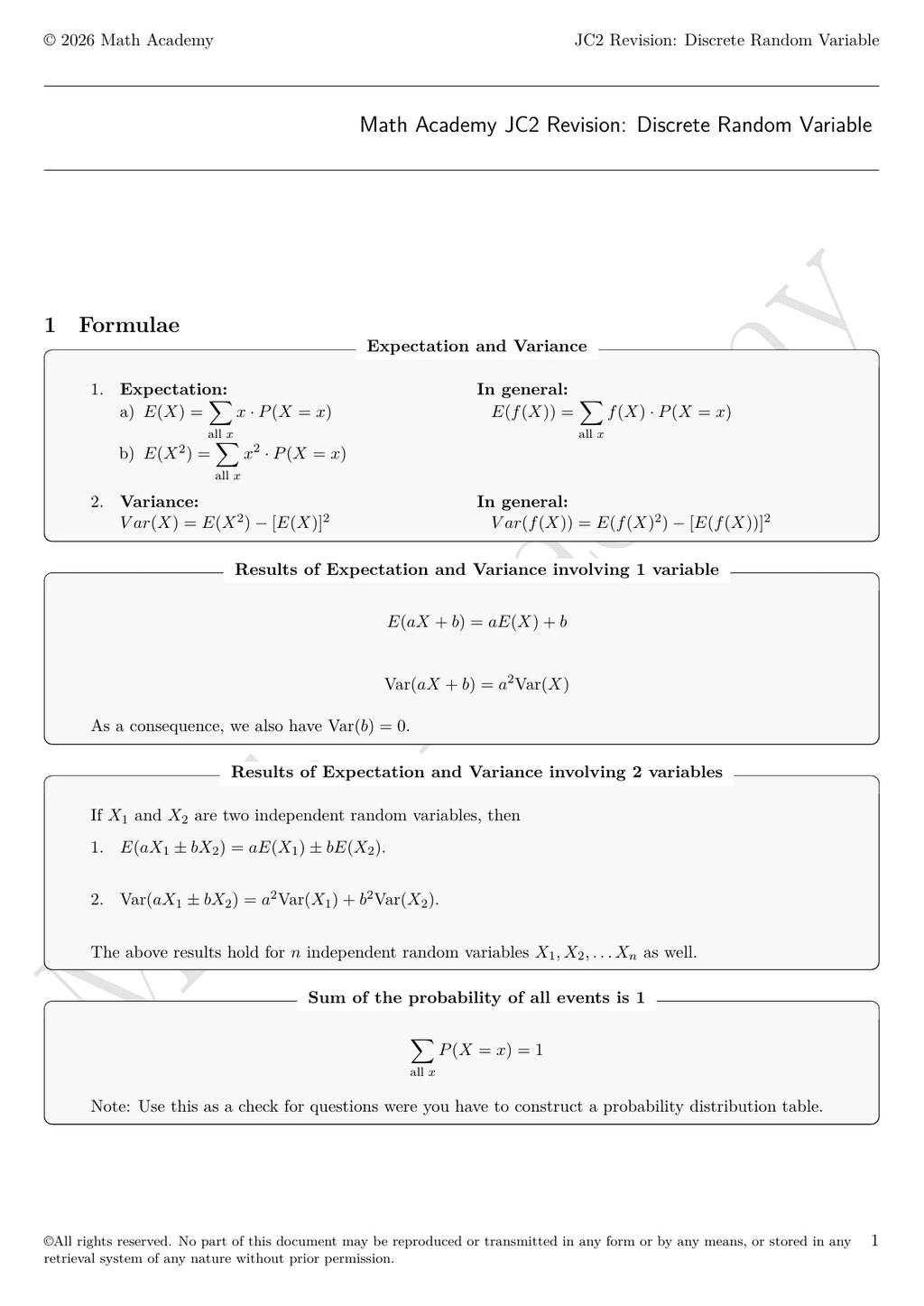 Discrete Random Variable
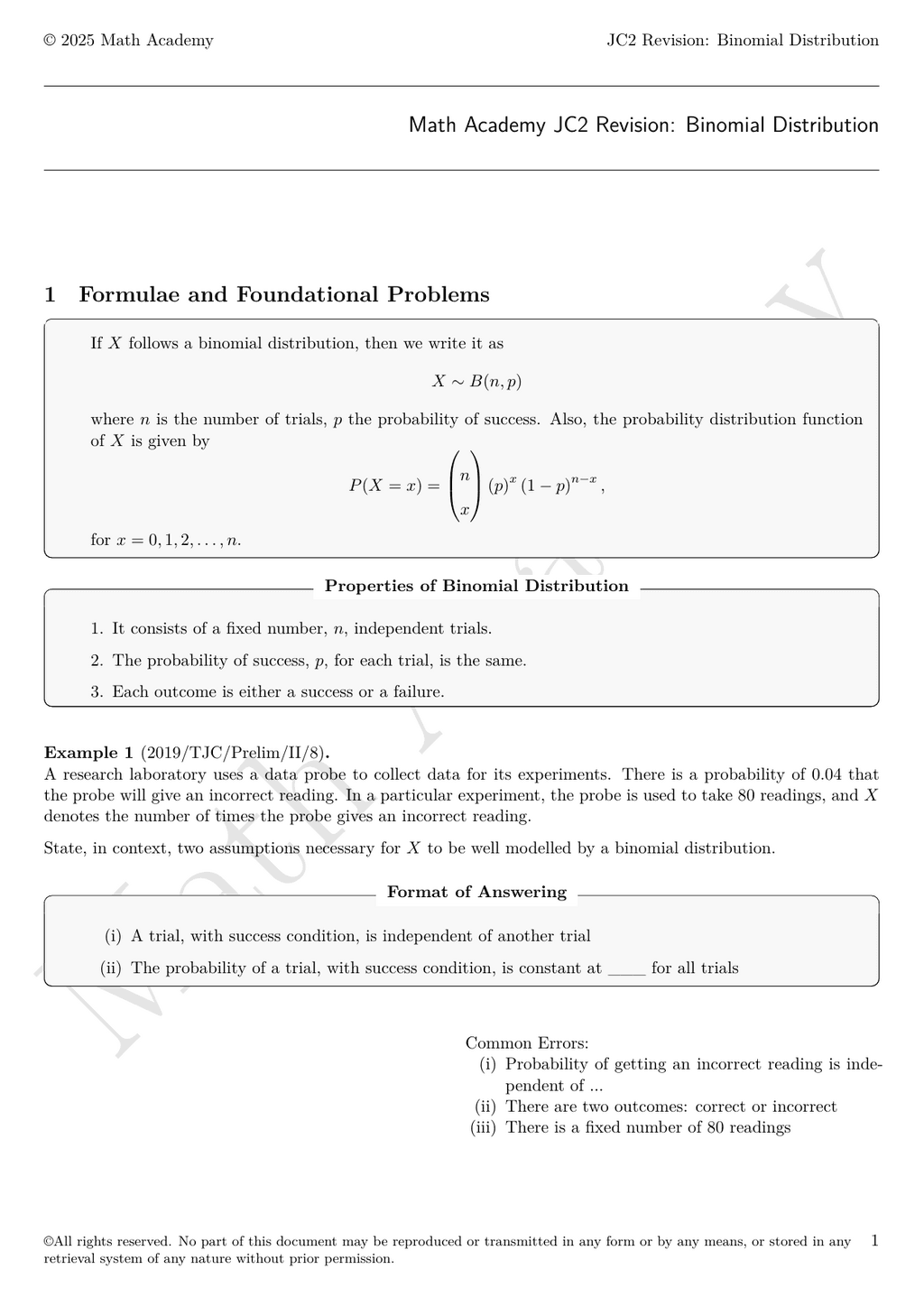 Binomial Distribution
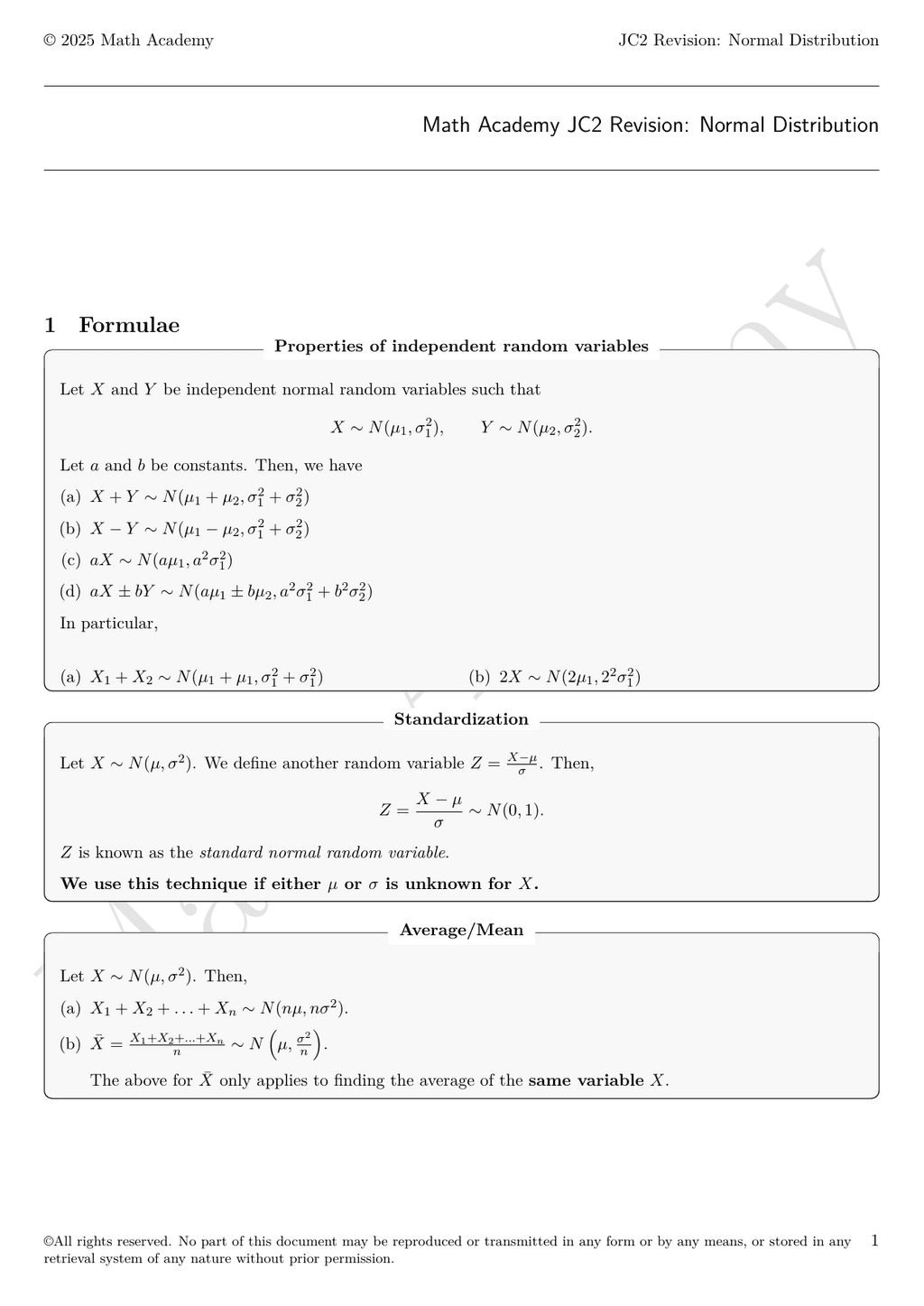 Normal Distribution
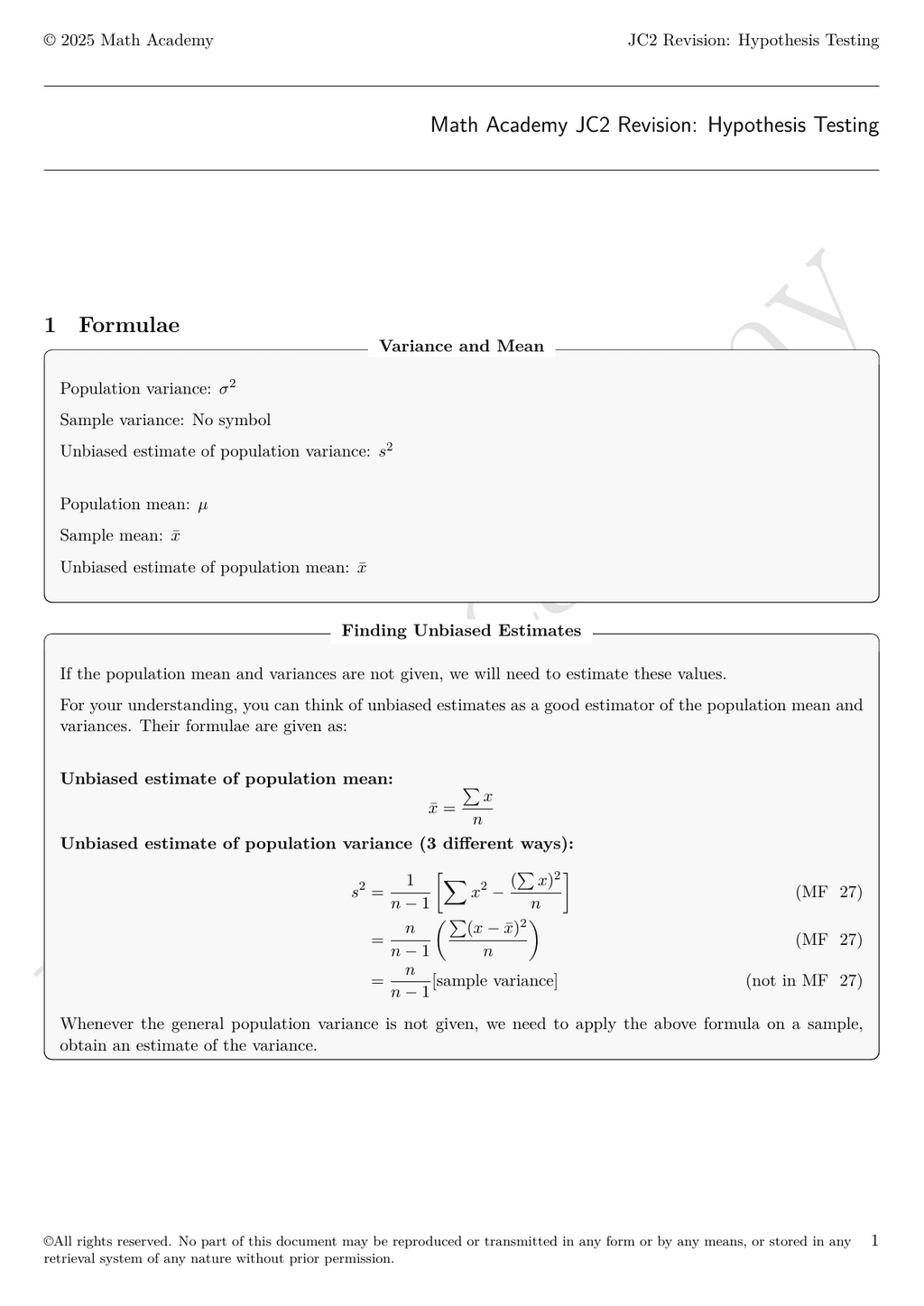 Hypothesis Testing
20 sets of notes. Every chapter. Exclusive to enrolled students. See the full notes package →
Try a Real Crash Course Worksheet — Free
Sourced from the 2025 JC Preliminary Examinations — the most recent prelims. Every crash course worksheet is updated each year so students always practise on the latest question types. Questions are sorted by sub-topic and difficulty level.
What you’re looking at:
This is the practice worksheet — the questions students work through after Mr Ian teaches the chapter using his in-house notes. The notes come first (not shown here): a concise formula summary and concept walkthrough built around exactly how A Level questions are set. The worksheet is how students test and apply that understanding. Every chapter in the crash course follows this same structure.
Practice Worksheet 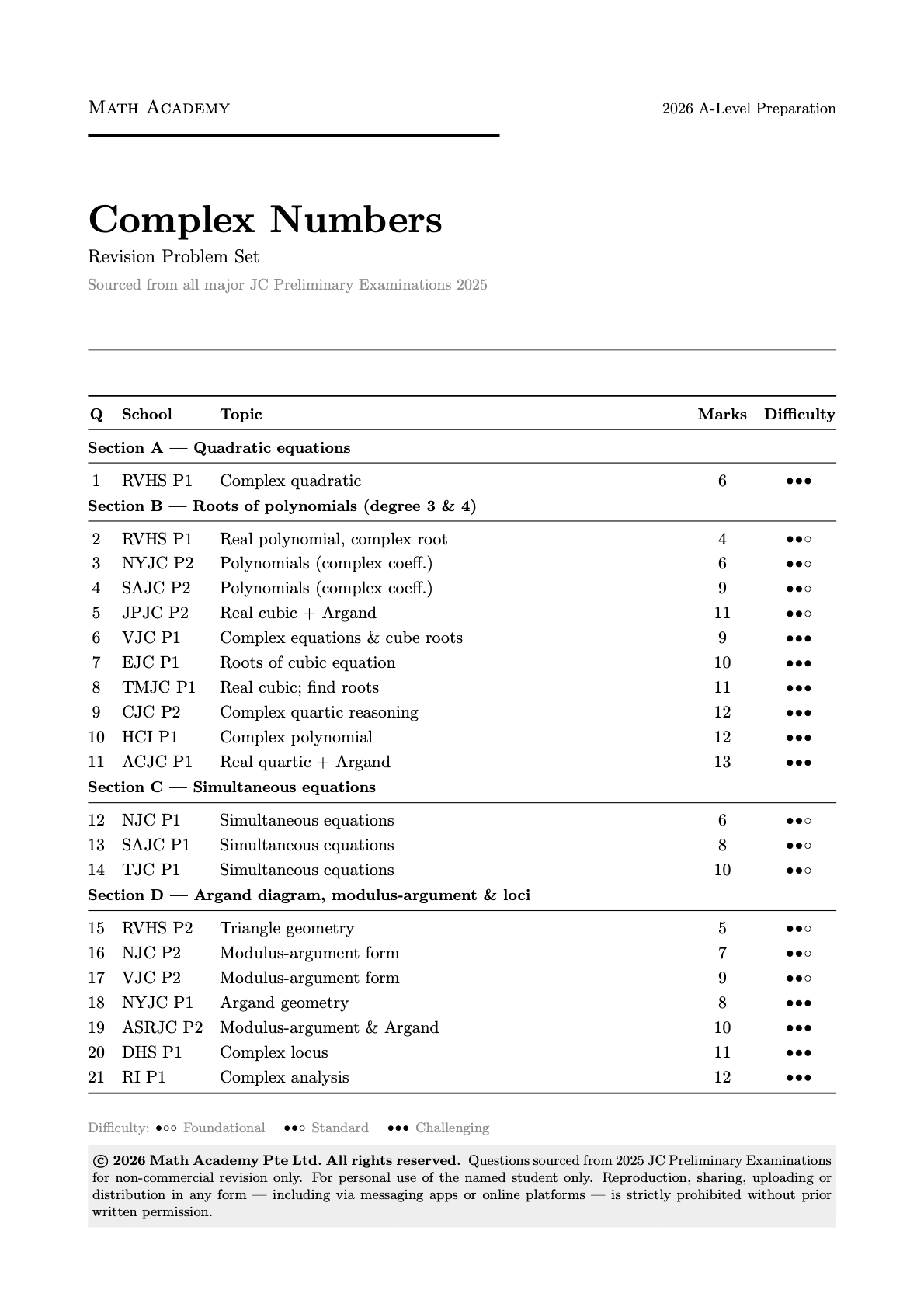
Complex Numbers | Worked Solutions 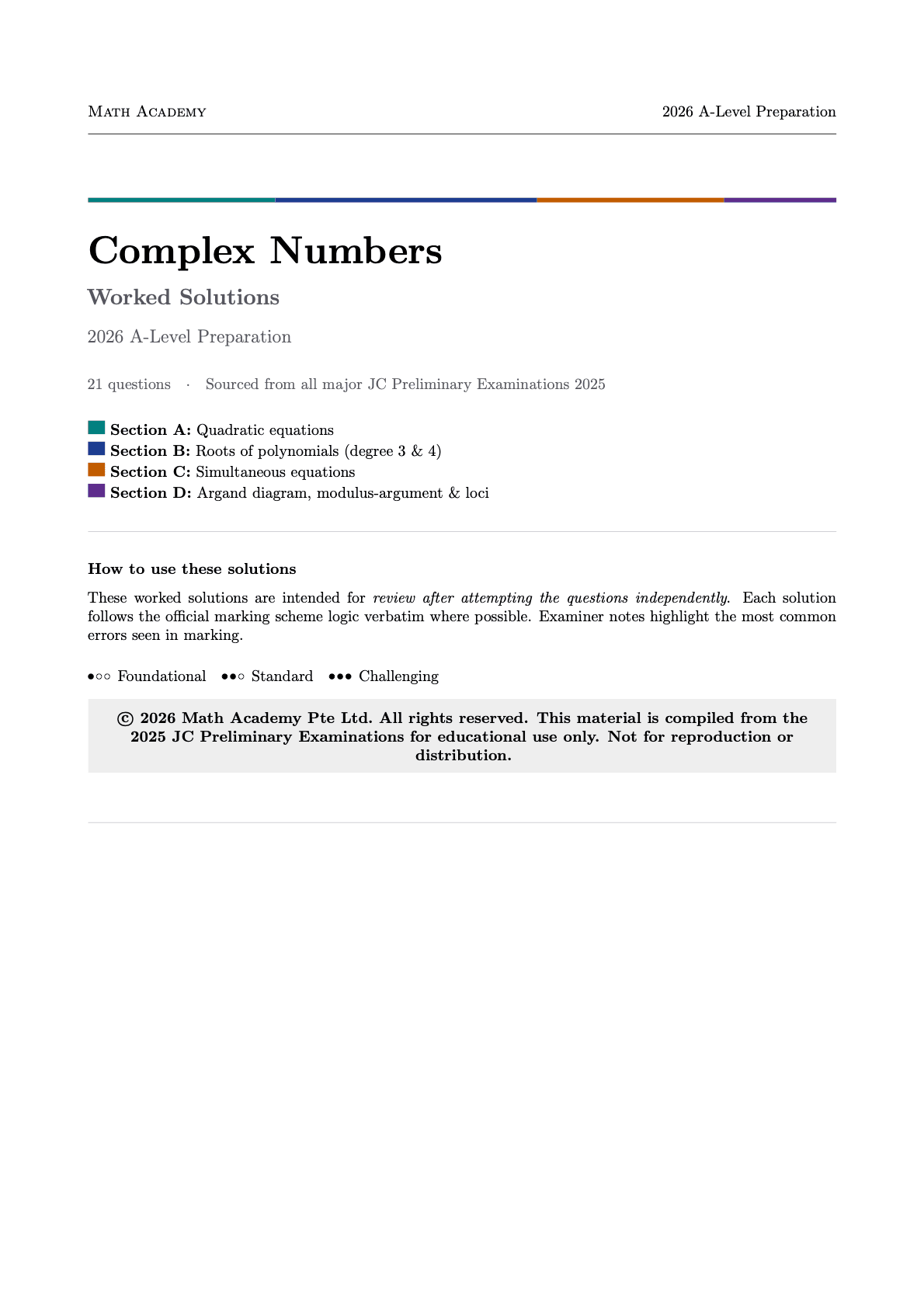
Complex Numbers |
There was a particular question that the majority of students did not know how to do as it wasn’t covered in school — but I could finish it swiftly because I remembered the method that was in Mr Ang’s notes. Felt so grateful for having such good notes where not even a single thing is missed.

Bansi Pavagadhi
NJC · 2023 A Levels
What Every JC2 H2 Math Crash Course Lesson Covers
Click any topic to expand the full lesson focus.
▾
▾
- Properties of Complex Conjugates: Understand how conjugates behave under addition, subtraction, multiplication, and division.
- Modulus and Argument: Learn key properties and relationships involving the modulus and argument of complex numbers.
- Purely Real and Imaginary Questions: Identify and solve question types where complex expressions are constrained to be purely real or purely imaginary.
- Finding Roots of Polynomial Equations (Degree 2 to 4): Solve equations involving complex roots, including the use of the conjugate root theorem and factorisation techniques.
- Fundamental Theorem of Algebra and Conjugate Root Theorem: Understand these theorems and how they apply to complex root questions.
- Simultaneous Equations Involving Complex Numbers: Solve challenging equations involving z, |z| and z*, using both algebraic and geometric reasoning.
- Geometrical Interpretation on the Argand Diagram: Visualize complex number operations using the Argand plane for deeper conceptual understanding.
▾
▾
- Key Formulas and Definitions: Ratio Theorem; Scalar (dot) product and vector (cross) product definitions and applications.
- Equations of Lines and Planes: Learn how to find and express the equations of lines and planes in various forms (vector, parametric, Cartesian).
- Foot of Perpendicular: Find the foot of the perpendicular from a point to a line or a plane.
- Angles Between Vectors, Lines, and Planes: Calculate angles between two vectors, two lines, two planes, and between a line and a plane.
- Distances in 3D Geometry: From a point to a line or plane; between skew lines; from the origin to a plane; between parallel planes.
- Planes at a Given Distance: Derive equations of planes that lie a fixed distance away from a given plane.
- Relationships Between Lines and Planes: Identify whether lines and planes are parallel, intersecting, or skew.
- Reflections in 3D: Reflect points, lines, and planes across other planes.
▾
▾
- Tangent and Normal Lines: Solve problems involving the equations of tangents and normals to parametric curves. Understand the geometric meaning and how to compute gradients using dy/dx.
- Converting Parametric to Cartesian Equations: Learn how to eliminate parameters to form Cartesian equations from parametric ones.
- Lines Parallel to the Axes: Apply properties of curves where parts are parallel to the x-axis or y-axis, and how this affects their derivatives.
- Sketching Parametric Curves: Accurately sketch parametric curves by identifying key points and direction of travel.
- Concavity of Curves: Determine concavity using second derivative and understand its interpretation in sketching.
- Rate of Change Problems: Apply parametric differentiation to real-world rate of change questions involving related variables.
- Maximum and Minimum Problems: Use derivatives to identify turning points on parametric curves and solve optimisation problems.
▾
▾
- Forming the Maclaurin Series: Learn how to manipulate given functions and apply the Maclaurin series formula.
- “Hence” Questions Using Known Series: Using binomial expansion; differentiating or integrating existing series; substituting or transforming the input to derive related series.
- Approximations and Error Analysis: Evaluate percentage error in approximation problems. Assess whether a given series offers a good approximation within a range.
- Range of Accuracy: Determine the range of x-values for which a Maclaurin series approximates the original function to within k units.
- Small Angle Approximation: Apply small angle approximations in appropriate contexts.
▾
▾
- Key Formulae Summary: General term of an AP/GP; sum of the first n terms; sum to infinity (for convergent GP only).
- Proof and Convergence: Prove the formulas for AP and GP using algebraic techniques.
- Odd and Even Term Concepts: Identify and work with odd- and even-numbered terms in sequences.
- Conditional Sums: Calculate the sum of integers within a given range, subject to specific conditions.
- Consecutive Terms in GP: Use these relationships to form and solve equations involving unknowns.
- Contextual and Real-World Applications: Compound interest, depreciation, savings plans using AP/GP models.
▾
▾
- Properties of Sigma Notation: Understand key properties of summation and how they can be used to simplify or manipulate expressions.
- Expanding Summations: Apply properties to “open up” or break down a sum into simpler components.
- AP and GP Summations: Identify arithmetic and geometric progressions within sigma notation and apply the appropriate sum formulas.
- “Hence” Replacement Questions: Tackle exam-style questions involving general terms and changing upper/lower limits.
- Using Graphing Calculator (GC): Use the GC effectively to solve for unknown integer values.
▾
▾
- Solving Sequences Using Simultaneous Equations: Apply simultaneous equations to find unknowns in arithmetic and geometric sequences.
- Recurrence Relations: Learn how to solve for unknowns in recurrence relations and interpret their structure.
- Graphing Calculator (GC) Applications: Use the GC to find specific terms in a sequence and explore sequence behaviour numerically.
- Limits and Convergence of Sequences: Solve for the limit of a sequence and justify convergence. Prove whether a sequence is increasing or decreasing using three different methods.
- Identifying a GP in Recurrence Relations: Recognise and prove that a recurrence relation forms a geometric progression.
▾
▾
- Summary of Key Formulae: Review essential integration formulas commonly used in exams.
- Fractions with Quadratic Denominators: Know when to factorise or complete the square, and how to proceed with integration accordingly.
- Trigonometric Integration: Tackle integrals involving trigonometric functions, including handling powers and factoring techniques.
- Substitution and Integration by Parts: Understand when and how to apply substitution and integration by parts effectively.
- Modulus Integration: Learn how to split the integral based on modulus expressions, determine the correct limits, and assign appropriate signs.
▾
▾
- Area with Respect to the x- or y-Axis: Calculate the area under a curve using integration along the x- or y-axis.
- Area Between Two Curves: Find the area of the region bounded between two curves, including when and why a negative sign is necessary.
- Volume of Revolution (x- and y-Axis): Identify scenarios where the graph needs to be divided before applying the formula.
- Single vs. Dual Curve Rotation: Recognise when to rotate a single curve, and when to use the “outer minus inner” method.
- Area Under a Curve Using Limits of Sums: Estimate area using the limit of a sum of rectangles, distinguishing between overestimation and underestimation.
▾
▾
- Integration: Identify common types of integration problems frequently tested in exams and apply the correct techniques.
- Substitution Methods: Understand and tackle various substitution-based integration questions.
- Differential Equations (Contextual Problems): Form the correct differential equations from real-world contexts, with emphasis on commonly tested exam formats.
- Graph Sketching in Differential Equations: Interpret and sketch solution curves accurately for exam-style problems.
▾
▾
- Properties of 1-1 Functions: Understand one-to-one functions and the horizontal line test.
- Inverse Functions: Understand properties of inverse functions, including domain and range relationships. Find inverse functions, especially for quadratic equations.
- Composite Functions: Find the domain of the composite function, determine when it exists, and use the mapping method to find its range.
- Graphing Functions and Their Inverses: Graph on the same diagram. Use a GC to sketch the inverse function without solving for its equation explicitly.
- Piecewise Functions and Compositions: Solve for equations of new composite functions involving piecewise functions.
▾
▾
- Sketching Rational Graphs: Identify and sketch rational functions, determining vertical and horizontal asymptotes.
- Range of Values for Rational Graphs: Solve algebraic problems involving domain restrictions and behaviour at asymptotes.
- Stationary Points and Discriminants: Apply the discriminant to find the number of stationary points on a graph.
- Conics: Understand the key properties of ellipse, hyperbola, and parabola through their general equations. Sketch these conic graphs manually without GC.
- Conic Transformations and Applications: Solve typical exam “hence” problems involving transformations of conics.
▾
▾
- Understanding Transformations: Translation (shifting); Scaling (stretching/compressing); Reflection (flipping) — and their corresponding equation replacements.
- Solving Examination Problems: Forming equations based on descriptions of transformations, both direct and reverse.
- Modulus Graphs: Draw modulus graphs accurately and understand the order of transformations in relation to modulus functions.
- Reciprocal and Derivative Graphs: Understand the properties of reciprocal graphs and their derivatives. Graph accurately with attention to asymptotes and intercepts.
- Recovering the Original Graph: Recover the original function y=f(x) from transformed graphs such as y=f(|x|) or y=f'(x).
▾
▾
- Inequalities on the Number Line: Solve algebraic inequalities by expressing solution sets using number line diagrams.
- Always Positive/Negative Expressions: Determine when an expression is always positive or negative.
- Modulus Inequalities: Learn how to “open up” modulus signs.
- “Hence” Question Types: Tackle exam-style questions involving replacing variables with common functions (e.g. x², eˣ, ln x).
- “Hence” Questions Involving Trigonometry: Construct the trigonometric graph to solve for the inequality.
- Using Graphs and Graphing Calculators (GC): Solve inequalities by interpreting intersections and shaded regions. Use GC to visualise and verify solution sets.
▾
▾
- Codeword Problems: Techniques for forming codewords using a subset of letters, systematically breaking the problem down by length, letter choice, and order relevance.
- Passcode Problems (Digits and Letters): Handle constraints such as “must contain at least one digit” and whether repetition is allowed.
- Distribution Problems: Distribute identical or distinct objects into groups, using permutations vs. combinations appropriately.
- “At Least” Questions: Complement method and case-by-case breakdowns.
- Circular Permutations and Rotational Symmetry: Solve problems involving circular arrangements and symmetry.
▾
▾
- Venn Diagram Problems: Solve question types involving Venn diagrams, with key formulas to apply and remember.
- Minimum and Maximum Value Problems: Find the minimum or maximum possible value in a Venn diagram under given conditions.
- Tree Diagram Questions: Construct and analyse tree diagrams for probability problems involving dependent or conditional events.
- Permutation and Combination Applications: Recognise and apply P&C techniques within probability exam questions.
- Geometric Progression in Probability: Identify and solve problems involving GPs in probability contexts, summing infinite series to calculate total probability.
▾
▾
- Summary of Expectation and Variance Formulas: Key formulas for expectation and variance of DRVs, including linear transformations and functions of variables.
- Constructing Outcome Tables: Identify when it’s necessary to build a complete table of all possible outcomes.
- Solving “Fairness” Questions: Approach problems involving fair games or scenarios using expected values.
- Case Listing for Independent Observations: Practice listing all possible outcomes for independent observations of a given variable.
- Application of the Central Limit Theorem (CLT): Apply the CLT to solve probability questions involving the sum or average of DRVs.
▾
▾
- Key Properties of the Binomial Distribution: The three essential properties that define a binomial distribution, and the exact phrasing needed in written responses.
- Identifying Trials and Successes: Clearly identify what constitutes a single trial and a success in less straightforward problem setups.
- Common Problem Type: “k-th Success is the n-th Trial”: A frequently tested question type — model and solve using appropriate binomial reasoning.
- Finding the Mode Using the GC: Use the graphing calculator to determine the mode of a binomial distribution efficiently.
- Using CLT with Binomial Variables: Apply the CLT to approximate probabilities for binomial variables when n is large.
- Relating P(k) and P(k+1): Use the binomial probability formula to establish relationships between consecutive probabilities.
▾
▾
- Key Formulae and Properties: Essential properties and formulas, including linear transformations (aX+b) and sum/difference of two normal variables.
- When to Apply Standardization: Recognise scenarios where standardising to Z~N(0,1) is appropriate.
- Modulus-Type Questions: Tackle question types involving modulus expressions, especially when keywords like “differs by”, “within”, or “at most” are present.
- Solving Inverse Normal (invNorm) Questions with Inequalities: Handle inverse normal questions where the given probability is linked to an inequality.
- Sketching Normal Distribution Curves: Accurately draw normal distribution curves to reflect various conditions. Understand the 68-95-99.7 rule.
▾
▾
This chapter is provided as a bonus video recording before the A Levels — so every student has full coverage of the syllabus going into the exam.
- Correct Use of Symbols for Mean and Variance: Accurately use μ, x̄, σ², s² and unbiased estimates.
- Using p-values and z-critical Values to Reject H₀: Compare the p-value with the significance level (α) for one-tailed and two-tailed tests.
- 5 Key Steps in Hypothesis Testing: The standard 5-step structure with exact phrasing expected for full marks.
- When to Apply the CLT: Recognise situations where the CLT must be quoted for sample means from non-normal distributions.
- Identifying Keywords for Formulating H₁: Spot keywords indicating the correct form of the alternative hypothesis, including “overstate”, “at most”, etc.
- Finding the Critical Region: Determine the critical region for hypothesis tests, applied to a past A-Level exam question.
JC2 H2 Math Revision Schedule — All Topics and Dates
Each topic is a self-contained lesson. Attend the full programme for complete A Level H2 Math coverage — from June through to the A Levels in November.
| # | Topic | Lesson Date(s) |
|---|---|---|
| 1 | Complex Numbers | 13 June 2026 · 20 June 2026 |
| 2 | Vectors | 27 June 2026 · 4 July 2026 |
| 3 | Differentiation Applications | 11 July 2026 |
| 4 | Maclaurin Series | 18 July 2026 |
| 5 | Sequences: APGP | 25 July 2026 |
| 6 | Summation of Series | 1 August 2026 |
| 7 | Sequences: Recurrence | 8 August 2026 |
| 8 | Integration Techniques | 15 August 2026 |
| 9 | Applications of Integration | 22 August 2026 |
| 10 | Differential Equations | 29 August 2026 |
| 11 | Functions | 5 September 2026 |
| 12 | Graphing Techniques | 12 September 2026 |
| 13 | Transformation of Graphs | 19 September 2026 |
| 14 | Inequalities | 26 September 2026 |
| 15 | Permutation and Combination | 3 October 2026 |
| 16 | Probability | 10 October 2026 |
| 17 | Discrete Random Variable | 17 October 2026 |
| 18 | Binomial Distribution | 24 October 2026 |
| 19 | Normal Distribution | 31 October 2026 |
| 20 | Hypothesis Testing · bonus recording provided before A Levels | — |
Starting 13 June 2026
Limited Spots — Secure Your Place
$300/month online · $440/month onsite. Same small-group standard as all Math Academy classes.
JC H2 Math Crash Course Conducted by Mr Ian Ang
This signature programme is conducted weekly by Mr Ian Ang — NUS First Class Honours in Pure Mathematics, co-founder of Math Academy, and the sole tutor for every JC H2 Math class. With over a decade teaching JC students, Mr Ang has refined this crash course to deliver maximum impact in the final lead-up to the A Levels.
His lessons go beyond rote learning. He equips students with clear thinking frameworks, exam strategies, and real insight into how A Level questions are set and marked. Students consistently describe his teaching as structured, insightful, and results-driven — because every lesson is designed around what the examiners actually want to see.
Weekly JC H2 Math Tuition
Looking for Regular JC H2 Math Classes?
This revision workshop runs weekly from June through November. If you are looking for regular weekly JC H2 Math tuition throughout the full year — for JC1 or JC2 — visit our main JC H2 Math tuition page for full details on Mr Ian’s weekly classes, lesson structure, and enrolment.
Class Schedule and Fees
Check Available Slots and Fees
Ready to sign up? Check the latest timetable and fees for all Math Academy classes — including JC H2 Math, Secondary A Maths, E Maths and Lower Sec Maths. Some slots are already full for 2026.
Frequently Asked Questions — JC2 H2 Math Crash Course
The crash course is priced the same as our regular weekly JC H2 Math classes — $300 per 4 lessons for online, and $440 per 4 lessons for onsite. WhatsApp us at 8859 1092 or call to confirm the current fee structure and check available spots.
Yes and no. The crash course runs within the same weekly class slots and is taught by Mr Ian Ang — same format, same notes, same standard. The difference is that the crash course is specifically structured for JC2 revision: every lesson focuses on a single topic with an exam-oriented summary, targeted practice, and worked examples. Students who are already in Mr Ian’s regular JC2 class attend the same sessions — the revision programme is built into the class structure from June onwards.
Not at all — joining in June is exactly the right time for this programme. The crash course starts 13 June 2026 and is designed for JC2 students entering the final stretch before A Levels. Several students have joined Math Academy in JC2 and gone on to achieve A grades. The key is committing fully to the programme from the first lesson.
All lessons are recorded and uploaded to the student portal. If a lesson is missed, students can watch the full recording and access the worksheet solutions at their own pace before the next session. WhatsApp access to Mr Ian remains available throughout the week for any follow-up questions.
Yes. IP students sit the same A Level examinations and face the same syllabus. The crash course covers the full H2 Mathematics syllabus in depth — the content, question types, and exam strategies are fully applicable to IP students heading into the A Levels.
Yes — online students receive the same in-house notes, worksheets, and model answers as onsite students. Lessons are recorded and uploaded, and online students have the same WhatsApp access to Mr Ian throughout the week. Several of our online students have achieved A grades at the A Levels.
Starting 13 June 2026
Limited Spots — Register for the JC2 H2 Math Crash Course Today
2 hours a week. Every A Level topic. Taught by Mr Ian Ang. Don’t leave your results to chance.