
Differentiation & Applications: Parametric; intersection — ASRJC 2025 H2 Math Prelim Paper 2
What this question tests
Question
The curve \(C\) is defined by the parametric equations \[ x = \cos t + \tfrac{1}{2}\cos 5t,\qquad y = \sin t + \tfrac{1}{2}\sin 5t \qquad \text{for } 0 \leq t \leq \tfrac{\pi}{2}. \]
- Find the coordinates of the point on the curve \(C\) corresponding to \(t = 0\).
Another curve \(D\) has parametric equations \[ x = 2 + k\cos\theta,\qquad y = \frac{\sqrt{3}}{2}\sin\theta \qquad \text{for } 0 \leq \theta \leq 2\pi,\quad k > 0. \]
- Find the Cartesian equation for curve \(D\).
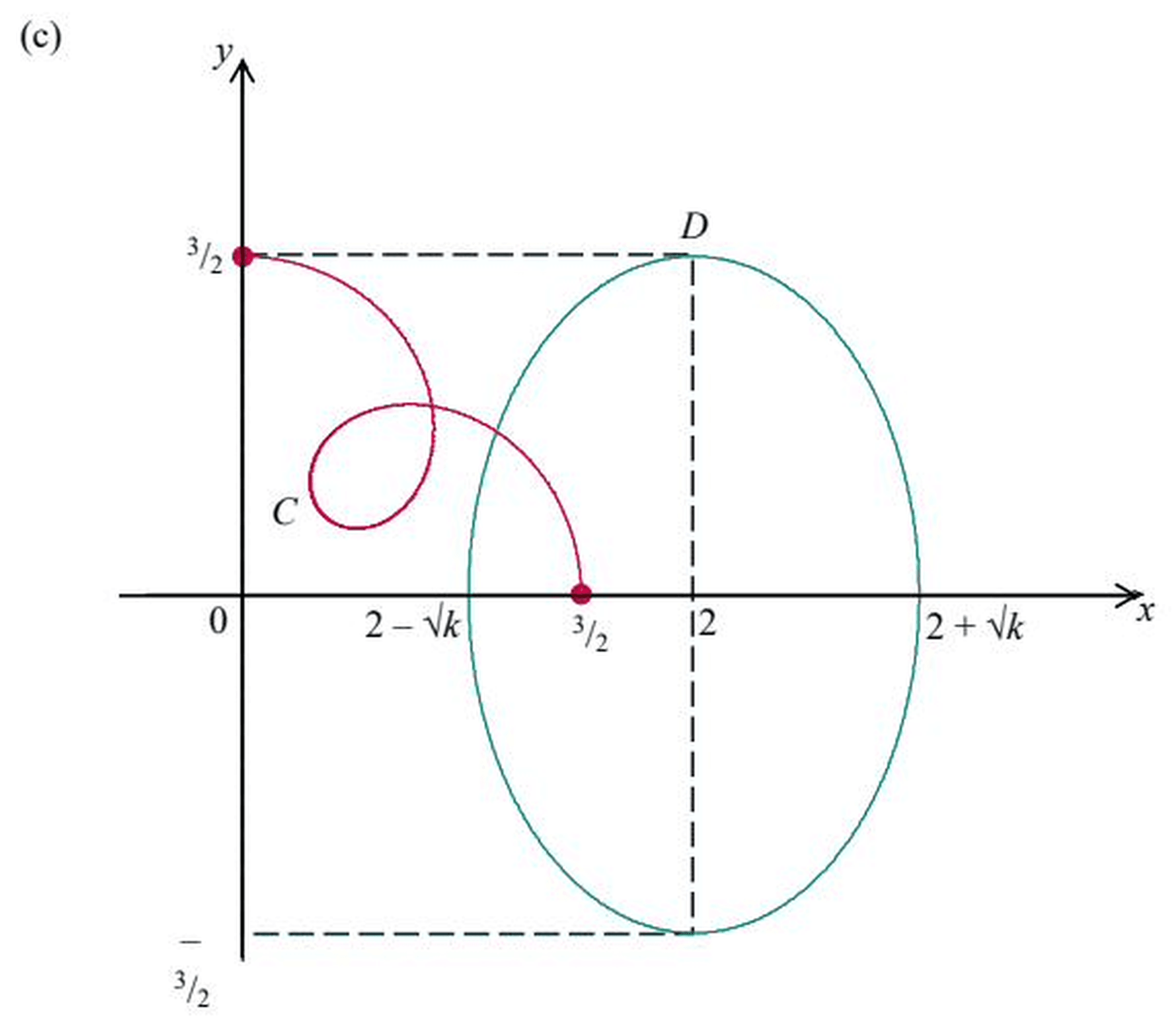
- Sketch the curves \(C\) and \(D\) on the same diagram.
- Hence determine the range of values of \(k\) such that the equation \[ \frac{\bigl(\cos t + \tfrac{1}{2}\cos 5t - 2\bigr)^2}{k} + \frac{4\bigl(\sin t + \tfrac{1}{2}\sin 5t\bigr)^2}{3} = 1 \] has no real solutions.
Show full worked solution▾
(a) When \(t = 0\): \[ x = \cos 0 + \tfrac{1}{2}\cos 0 = \tfrac{3}{2},\qquad y = 0. \]
Coordinates: \(\left(\dfrac{3}{2},\, 0\right)\).
(b)
\[\begin{aligned} x = 2 + \sqrt{k}\cos\theta &\implies \cos\theta = \frac{1}{\sqrt{k}}(x-2) \\[6pt] y = \frac{3}{2}\sin\theta &\implies \sin\theta = \frac{2}{3}y \end{aligned}\]Since \(\cos^2\theta + \sin^2\theta = 1\), \[\begin{aligned} \left[\frac{1}{\sqrt{k}}(x-2)\right]^2 + \left(\frac{2}{3}y\right)^2 &= 1 \\ \frac{(x-2)^2}{k} + \frac{4y^2}{9} &= 1 \end{aligned}\]
\[ \frac{(x-2)^2}{k} + \frac{4y^2}{9}= 1 \](c) Curve \(C\) (parametric rose, \(0 \leq t \leq \pi/2\)) and curve \(D\) (ellipse):
(d)
For \(\dfrac{(\cos t + 0.5\cos 5t - 2)^2}{k} + \dfrac{4(\sin t + 0.5\sin 5t)^2}{9} = 1\) to have no solutions, there must not be any intersections b/w the 2 curves.
Hence \(2 - \sqrt{k} > \dfrac{3}{2} \implies \sqrt{k} < \dfrac{1}{2}\)
Since \(k\) is positive, we have \(0 < k < \dfrac{1}{4}\)
\[ 0 < k < \frac{1}{4}. \]