
Binomial Expansion: B\((n,p)\); at-least, conditional — CJC 2025 H2 Math Prelim Paper 2
What this question tests
Question
In each batch of pralines that a chocolate factory produces, they are packed into boxes of 16. Due to the new health guidelines regarding sugar content, quality control tests are implemented and show that on average, the proportion of pralines that exceed the recommended sugar content is \(p\). The number of pralines in a box that exceed the recommended sugar content is denoted by \(X\).
- (a)(i) State, in context of the question, two assumptions needed for \(X\) to be well-modelled by a binomial distribution.
Assume now that \(X\) is modelled by a binomial distribution.
- (a)(ii) It is known that the most probable number of pralines that exceed the recommended sugar content is 2. Find the exact range of values that \(p\) can take.
For each batch of pralines produced, the chocolate factory implements the following quality control system by testing the first random sample of 16 pralines in a box:
- If there are at most 1 praline that exceed the recommended sugar content in a box, the batch is accepted.
- If there are 3 or more pralines that exceed the recommended sugar content in a box, the batch is rejected.
- If there are 2 pralines that exceed the recommended sugar content in a box, a second box of 16 pralines is tested. The batch will be accepted if there are at most 1 praline that exceed the recommended sugar content in the second box, otherwise the batch will be rejected.
It is given that \(p = 0.15\).
- (b)(i) Find the probability that the batch of pralines is accepted under this quality control system.
- (b)(ii) Given that the batch of pralines is accepted, find the probability that a second box of pralines is tested.
Show full worked solution▾
(a)(i) Two assumptions:
- The probability of a praline exceeding the recommended sugar content is constant at \(p\) for every praline.
- Whether a praline has exceeded the recommended sugar content is independent of any other praline.
(a)(ii) \(X\sim\mathrm{B}(16,p)\). Mode \(= 2\) means \(\mathrm{P}(X=2)>\mathrm{P}(X=1)\) and \(\mathrm{P}(X=2)>\mathrm{P}(X=3)\).
From \(\mathrm{P}(X=2)>\mathrm{P}(X=1)\): \[\begin{aligned} \binom{16}{2}p^2(1-p)^{14} &> \binom{16}{1}p(1-p)^{15}\\ 120p^2(1-p)^{14} &> 16p(1-p)^{15}\\ 15p &> 2(1-p)\\ p &> \frac{2}{17} \end{aligned}\]
From \(\mathrm{P}(X=2)>\mathrm{P}(X=3)\): \[\begin{aligned} \binom{16}{2}p^2(1-p)^{14} &> \binom{16}{3}p^3(1-p)^{13}\\ 120p^2(1-p)^{14} &> 560p^3(1-p)^{13}\\ 3(1-p) &> 14p\\ p &< \frac{3}{17} \end{aligned}\]
(b)(i) \(X\sim\mathrm{B}(16,\,0.15)\).
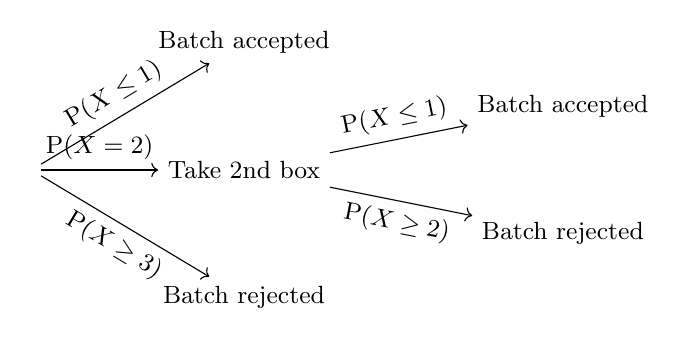
(b)(ii) \[\begin{aligned} \mathrm{P}(\text{2nd box tested}\mid\text{batch accepted}) &= \frac{\mathrm{P}(X=2)\cdot\mathrm{P}(X\leq1)}{\mathrm{P}(\text{accepted})}\\ &= \frac{0.2774781077\times 0.2839012136}{0.3626775851}\\ &= 0.2172077205\\ &\approx 0.217\text{ (3 s.f.)} \end{aligned}\]