Normal Distribution: Normal; percentile, \(P(X<a)\) — CJC 2025 H2 Math Prelim Paper 2
What this question tests
Question
Fishing Company A has two types of fishing vessels, the “Standard” vessel and the “Large” vessel. The amount of fish caught by the respective vessels on a typical fishing trip are normally distributed with means and standard deviations as shown in the table.
| Mean (kg) | Standard deviation (kg) | |
|---|---|---|
| Standard | 300 | \(\sigma\) |
| Large | 540 | 110 |
- If a Standard vessel returns with more than 400 kg of fish, it is called a Bumper catch. Bumper catches occur 8% of the time. Show that \(\sigma \approx 71.2\).
- On a particular fishing trip, Company A sends out 3 Standard vessels and 2 Large vessels, with a target to catch at least 2100 kg of fish. Find the probability that the fishing vessels are able to meet their target.
- State an assumption needed in your calculation in part (b).
Fishing Company B operates in the same seas as Fishing Company A. However, Company B has the improved versions of the two types of fishing vessels that Company A has: the “Premium-Standard” vessel and the “Premium-Large” vessel. In a fishing trip, the Premium-Standard vessel is capable of catching 3 times as much fish as the Standard vessel and the Premium-Large vessel is capable of catching 2 times as much fish as Large vessel.
- Company B sends out 1 Premium-Standard vessel and 1 Premium-Large vessel, with the same target to catch at least 2100 kg of fish. Find the probability that these two fishing vessels are able to meet their target.
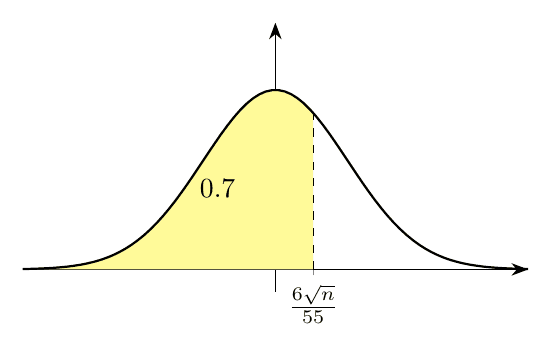
- It is found that, in a sample of \(n\) randomly chosen fishing trips, the probability that the average catch of a Large vessel being less than 552 kg is at least 0.7. Find the least possible value of \(n\).
Show full worked solution▾
Let \(S\sim\mathrm{N}(300,\sigma^2)\) and \(L\sim\mathrm{N}(540,\,110^2)\).
(a) \[\begin{aligned} \mathrm{P}(S>400) &= 0.08\\ \mathrm{P}\!\left(Z>\frac{400-300}{\sigma}\right) &= 0.08\\ \frac{100}{\sigma} &= 1.40507\\ \sigma &= 71.2\text{ (3 s.f.)}\quad\text{(shown)} \end{aligned}\]
(b) Let \(A = S_1+S_2+S_3+L_1+L_2\). \[\begin{aligned} A &\sim \mathrm{N}\!\left(3\times300+2\times540,\; 3\times71.171^2+2\times110^2\right)\\ &\sim \mathrm{N}\!\left(1980,\; 198.484^2\right) \end{aligned}\] \[ \mathrm{P}(A\geq2100) = 0.273\text{ (3 s.f.)} \]
(c) The amounts of fish caught by all the vessels are independent of one another.
(d) Premium-Standard catches \(3S\sim\mathrm{N}(900,\;9\sigma^2)\); Premium-Large catches \(2L\sim\mathrm{N}(1080,\;4\times110^2)\).
Let \(B = 3S+2L\). \[\begin{aligned} B &\sim \mathrm{N}\!\left(900+1080,\; 9\times71.171^2+4\times110^2\right)\\ &\sim \mathrm{N}\!\left(1980,\; 306.574^2\right) \end{aligned}\] \[ \mathrm{P}(B\geq2100) = 0.348\text{ (3 s.f.)} \]
(e) \(\bar{L}\sim\mathrm{N}\!\left(540,\dfrac{110^2}{n}\right)\).
Require \(\mathrm{P}(\bar{L}<552)\geq 0.7\).
Method 1 (GC table)
| \(n\) | \(\mathrm{P}(\bar{L}<552)\) |
|---|---|
| 23 | 0.6996 |
| 24 | 0.7035 |
| 25 | 0.7073 |
Least value of \(n\) is \(\mathbf{24}\).
Method 2 (Standardising)
\[\begin{aligned} \mathrm{P}\!\left(Z < \frac{552-540}{110/\sqrt{n}}\right) &\geq 0.7\\ \mathrm{P}\!\left(Z < \frac{6\sqrt{n}}{55}\right) &\geq 0.7 \end{aligned}\] \(\mathrm{P}(Z<k)=0.7 \Rightarrow k=0.5244\), so \(\dfrac{6\sqrt{n}}{55}\geq 0.5244\): \[\begin{aligned} 6\sqrt{n} &\geq 28.842\\ \sqrt{n} &\geq 4.807\\ n &\geq 23.1 \end{aligned}\] Least value of \(n\) is \(\mathbf{24}\).