
Graphs & Transformations: Parametric curve & symmetry — DHS 2025 H2 Math Prelim Paper 1
What this question tests
Question
A curve \(C\) is defined parametrically by \[ x = a\tan t, \qquad y = a\sec^2 t\sin t, \qquad -\tfrac{\pi}{4} < t < \tfrac{\pi}{4}, \] where \(a\) is a positive constant.
- Show that \(\dfrac{\tan t}{\sqrt{1+\tan^2 t}} = \sin t\).
- By using part (a) or otherwise, find the Cartesian equation of \(C\) in the form \(y = \mathrm{f}(x)\), simplifying your answer.
- Show that \(\mathrm{f}(-x) = -\mathrm{f}(x)\). Hence sketch \(C\).
- Find the exact area of the region bounded by \(C\), the \(x\)-axis and the lines \(x = -A\) and \(x = A\), where \(0 < A < a\), leaving your answer in terms of \(A\) and \(a\).
Show full worked solution▾
(a) \[\begin{aligned} \text{LHS} &= \frac{\tan t}{\sqrt{1+\tan^2 t}} = \frac{\tan t}{\sqrt{\sec^2 t}} = \frac{\tan t}{|\sec t|} = \frac{\tan t}{\sec t} \quad \left(\because \sec t > 0 \text{ for } -\tfrac{\pi}{4} < t < \tfrac{\pi}{4}\right) \\ &= \frac{\sin t}{\cos t} \cdot \cos t = \sin t = \text{RHS} \qquad \text{(shown)} \end{aligned}\]
(b) From \(x = a\tan t \Rightarrow \tan t = \dfrac{x}{a}\). Using part (a): \[\begin{aligned} y &= a\sec^2 t\sin t\\ & = a(\tan^2 t + 1)\sin t\\ & = a(\tan^2 t + 1)\cdot\frac{\tan t}{\sqrt{1+\tan^2 t}} \\ &= a\sqrt{1+\tan^2 t}\cdot\tan t\\ & = a\sqrt{1+\left(\frac{x}{a}\right)^2}\cdot\frac{x}{a} \end{aligned}\]
\(y = \dfrac{x\sqrt{x^2+a^2}}{a}\), where \(-a < x < a\)
(c) \[ \mathrm{f}(-x) = \frac{(-x)\sqrt{(-x)^2+a^2}}{a} = \frac{-x\sqrt{x^2+a^2}}{a} = -\mathrm{f}(x) \quad \text{(shown)} \] Since \(\mathrm{f}(-x) = -\mathrm{f}(x)\), the curve is odd (rotationally symmetric about the origin).
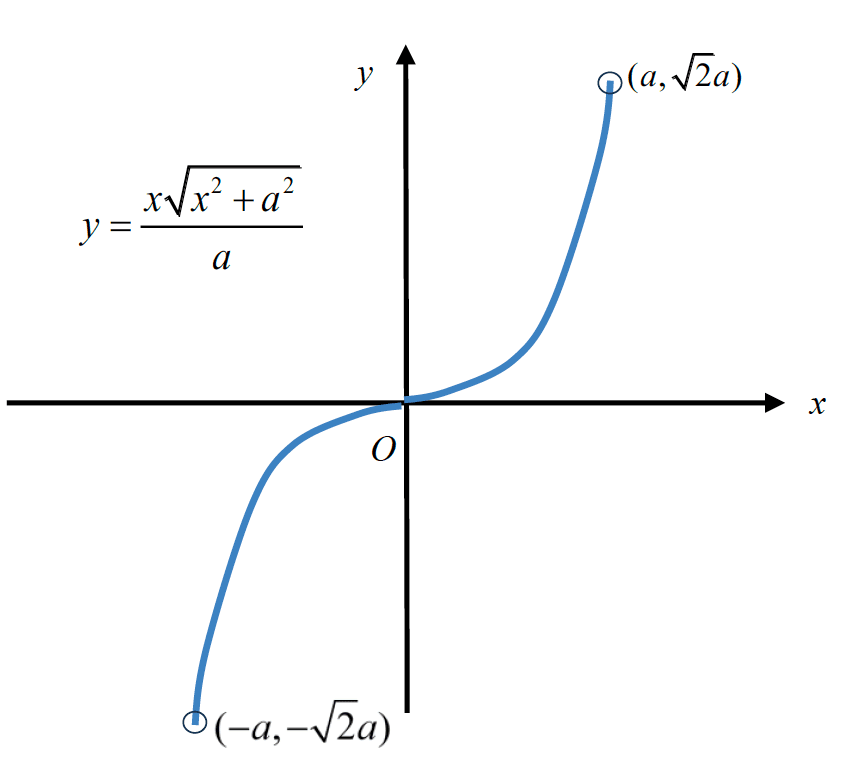
Open endpoints at \((-a, -\sqrt{2}\,a)\) and \((a, \sqrt{2}\,a)\).
(d) By symmetry (\(\mathrm{f}\) is odd): \[\begin{aligned} \text{Area} &= 2\int_0^A \frac{x\sqrt{x^2+a^2}}{a}\,\mathrm{d}x \\ &= \frac{1}{a}\int_0^A 2x\sqrt{x^2+a^2}\,\mathrm{d}x \\ &= \frac{1}{a}\left[\frac{2}{3}(x^2+a^2)^{3/2}\right]_0^A \end{aligned}\]