Functions: Restricted domain & \(g^n\) pattern — EJC 2025 H2 Math Prelim Paper 1
What this question tests
Question
- State the coordinates of the turning points of the graph of \(y = x^3 - 3x^2 - 9x + 5\).
- The function \(\mathrm{f}\) is defined by \[ \mathrm{f}(x) = x^3 - 3x^2 - 9x + 5,\quad x \in \mathbb{R},\ x \leq a, \] where \(a\) is a constant. Find the largest possible value of \(a\) such that \(\mathrm{f}^{-1}\) exists, and state the domain of \(\mathrm{f}^{-1}\) in this case.
- The function \(\mathrm{g}\) is defined by \(\mathrm{g}(x) = \dfrac{1-2x}{x+2}\), \(x \in \mathbb{R}\), \(x \neq -2\).
- Find \(\mathrm{g}^2(x)\).
- Hence find the possible expressions of \(\mathrm{g}^n(x)\), where \(n\) is a positive integer.
- The function \(\mathrm{h}\) is defined by \(\mathrm{h}(x) = x^2\), \(x \in \mathbb{R}\), \(x \leq 0\).
- Explain why the composite function \(\mathrm{gh}\) exists.
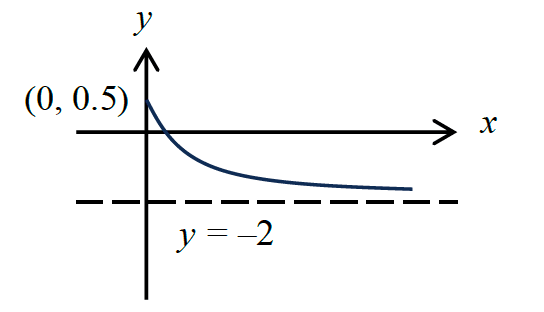
- Find the range of \(\mathrm{gh}\).
Show full worked solution▾
From GC: \((-1, 10)\) and \((3, -22)\).
Turning points: \((-1,\,10)\) and \((3,\,-22)\)
\(\mathrm{f}^{-1}\) exists iff \(\mathrm{f}\) is one-to-one. With domain \(x \leq a\), \(\mathrm{f}\) is one-to-one iff \(a \leq -1\) (the local maximum). Largest value is \(a = -1\).
Domain of \(\mathrm{f}^{-1}\) = Range of \(\mathrm{f}\) (with \(x \leq -1\)) \(= (-\infty, 10]\).
Largest \(a = -1\). Domain of \(\mathrm{f}^{-1}\) is \((-\infty,\,10]\).
\[\begin{aligned} \mathrm{g}^2(x) &= \mathrm{g}\!\left(\frac{1-2x}{x+2}\right)\\ &= \frac{1 - 2\!\left(\dfrac{1-2x}{x+2}\right)}{\dfrac{1-2x}{x+2}+2}\\ &= \frac{\dfrac{x+2-2(1-2x)}{x+2}}{\dfrac{1-2x+2(x+2)}{x+2}}\\[8pt] &= \frac{x+2-2+4x}{1-2x+2x+4}\\ &= \frac{5x}{5} = x \end{aligned}\] \(\mathrm{g}^2(x) = x\)Since \(\mathrm{g}^2(x) = x\) (the identity), applying \(\mathrm{g}\) again gives \(\mathrm{g}^3 = \mathrm{g}\), \(\mathrm{g}^4 = \mathrm{g}^2 = \mathrm{Id}\), etc.
\(\mathrm{g}^n(x) = \begin{cases} x & \text{if } n \text{ is even}\\ \dfrac{1-2x}{x+2} & \text{if } n \text{ is odd} \end{cases}\) \(\mathrm{R_h} = [0, \infty)\)\(\mathrm{D_g} = \mathbb{R}\setminus\{-2\}\) OR \(\mathrm{D_g} = (-\infty, -2) \cup (-2, \infty)\)
Since \(\mathrm{R_h} \subseteq \mathrm{D_g}\), then \(\mathrm{gh}\) exists.
From graph of \(y = \mathrm{g}(x)\) with domain restricted to \([0, \infty)\)