
Summation of Series: Riemann sums; \(\ln 2\) bounds — EJC 2025 H2 Math Prelim Paper 1
What this question tests
Question
The diagram shows the curve with equation \(y = \dfrac{1}{x}\).
\(n\) rectangles of equal width are drawn under the curve between \(x = 1\) and \(x = 2\).
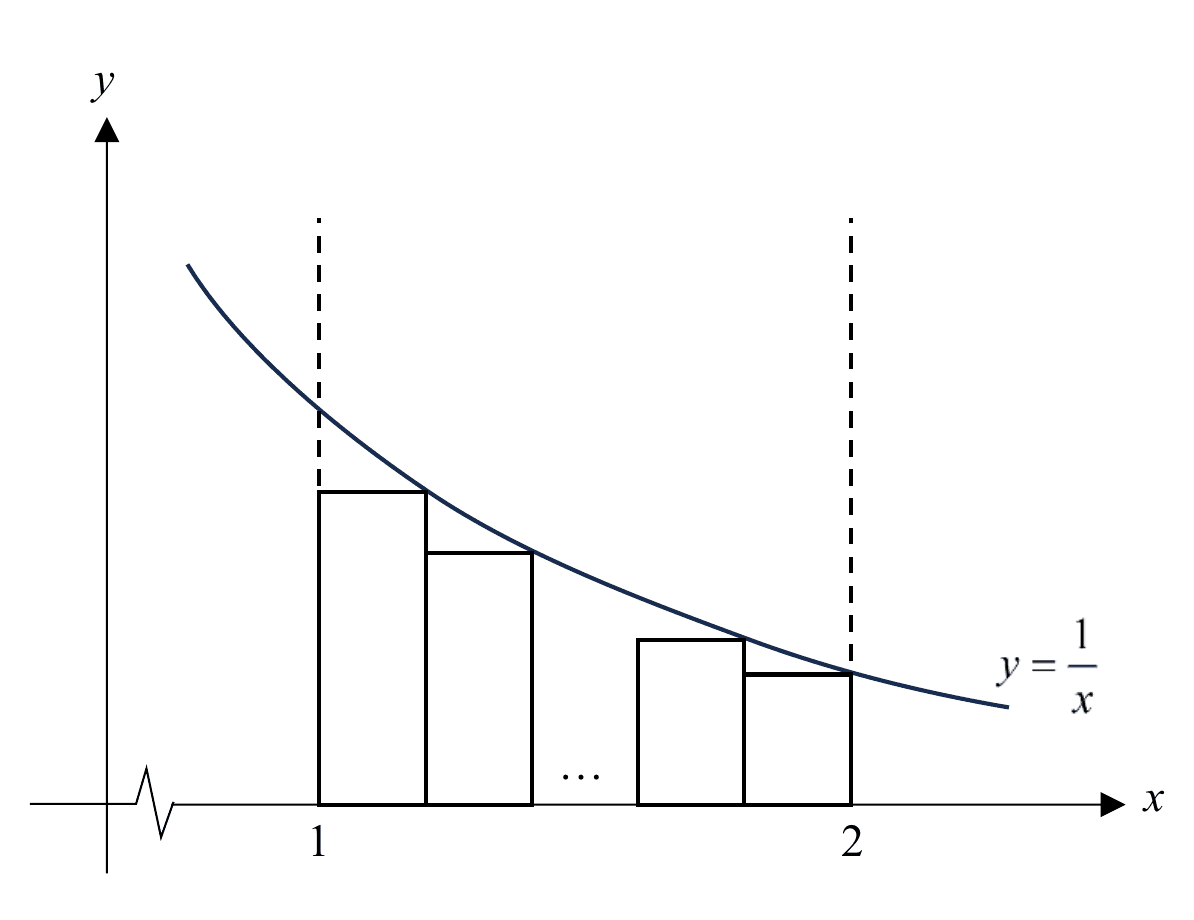
Let \(S_n\) be the total area of the \(n\) rectangles.
- Let \(n = 2\). By considering \(S_2\), show that \(\dfrac{7}{12} < \ln 2\). State your reasoning clearly.
- By considering \(S_n\) for a suitable value of \(n\), find a rational number \(q\) such that \(\dfrac{7}{12} < q < \ln 2\).
- Express \(S_n\) in the form \(\displaystyle\sum_{r=1}^{n} \mathrm{g}(r)\), where the function \(\mathrm{g}\) is to be determined.
- By considering another suitable set of \(n\) rectangles, show with the aid of a diagram that \[ \ln 2 < S_n + \frac{1}{2n} \] where \(n\) is any given positive integer.
Show full worked solution▾
Area under curve between \(x = 1\) and \(x = 2\) is \(\displaystyle\int_1^2 \frac{1}{x}\,\mathrm{d}x = \Big[\ln x\Big]_1^2 = \ln 2\)
Since the two rectangles lie under the curve, the area of the two rectangles must be less than the area under curve, so \[ \frac{7}{12} < \ln 2 \]
Use any integer \(n \geq 3\). For example \(n=3\):
\[ S_3 = \tfrac{1}{3}\!\left(\tfrac{1}{4/3}+\tfrac{1}{5/3}+\tfrac{1}{2}\right) = \tfrac{1}{3}\!\left(\tfrac{3}{4}+\tfrac{3}{5}+\tfrac{1}{2}\right) = \tfrac{1}{3}\cdot\tfrac{37}{20} = \tfrac{37}{60} \]\(q = \dfrac{37}{60}\) (any valid rational with \(\dfrac{7}{12} < q < \ln 2\) accepted)
\[\begin{aligned} S_n &= \left(\frac{1}{n}\right)\!\left(\frac{1}{\frac{n+1}{n}}\right) + \left(\frac{1}{n}\right)\!\left(\frac{1}{\frac{n+2}{n}}\right) + \cdots + \left(\frac{1}{n}\right)\!\left(\frac{1}{\frac{2n}{n}}\right) \\[8pt] &= \frac{1}{n+1} + \frac{1}{n+2} + \cdots + \frac{1}{2n-1} + \frac{1}{2n} \\[8pt] &= \sum_{r=1}^{n} \frac{1}{n+r} \end{aligned}\] \(\mathrm{g}(r) = \dfrac{1}{n+r}\)Consider \(n\) rectangles of equal width \(\tfrac{1}{n}\) drawn above the curve, with heights equal to the function value at the left endpoint of each strip (\(1, 1+\tfrac{1}{n}, \ldots, 1+\tfrac{n-1}{n}\)):
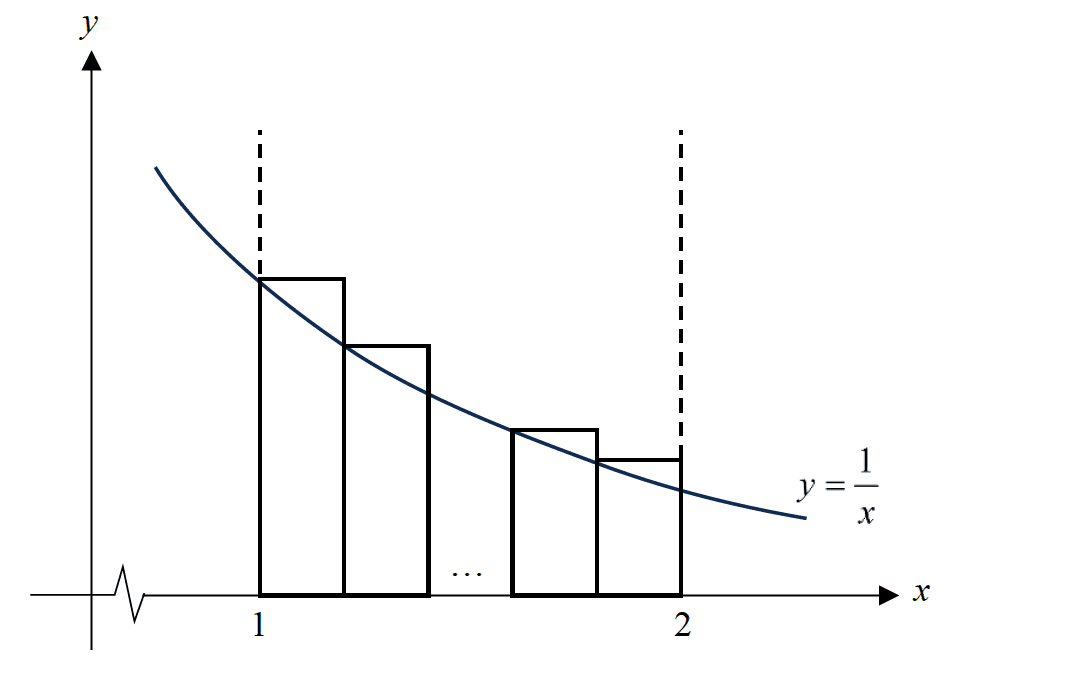
Area of upper rectangles \(= \dfrac{1}{n}\!\left(\dfrac{1}{1} + \dfrac{1}{1+1/n} + \cdots + \dfrac{1}{1+(n-1)/n}\right) = \dfrac{1}{n} + \dfrac{1}{n+1} + \cdots + \dfrac{1}{2n-1}\).
Since these lie above the curve, \(\ln 2 < \) Area of upper rectangles.
\[\begin{aligned} \text{Area of upper rectangles} &= \frac{1}{n} + \frac{1}{n+1} + \cdots + \frac{1}{2n-1}\\[4pt] &= \frac{1}{n} + \underbrace{\frac{1}{n+1} + \cdots + \frac{1}{2n-1} + \frac{1}{2n}}_{{} = S_n} - \frac{1}{2n}\\[4pt] &= S_n + \frac{1}{n} - \frac{1}{2n} = S_n + \frac{1}{2n} \end{aligned}\]Therefore \(\ln 2 < S_n + \dfrac{1}{2n}\). (shown)