
Graphs & Transformations: Rational curve, ellipse & volume — EJC 2025 H2 Math Prelim Paper 2
What this question tests
Question
The curve \(C_1\) has equation \(y = \dfrac{x^2 - 8x + 28}{2 - x}\).
The curve \(C_2\) has equation \(\dfrac{(x - 6)^2}{16} + \dfrac{y^2}{25} = 1\).
- Sketch \(C_1\) and \(C_2\) on the same diagram, stating the coordinates of any vertices, turning points, intersections with the \(x\)-axis and the equations of any asymptotes.
- Find the volume of solid obtained when the smaller region bounded by \(C_1\) and \(C_2\) is rotated through \(2\pi\) radians about the \(x\)-axis.
Show full worked solution▾
(a) For \(C_1: y = \dfrac{x^2 - 8x + 28}{2 - x}\), perform long division: \[ y = -x - 6 + \frac{16}{2 - x} = (6 - x) + \frac{16}{2 - x} \] So \(C_1\) has oblique asymptote \(y = 6 - x\) and vertical asymptote \(x = 2\). The turning point is \((-2,\, 12)\) (minimum) from differentiating, and there are no \(x\)-intercepts (discriminant of \(x^2 - 8x + 28\) is \(64 - 112 < 0\)).
For \(C_2: \dfrac{(x - 6)^2}{16} + \dfrac{y^2}{25} = 1\) is an ellipse centred at \((6,\,0)\), with \(x\)-vertices at \((2,\,0)\) and \((10,\,0)\), and \(y\)-vertices at \((6,\,5)\) and \((6,\,-5)\).
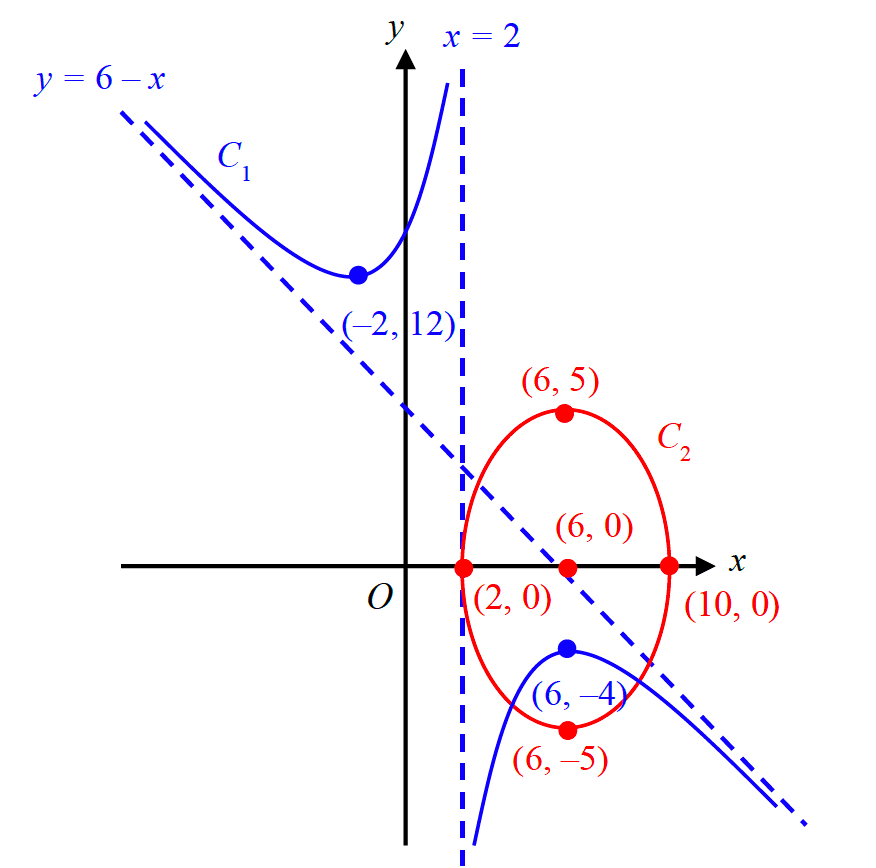
Figure 1. Sketch of \(C_1\) (blue) and \(C_2\) (red).
\(C_1\): vertical asymptote \(x=2\); oblique asymptote \(y=6-x\); minimum at \((-2,12)\).
\(C_2\): ellipse, vertices \((2,0)\), \((10,0)\), \((6,5)\), \((6,-5)\).
(b) From the GC, \(C_1\) and \(C_2\) intersect (in the smaller bounded region) at \(x \approx 4.6391\) and \(x \approx 7.7172\) (to 5 s.f.).
From \(C_2\), \(y^2 = 25\!\left(1 - \dfrac{(x-6)^2}{16}\right)\).
The smaller region is bounded above by the ellipse and below by \(C_1\) (in this \(x\)-range). Volume of revolution about the \(x\)-axis: \[\begin{aligned} V &= \pi \int_{4.6391}^{7.7172} \!\!\left[\,25\!\left(1 - \frac{(x-6)^2}{16}\right) - \left(\frac{x^2 - 8x + 28}{2 - x}\right)^{\!2}\,\right] dx\\ &= 58.7 \text{ units}^3 \quad (\text{from GC}). \end{aligned}\]