
Differentiation & Applications: Apps of differentiation — HCI 2025 H2 Math Prelim Paper 1
Hwa Chong Institution2025 PrelimPaper 1●●○ Standard6 marks
What this question tests
Apps of differentiation.
Question
A curve has equation \(y = x + 1 + \dfrac{3}{x-1}\). Using differentiation, find the set of values of \(x\) where the curve is strictly decreasing. Give your answers in exact form.
Show full worked solution▾
We write \(y = x + 1 + 3(x-1)^{-1}\), so \[ \frac{\mathrm{d}y}{\mathrm{d}x} = 1 + 0 - 3(x-1)^{-2} = 1 - \frac{3}{(x-1)^2}. \]
For the curve to be strictly decreasing we require \(\dfrac{\mathrm{d}y}{\mathrm{d}x} < 0\), i.e. \[ 1 - \frac{3}{(x-1)^2} < 0. \]
\[\begin{aligned} \frac{(x-1)^2 - 3}{(x-1)^2} &< 0\\ \frac{x^2 - 2x + 1 - 3}{(x-1)^2} &< 0\\ \frac{x^2 - 2x - 2}{(x-1)^2} &< 0. \end{aligned}\]The denominator \((x-1)^2 > 0\) for \(x \ne 1\), so we need \(x^2 - 2x - 2 < 0\). Solving \(x^2 - 2x - 2 = 0\): \[ x = \frac{2 \pm \sqrt{4 + 8}}{2} = 1 \pm \sqrt{3}. \]
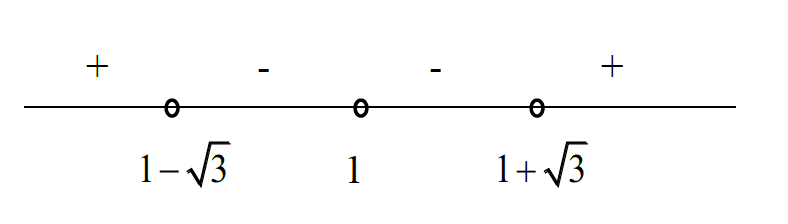
So the curve is strictly decreasing on \[ \{x \in \mathbb{R} : 1 - \sqrt{3} \le x < 1 \text{ or } 1 < x \le 1 + \sqrt{3}\}. \]
Answer: \(\{x\in\mathbb{R} : 1-\sqrt{3} \le x < 1 \text{ or } 1 < x \le 1+\sqrt{3}\}\)