
Summation of Series: Riemann sum limit — HCI 2025 H2 Math Prelim Paper 1
What this question tests
Question
The diagram shows a sketch of the function \(\mathrm{f}(x) = \mathrm{e}^{3x} + 1\), for \(0 \le x \le 1\). The region bounded by the curve and the lines \(y=0\), \(x=0\) and \(x=1\) is \(A\). The region \(A\) is split into 5 vertical strips of equal width \(h\), as shown in the diagram.
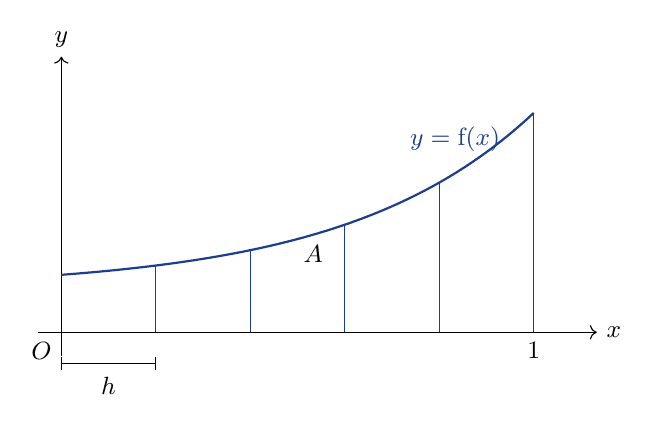
(a) State the value of \(h\) and using a suitable sketch, explain whether \(\displaystyle\sum_{k=1}^{5} \bigl(h\,\mathrm{f}(kh)\bigr)\) is less or more than the area of \(A\).
(b) \(A\) is now split into \(n\) vertical strips of equal width. Using calculus, find the exact value of \[ \lim_{n\to\infty} \dfrac{1}{n}\!\left(\mathrm{e}^{\tfrac{3}{n}} + \mathrm{e}^{\tfrac{6}{n}} + \mathrm{e}^{\tfrac{9}{n}} + \cdots + \mathrm{e}^{\tfrac{3n-3}{n}} + \mathrm{e}^{3} + n\right). \]
Show full worked solution▾
(a) The interval \([0,1]\) is split into \(5\) equal parts, so \[ h = \tfrac{1}{5}. \]
The expression \(\sum_{k=1}^{5} h\,\mathrm{f}(kh)\) is the right Riemann sum: each rectangle has width \(h\) and height \(\mathrm{f}(kh)\) (the value at the right endpoint of the \(k\)-th strip). Because \(\mathrm{f}\) is strictly increasing, \(\mathrm{f}(kh)\) exceeds every value of \(\mathrm{f}\) on \([(k-1)h, kh]\), so each rectangle lies entirely above the curve segment.
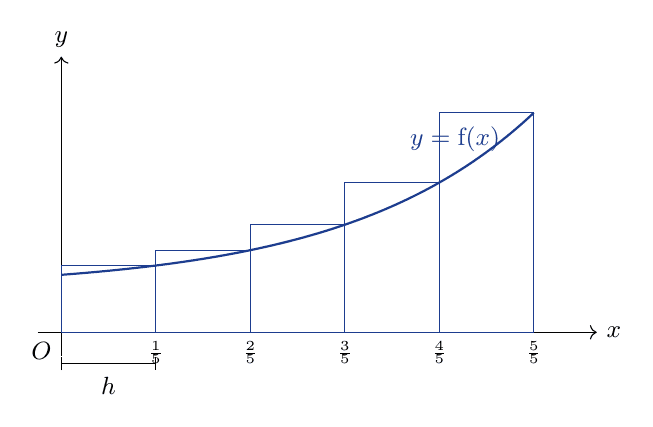
Therefore \[ \sum_{k=1}^{5} h\,\mathrm{f}(kh) \;=\; \tfrac{1}{5}\bigl[\mathrm{f}(\tfrac{1}{5}) + \mathrm{f}(\tfrac{2}{5}) + \mathrm{f}(\tfrac{3}{5}) + \mathrm{f}(\tfrac{4}{5}) + \mathrm{f}(\tfrac{5}{5})\bigr] \;=\; \text{area of 5 rectangles} \;>\; \text{area of } A. \]
(b) \[\begin{aligned} &\lim_{n\to\infty} \frac{1}{n}\!\left(\mathrm{e}^{\frac{3}{n}} + \mathrm{e}^{\frac{6}{n}} + \mathrm{e}^{\frac{9}{n}} + \cdots + \mathrm{e}^{\frac{3n-3}{n}} + \mathrm{e}^{3} + n\right)\\ &= \lim_{n\to\infty} \frac{1}{n}\!\left[\!\left(\mathrm{e}^{\frac{3}{n}}+1\right)+\left(\mathrm{e}^{\frac{6}{n}}+1\right)+\left(\mathrm{e}^{\frac{9}{n}}+1\right)+\cdots+\left(\mathrm{e}^{\frac{3n-3}{n}}+1\right)+\left(\mathrm{e}^{3}+1\right)\right]\\ &= \int_{0}^{1} \mathrm{e}^{3x} + 1\,\mathrm{d}x\\ &= \left[\frac{\mathrm{e}^{3x}}{3} + x\right]_{0}^{1}\\ &= \frac{\mathrm{e}^{3}}{3} + 1 - \frac{\mathrm{e}^{0}}{3} - 0\\ &= \frac{\mathrm{e}^{3}}{3} + \frac{2}{3} \end{aligned}\]