
Graphs & Transformations: Parametric & hyperbola — HCI 2025 H2 Math Prelim Paper 2
What this question tests
Question
The parametric equations of the curve \(C\) are \[ x=1-3\operatorname{cosec}\theta\quad\text{and}\quad y=2\cot\theta-3,\quad\text{where }0\le\theta\le\pi. \]
(a) Show \(\dfrac{\mathrm{d}y}{\mathrm{d}x}=-\dfrac{2}{3}\sec\theta\). Hence find the equation of the normal to \(C\) at the point where \(\theta=\dfrac{\pi}{4}\). Give the equation in the form \(y=Ax+B\), where \(A\) and \(B\) are exact constants to be found.
(b) Show that the normal found in part (a) will cut \(C\) again.
(c) Find the Cartesian equation of \(C\).
(d) Sketch \(C\), indicating clearly its key features.
(e) Find the range of values of \(m\) such that there is no intersection between the line \(y=m(x-1)-3\) and \(C\).
Show full worked solution▾
(a) \[ \frac{\mathrm{d}x}{\mathrm{d}\theta}=-3(-\operatorname{cosec}\theta\cot\theta),\qquad \frac{\mathrm{d}y}{\mathrm{d}\theta}=-2\operatorname{cosec}^{2}\theta. \] \[\begin{aligned} \frac{\mathrm{d}y}{\mathrm{d}x} &= -\frac{2\operatorname{cosec}^{2}\theta}{3\operatorname{cosec}\theta\cot\theta} = -\frac{2\operatorname{cosec}\theta}{3\cot\theta} = -\frac{2}{3}\sec\theta. \end{aligned}\]
When \(\theta=\dfrac{\pi}{4}\): \(\ x=1-3\sqrt{2},\ y=-1,\ \dfrac{\mathrm{d}y}{\mathrm{d}x}=-\dfrac{2}{3}\!\left(\dfrac{1}{\cos(\pi/4)}\right)=-\dfrac{2\sqrt{2}}{3}.\)
Gradient of normal \(=\dfrac{3}{2\sqrt{2}}\). Equation of the normal: \[\begin{aligned} y-(-1) &= \frac{3}{2\sqrt{2}}\!\left(x-(1-3\sqrt{2})\right) \\ y &= \frac{3}{2\sqrt{2}}(x-1+3\sqrt{2})-1 \\ &= \frac{3}{2\sqrt{2}}x-\frac{3}{2\sqrt{2}}+\frac{9}{2}-1 \\ \therefore y &= \frac{3}{2\sqrt{2}}x-\frac{3}{2\sqrt{2}}+\frac{7}{2}. \end{aligned}\]
(b) Substitute \(x=1-3\operatorname{cosec}\theta\) and \(y=2\cot\theta-3\) into the normal: \[ 2\cot\theta-3=\frac{3}{2\sqrt{2}}(1-3\operatorname{cosec}\theta)-\frac{3}{2\sqrt{2}}+\frac{7}{2}. \]
By GC graph,
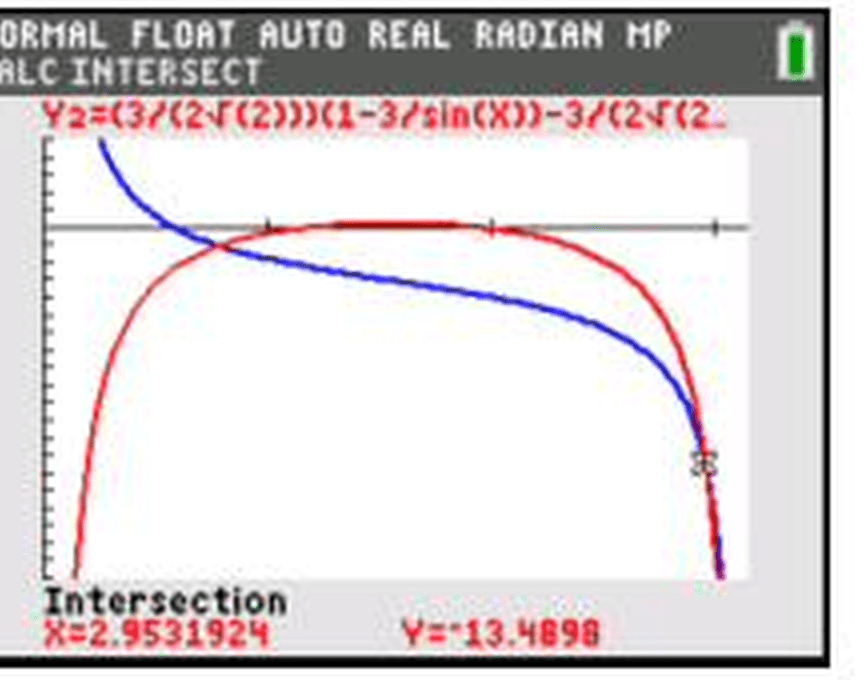
Enter \(Y_{1}=2\cot\theta-3\) and \(Y_{2}=\dfrac{3}{2\sqrt{2}}(1-3\operatorname{cosec}\theta)-\dfrac{3}{2\sqrt{2}}+\dfrac{7}{2}\),
and find points of intersection. \[ \theta=2.95319\quad\text{or}\quad 0.7853982=\frac{\pi}{4} \] Since there are 2 values of \(\theta\), the normal line will cut the curve again. (shown)
(c) From the parametric equations, \(\operatorname{cosec}\theta=\dfrac{1-x}{3}\) and \(\cot\theta=\dfrac{y+3}{2}\).
For \(0\le\theta\le\pi\): \[\begin{aligned} 0\le\sin\theta&\le 1 \\ \operatorname{cosec}\theta&\ge 1 \\ -3\operatorname{cosec}\theta&\le -3 \\ 1-3\operatorname{cosec}\theta&\le -2 \\ \Rightarrow x&\le -2. \end{aligned}\]
Using \(\cot^{2}\theta+1=\operatorname{cosec}^{2}\theta\): \[ \left(\frac{y+3}{2}\right)^{2}+1=\left(\frac{1-x}{3}\right)^{2} \quad\Longrightarrow\quad \left(\frac{x-1}{3}\right)^{2}-\left(\frac{y+3}{2}\right)^{2}=1,\ x\le-2. \]
(d) The sketch below shows \(C\) together with the normal from part (a) and its reflection through the centre. \(C\) is the left branch of a hyperbola with centre \((1,-3)\), vertex at \((-2,-3)\), and asymptotes of gradients \(\pm\tfrac{2}{3}\) passing through \((1,-3)\). The point of tangency \(Q\) lies near the upper-left of the vertex.
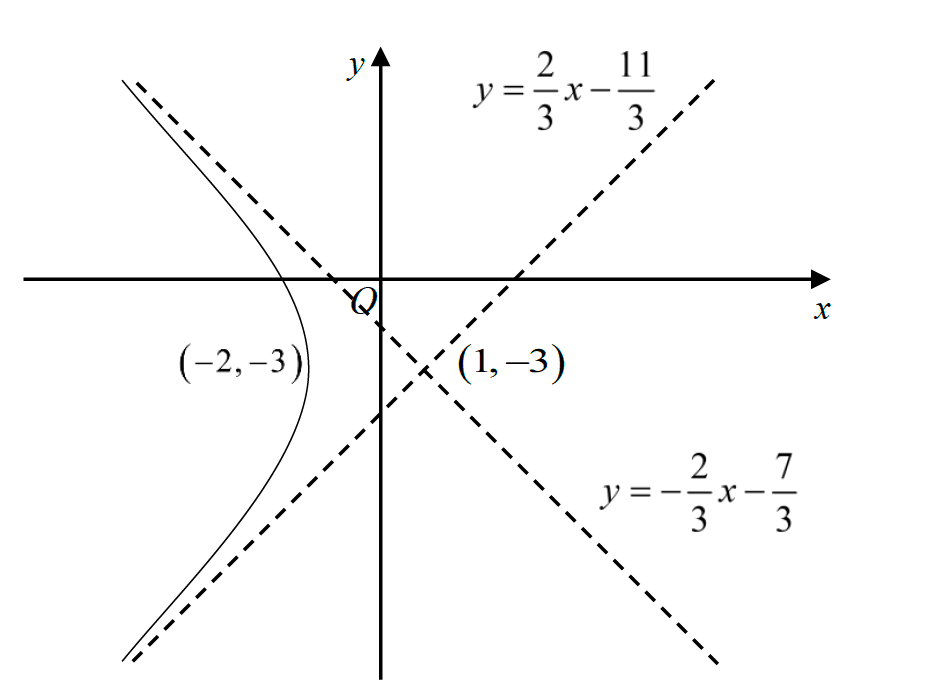
Figure 2 — Curve \(C\) (left branch of hyperbola), asymptotes \(y=\tfrac{2}{3}x-\tfrac{11}{3}\) and \(y=-\tfrac{2}{3}x-\tfrac{7}{3}\).
(e) When \(x=1\), \(y=m(1-1)-3=-3\).
The line passes through the centre \((1,-3)\), of the hyperbola.
For no intersection between the line and \(C\), the range of values for \(m\) is \(m\le-\dfrac{2}{3}\) or \(m\ge\dfrac{2}{3}\).