
Graphs & Transformations: Ellipse, normal & volume — NJC 2025 H2 Math Prelim Paper 2
What this question tests
Question
The curve \(E\) has equation \[ (x-a)^2 + 4y^2 = 4, \quad \text{where } 0 < a < 2. \]
- Sketch \(E\).
You are now given that \(a = 1\).
- Show that the equation of a normal to \(E\) at \(x=0\) is \(y = 2\sqrt{3}\,x - \dfrac{\sqrt{3}}{2}\).
- The region \(R\) is bounded by \(E\), the normal in part (ii) and the \(y\)-axis. Find the volume of the solid generated when \(R\) is rotated through \(2\pi\) radians about the \(y\)-axis.
Show full worked solution▾
(i)
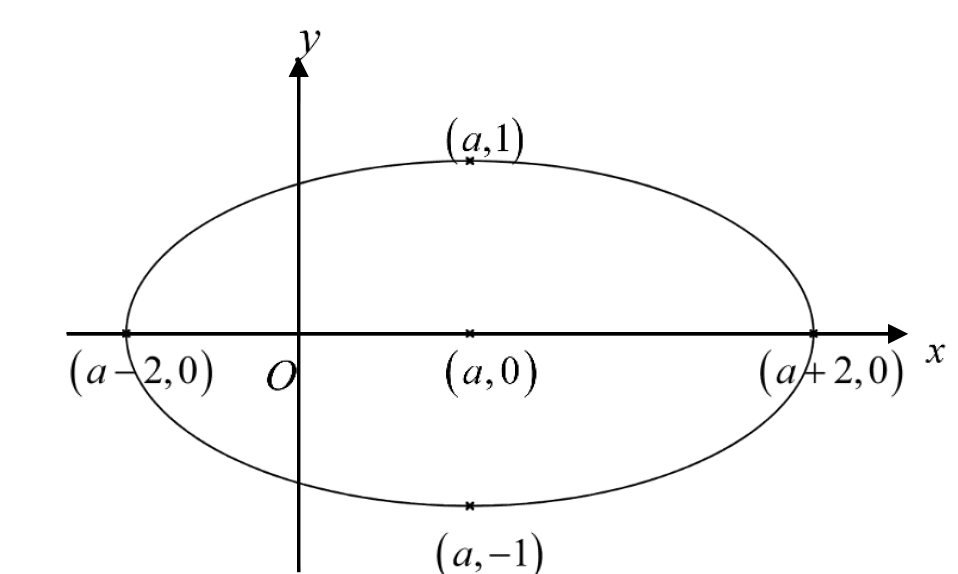
The ellipse \((x-a)^2 + 4y^2 = 4\) rewrites as \(\dfrac{(x-a)^2}{4} + y^2 = 1\): centred at \((a, 0)\), semi-major axis 2 (horizontal), semi-minor axis 1 (vertical).
(ii)
Given \((x-1)^2 + 4y^2 = 4\). When \(x = 0\), \[ (0-1)^2 + 4y^2 = 4 \] \[ y = \pm\frac{\sqrt{3}}{2} \]
Differentiate w.r.t. \(x\), \[\begin{aligned} 2(x-1) + 8y\frac{\mathrm{d}y}{\mathrm{d}x} &= 0 \\ \frac{\mathrm{d}y}{\mathrm{d}x} &= -\frac{x-1}{4y} \end{aligned}\] \[ \text{grad.\ of normal} = \frac{4y}{x-1} \]
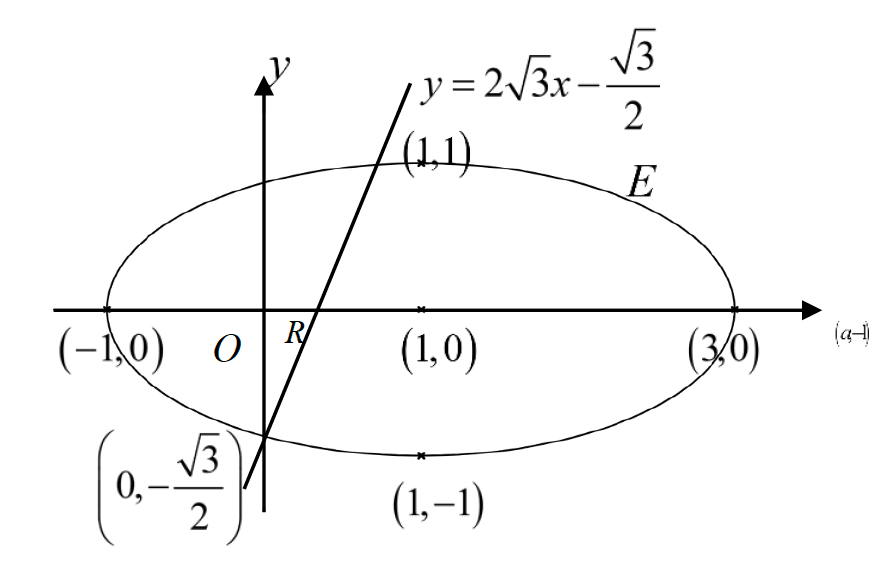
Since gradient of \(y = 2\sqrt{3}x - \dfrac{\sqrt{3}}{2}\) is positive, from the diagram, the normal should have the \(y\)-intercept below the \(O\), i.e. \(-\dfrac{\sqrt{3}}{2}\).
For the point \(\left(0, -\dfrac{\sqrt{3}}{2}\right)\), grad of normal \(= \dfrac{4\!\left(-\dfrac{\sqrt{3}}{2}\right)}{0-1} = 2\sqrt{3}\).
Equation of line: \(y = 2\sqrt{3}x - \dfrac{\sqrt{3}}{2}\) (since \(y\)-intercept is \(-\dfrac{\sqrt{3}}{2}\))
(iii)
Make \(x\) the subject of the ellipse: \(x = 1 \pm \sqrt{4 - 4y^2}\).
By GC, the intersection point is \((0.530612,\; 0.972069)\).
The \(y\)-intercept of \(E\) is \(0.866025\).