
Differential Equations: Biomass; growth models — NYJC 2025 H2 Math Prelim Paper 1
What this question tests
Question
Scientists are studying the growth of a newly discovered biomass that entered Earth's atmosphere together with an asteroid. A sample of 100 grams of the biomass was collected initially. It was found that on the next day, the sample grew to 110 grams. The scientists observed that the rate of growth of biomass was proportional to the amount of biomass present. The amount of biomass at time \(t\) days is denoted by \(B\) grams.
(a) Write down a differential equation relating \(B\) and \(t\).
(b) Solve the differential equation obtained in part (a), expressing \(B\) in terms of \(t\).
(c) Sketch the graph of \(B\) against \(t\), and explain what would happen if the biomass was left on its own.
To limit the growth of the biomass, the scientist collected a second sample of 100 grams of the biomass and introduced a nutrient depletion serum to the sample the moment it was collected. The rate of growth of the biomass for this second sample is modelled by the differential equation \[ \frac{\mathrm{d}B}{\mathrm{d}t} = \frac{mB}{3 + 2t^2} \] where \(m\) is a constant.
After 1 day, the second sample grew to 101 grams.
(d) For this second sample, find \(B\) in terms of \(t\).
(e) Determine the amount of the second biomass sample after a long time, leaving your answer to 5 decimal places.
Show full worked solution▾
(a) \[ \frac{\mathrm{d}B}{\mathrm{d}t} = kB,\quad k\in\mathbb{R} \]
(b) \[ \frac{1}{B}\frac{\mathrm{d}B}{\mathrm{d}t} = k \implies \int\frac{1}{B}\;\mathrm{d}B = \int k\;\mathrm{d}t \] \[ \ln B = kt + C \implies B = De^{kt} \] Given \(B = 100\) when \(t = 0\): \(D = 100\).
Given \(B = 110\) when \(t = 1\): \(110 = 100e^k \implies k = \ln\dfrac{11}{10}\). \[ \therefore\; B = 100e^{t\ln\frac{11}{10}} = 100\!\left(\frac{11}{10}\right)^t \]
(c)
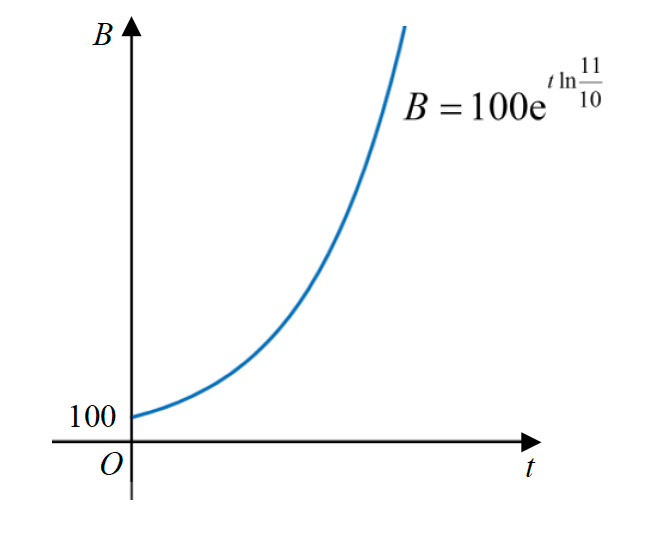
The biomass would grow indefinitely if it was left on its own.
(d) \[ \frac{1}{B}\frac{\mathrm{d}B}{\mathrm{d}t} = \frac{m}{3+2t^2} \] \[ \int\frac{1}{B}\;\mathrm{d}B = \int\frac{m}{3+2t^2}\;\mathrm{d}t = \frac{m}{2}\int\frac{1}{\frac{3}{2}+t^2}\;\mathrm{d}t = \frac{m}{2}\cdot\sqrt{\frac{2}{3}}\tan^{-1}\!\!\left(\sqrt{\frac{2}{3}}\,t\right) + C \] \[ \ln B = \frac{m}{\sqrt{6}}\tan^{-1}\!\!\left(\sqrt{\frac{2}{3}}\,t\right) + C \implies B = De^{\frac{m}{\sqrt{6}}\tan^{-1}\!\!\left(\sqrt{\frac{2}{3}}\,t\right)} \]
Given \(B = 100\) when \(t = 0\): \(100 = De^0 \implies D = 100\).
Given \(B = 101\) when \(t = 1\): \[ 101 = 100e^{\frac{m}{\sqrt{6}}\tan^{-1}\!\sqrt{\frac{2}{3}}} \implies m = \ln\!\frac{101}{100}\cdot\frac{\sqrt{6}}{\tan^{-1}\!\sqrt{\frac{2}{3}}} = 0.03559595\ldots \]
\[ B = 100e^{\frac{0.03559595}{\sqrt{6}}\tan^{-1}\!\!\left(\sqrt{\frac{2}{3}}\,t\right)} = 100e^{0.014532\tan^{-1}\!\!\left(\sqrt{\frac{2}{3}}\,t\right)} \approx 100e^{0.0145\tan^{-1}\!\!\left(\sqrt{\frac{2}{3}}\,t\right)} \](e) As \(t\to\infty\), \(\tan^{-1}\!\!\left(\sqrt{\dfrac{2}{3}}\,t\right) \to \dfrac{\pi}{2}\). \[ B \to 100e^{0.014532\cdot\frac{\pi}{2}} = 100e^{0.022816\ldots} = 102.30893\text{ grams (5 d.p.)} \]