
System of Linear Equations: Two planes: angle, intersection & distance — NYJC 2025 H2 Math Prelim Paper 2
What this question tests
Question
Two planes \(p_1\) and \(p_2\) have respective cartesian equations given by \[ 4x+y+z=8 \qquad \text{and} \qquad 4x+3y-z=0. \]
- Find the sine of the acute angle between \(p_1\) and \(p_2\) in the form \(\dfrac{m}{\sqrt{n}}\) where \(m\) and \(n\) are positive integers to be determined.
- Verify that the point \(A\) with coordinates \((1,0,4)\) lies on \(p_1\) and \(p_2\). Hence, without the use of a calculator, find the vector equation of the line \(l\) formed by the intersection of \(p_1\) and \(p_2\).
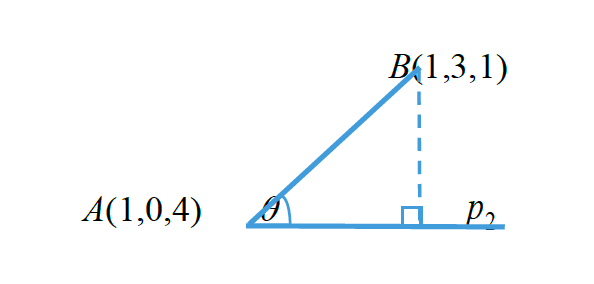
- It is given that \(B\) is a point on \(p_1\) with coordinates \((1,3,1)\). Show that \(AB\) is perpendicular to \(l\) and hence use (a) to deduce exactly the shortest distance from \(B\) to \(p_2\).
- Find the cartesian equation of the plane \(p_3\) which contains \(B\) and is perpendicular to both \(p_1\) and \(p_2\).
Show full worked solution▾
(a)
Let \(\theta\) be the acute angle between \(p_1\) and \(p_2\). The normal vectors are \(\mathbf{n}_1=\begin{pmatrix}4\\1\\1\end{pmatrix}\) and \(\mathbf{n}_2=\begin{pmatrix}4\\3\\-1\end{pmatrix}\).
\[\begin{aligned} \cos\theta &= \frac{\left|\mathbf{n}_1\cdot\mathbf{n}_2\right|}{|\mathbf{n}_1||\mathbf{n}_2|} = \frac{|16+3-1|}{\sqrt{18}\cdot\sqrt{26}} = \frac{18}{\sqrt{468}} = \frac{3}{\sqrt{13}} \end{aligned}\](b)
\(4(1)+0+4=8\) and \(4(1)+3(0)-4=0\) , so \(A(1,0,4)\) lies on both planes.
The direction of \(l\) is \(\mathbf{n}_1\times\mathbf{n}_2=\begin{pmatrix}4\\1\\1\end{pmatrix}\times\begin{pmatrix}4\\3\\-1\end{pmatrix} =\begin{pmatrix}-4\\8\\8\end{pmatrix}=4\begin{pmatrix}-1\\2\\2\end{pmatrix}\).
(c)
\(\overrightarrow{AB}=\begin{pmatrix}0\\3\\-3\end{pmatrix}\).
\(\overrightarrow{AB}\cdot\begin{pmatrix}-1\\2\\2\end{pmatrix}=0+6-6=0\), so \(AB\) is perpendicular to \(l\).
\(AB=\left|\begin{pmatrix}0\\3\\-3\end{pmatrix}\right|=\sqrt{9+9}=3\sqrt{2}\).
By (a), the perpendicular distance from \(B\) to \(p_2\) is:
(d)
Since \(p_3\) is perpendicular to both \(p_1\) and \(p_2\), the normal vectors of \(p_1\) and \(p_2\) are both parallel to \(p_3\). From (b), a normal vector of \(p_3\) is \(\begin{pmatrix}-1\\2\\2\end{pmatrix}\).
Equation of \(p_3\): \[ \mathbf{r}\cdot\begin{pmatrix}-1\\2\\2\end{pmatrix}=\begin{pmatrix}1\\3\\1\end{pmatrix}\cdot\begin{pmatrix}-1\\2\\2\end{pmatrix}=-1+6+2=7. \]