Graphs & Transformations: Parametric, normals & intersection — RVHS 2025 H2 Math Prelim Paper 1
What this question tests
Question
A curve \(C\) has equation \(y = ax + b + \dfrac{b-2a}{x+2}\), where \(a\) and \(b\) are real constants such that \(a > 0\), \(a \neq \tfrac{1}{2}b\) and \(x \neq -2\).
- Given that \(C\) has stationary points, use differentiation to find the relationship between \(a\) and \(b\).
It is now given that \(a = 1\) and \(b = 3\).
- Prove algebraically that \(y\) cannot lie between \(-1\) and \(3\).
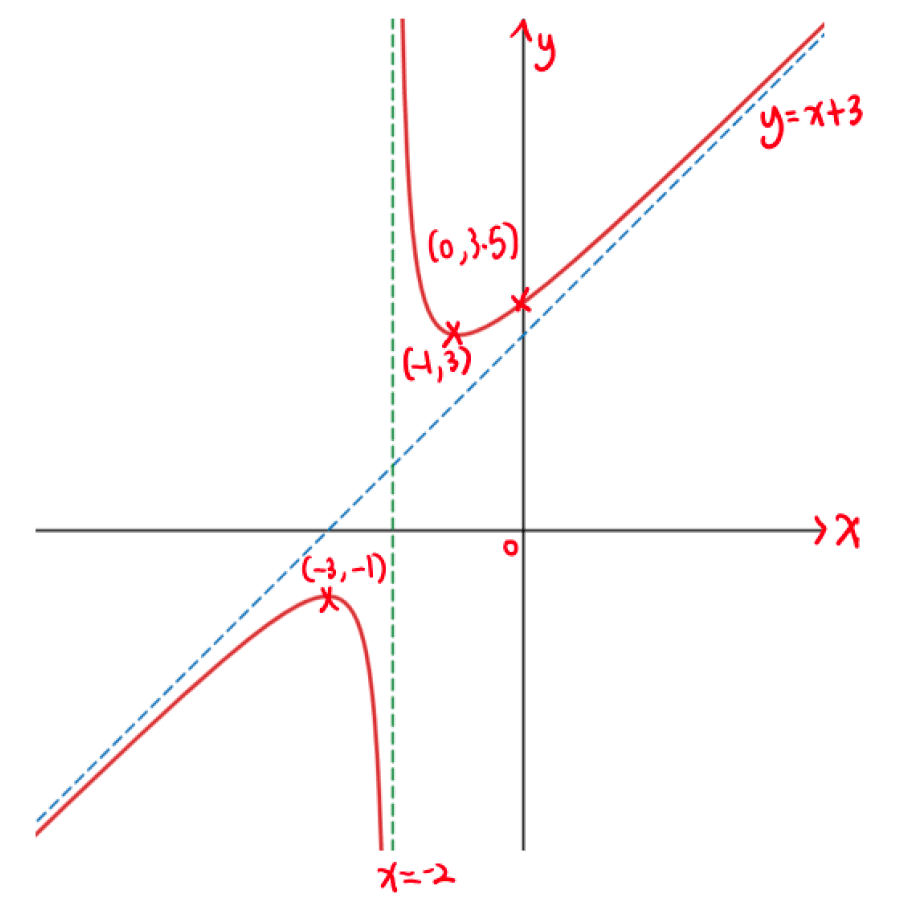
- Sketch \(C\), stating the equations of any asymptotes and the coordinates of any axial intercepts and turning points.
Show full worked solution▾
(a) Show that \(b > 2a\).
\[ \frac{\mathrm{d}y}{\mathrm{d}x} = a - \frac{b-2a}{(x+2)^2} \]At a stationary point, \(\dfrac{\mathrm{d}y}{\mathrm{d}x} = 0\): \[ a - \frac{b-2a}{(x+2)^2} = 0 \implies a = \frac{b-2a}{(x+2)^2} \implies (x+2)^2 = \frac{b-2a}{a} \]
Note that \((x+2)^2 \geq 0\) for all \(x\). Hence \(\dfrac{b-2a}{a} \geq 0\).
Since \(a > 0\) (given), \(b - 2a \geq 0\).
Since \(a \neq \dfrac{1}{2}b\) (given), \(b - 2a \neq 0\), so \(b - 2a > 0\).
(b) With \(a = 1\), \(b = 3\): prove that \(y\) cannot take values strictly between \(-1\) and \(3\).
\(y = x + 3 + \dfrac{1}{x+2}\). Rearranging: \[\begin{aligned} y(x+2) &= (x+3)(x+2) + 1\\ xy + 2y &= x^2 + 5x + 7\\ x^2 + 5x - xy + 7 - 2y &= 0\\ x^2 + x(5-y) + 7 - 2y &= 0 \end{aligned}\]
For real values of \(x\), the discriminant \(b^2 - 4ac \geq 0\): \[\begin{aligned} b^2 - 4ac &= (5-y)^2 - 4(1)(7-2y)\\ &= 25 - 10y + y^2 - 28 + 8y\\ &= y^2 - 2y - 3\\ &= (y+1)(y-3) \end{aligned}\]
Requiring \((y+1)(y-3) \geq 0\) gives \(y \leq -1\) or \(y \geq 3\).
Hence \(y\) cannot lie strictly between \(-1\) and \(3\). \( \)
(c) Sketch the graph of \(C\) for \(a = 1\), \(b = 3\).