
Inequalities: Rational & exponential chain — RVHS 2025 H2 Math Prelim Paper 1
River Valley High School2025 PrelimPaper 1●○○ Introductory6 marks
What this question tests
Rational & exponential chain.
Question
Without using a calculator, solve the inequality \(\displaystyle\frac{9}{1-x^2} < \frac{x+5}{x+1}\).
Hence solve \(\displaystyle\frac{9}{1-e^{2x}} < \frac{e^x+5}{e^x+1}\).
Show full worked solution▾
Part 1: Solve \(\dfrac{9}{1-x^2} < \dfrac{x+5}{x+1}\).
\[\begin{aligned} \frac{9-(x+5)(1-x)}{(x+1)(1-x)} &< 0\\[4pt] \frac{9-(-x^2-4x+5)}{(x+1)(1-x)} &< 0\\[4pt] \frac{x^2+4x+4}{(x+1)(1-x)} &< 0\\[4pt] \frac{(x+2)^2}{(x+1)(1-x)} &< 0 \end{aligned}\]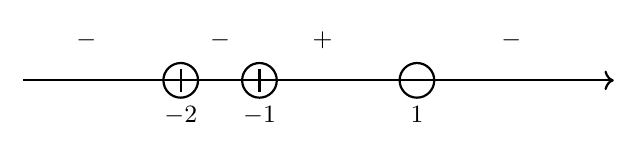
Since \((x+2)^2 \geq 0\) for all \(x\), and \((x+2)^2 = 0\) only when \(x = -2\), the sign is determined by \((x+1)(1-x)\) alone (excluding \(x = -1\), \(x = 1\) where undefined, and \(x = -2\) where numerator is zero).
Part 2: Solve \(\dfrac{9}{1-e^{2x}} < \dfrac{e^x+5}{e^x+1}\).
Replace \(x\) with \(e^x\) in the previous result. Since \(e^x > 0\) for all \(x \in \mathbb{R}\):
\(e^x < -1\): no solution (since \(e^x > 0\)).
\(e^x > 1\): \(x > 0\).
Note: \(e^x \neq -2\) is always true.
Answer: Part 1: \(x < -1\) or \(x > 1\), \(x \neq -2\) (Alternatively: \(x < -2\) or \(-2 < x < -1\) or \(x > 1\)) Part 2: \(x > 0\)