
Differential Equations: Particulates; separable DE — SAJC 2025 H2 Math Prelim Paper 1
What this question tests
Question
Welding fumes contain a dangerous amount of particulates. To protect workers in a workshop, an extraction device removes particulates in the air continuously. Let \(V\) mg represent the mass of particulates in the air in the workshop at time \(t\) min after the extraction device is activated.
Particulates are produced at a constant rate of \(0.32\) mg/min. The rate at which particulates are removed is proportional to the mass of particulates in the air.
When the mass of particulates in the air in the workshop is \(18.75\) mg, the mass of particulates in the air increases at a rate of \(0.12\) mg/min.
(i) Show that \(\dfrac{\mathrm{d}V}{\mathrm{d}t} = \dfrac{4}{375}(30 - V)\).
(ii) Solve the differential equation, given that the workshop is initially free of particulates.
(iii) Sketch the graph of \(V\) against \(t\).
(iv) It is recommended that the mass of particulates in this workshop should be kept below \(32\) mg. Comment on whether the extraction device is effective enough to meet the recommendation.
The extraction device becomes less efficient and now removes particulates at half its original rate.
(v) Write down a new differential equation to model this.
(vi) The mass of particulates in the air in the workshop is said to reach a steady-state when it remains constant. Find the value of \(V\) at steady-state.
Show full worked solution▾
(i) \[ \frac{\mathrm{d}V}{\mathrm{d}t} = \frac{\mathrm{d}V_{\mathrm{in}}}{\mathrm{d}t} - \frac{\mathrm{d}V_{\mathrm{out}}}{\mathrm{d}t} = 0.32 - kV \]
When \(\dfrac{\mathrm{d}V}{\mathrm{d}t} = 0.12\) and \(V = 18.75\) mg: \[ 0.12 = 0.32 - k(18.75) \implies k = \frac{0.2}{18.75} = \frac{4}{375} \] \[ \frac{\mathrm{d}V}{\mathrm{d}t} = 0.32 - \frac{4}{375}V = \frac{1}{375}(120-4V) = \frac{4}{375}(30-V) \quad\text{(shown)} \]
(ii) \[ \int\frac{1}{30-V}\,\mathrm{d}V = \int\frac{4}{375}\,\mathrm{d}t \] \[ -\ln|30-V| = \frac{4}{375}t + C \] \[ \ln|30-V| = -\frac{4}{375}t - C \] \[ |30-V| = \mathrm{e}^{-\frac{4}{375}t - C} \] \[ 30 - V = A\mathrm{e}^{-\frac{4}{375}t},\quad A = \pm\mathrm{e}^{-C} \] \[ V = 30 - A\mathrm{e}^{-\frac{4}{375}t} \]
When \(t=0\), \(V=0\): \(A = 30\).
(iii)
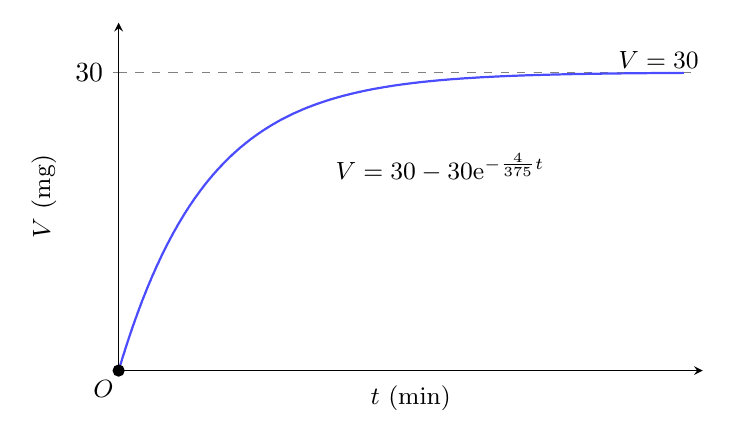
(iv) As the maximum mass of particulates is 30 mg, the extraction device is effective enough to meet the recommendation.
(v) \[ \frac{\mathrm{d}V}{\mathrm{d}t} = 0.64 - \frac{4}{375}V = \frac{2}{375}(120 - 2V) = \frac{4}{375}(60 - V) \]
(vi) At steady state, \(\dfrac{\mathrm{d}V}{\mathrm{d}t} = 0\): \[ 0 = 60 - V \implies V = 60 \]