Functions: Periodic function & composite — SAJC 2025 H2 Math Prelim Paper 1
What this question tests
Question
(a) The function \(\mathrm{f}\) is defined by \[ \mathrm{f}(x) = \begin{cases} a^2 - x^2, & 0 < x \le a, \\ a(x - a), & a < x \le 2a, \end{cases} \] and \(\mathrm{f}(x) = \mathrm{f}(x + 2a)\) for all real values of \(x\), where \(a\) is a positive constant.
(i) Sketch the graph of \(y = \mathrm{f}(x)\) for \(-2a \le x \le 3a\).
(ii) Find \(\mathrm{f}\!\left(\dfrac{101a}{2}\right)\) in terms of \(a\).
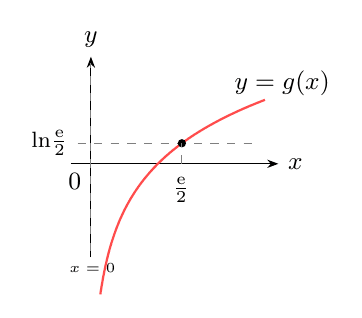
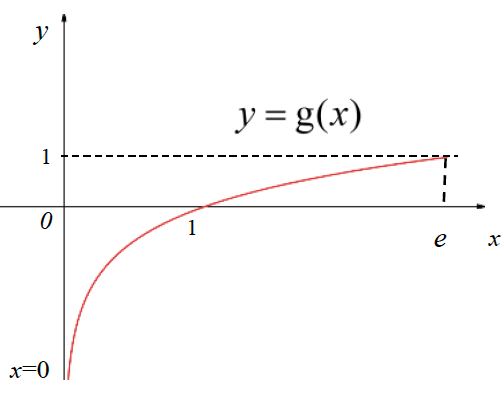
(b) The function \(\mathrm{g}\) is defined by \[ \mathrm{g} : x \mapsto \ln x, \quad \text{where } x \in \mathbb{R},\ 0 < x \le \mathrm{e}. \]
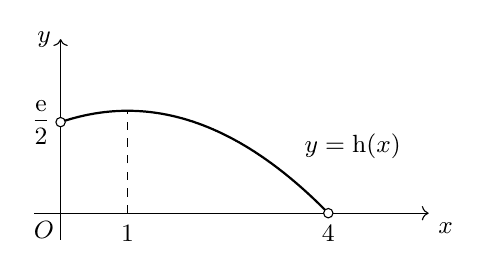
The diagram below shows the graph of the quadratic function \(\mathrm{h}\) with domain defined where \(0 < x < 4\). The graph has a maximum point at \(x = 1\) and has endpoints \(\left(0, \dfrac{\mathrm{e}}{2}\right)\) and \((4, 0)\).
(i) Determine whether \(\mathrm{hg}\) exists. Justify your answer.
(ii) State the other value of \(x\) for which \(\mathrm{h}(x) = \dfrac{\mathrm{e}}{2}\). Given that \(\mathrm{h}^{-1}\) exists, deduce the restricted domain of \(\mathrm{h}\) such that the domain of \(\mathrm{h}^{-1}\) is \(\left(0, \dfrac{\mathrm{e}}{2}\right]\).
(iii) Using the restricted domain of \(\mathrm{h}\) found in (ii), find the range of \(\mathrm{gh}\).
Show full worked solution▾
(a)(i)
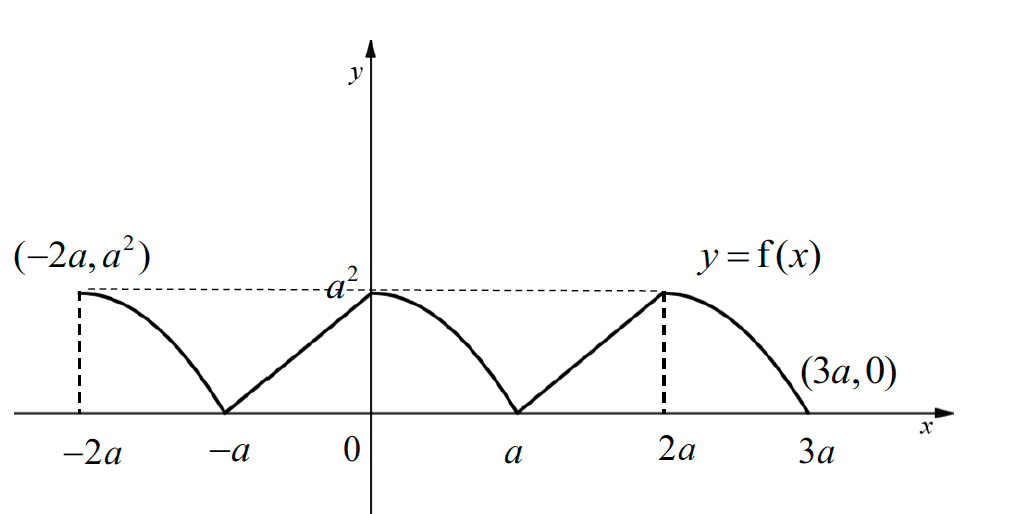
(a)(ii) \[ \mathrm{f}\!\left(\frac{101a}{2}\right) = \mathrm{f}\!\left(50a + \frac{a}{2}\right) = \mathrm{f}\!\left(\frac{a}{2}\right) = a^2 - \left(\frac{a}{2}\right)^{\!2} = \frac{3a^2}{4} \]
(b)(i)
(b)(ii) Since \(h\) is a quadratic function with maximum point at \(x=1\), by symmetry, when \(h(x) = \dfrac{\mathrm{e}}{2}\), \(x = 0\) and \(x = 2\). The other value of \(x\) is \(\mathbf{2}\).
Since \(h^{-1}\) exists, \(h\) is one-to-one and \[ R_{h^{-1}} = D_h = \left(0,\,\frac{\mathrm{e}}{2}\right] \quad\text{(given)} \] From the graph of \(h\), restricted \(D_h = [2,4)\).
(b)(iii) To find range of \(gh\): \[ D_h \xrightarrow{h} R_h \xrightarrow{g} R_{gh} \] \[ [2,4) \xrightarrow{h} \left(0,\,\frac{\mathrm{e}}{2}\right] \xrightarrow{g} \left(-\infty,\,1-\ln 2\right] \]