
Normal Distribution: Mean and sum; conditional — TJC 2025 H2 Math Prelim Paper 2
What this question tests
Question
An examination consists of two parts: a written paper and a lab-based practical. Marks obtained by a randomly chosen candidate follow normal distributions with means and standard deviations as shown in the following table.
| Mean | Standard deviation | |
|---|---|---|
| Written paper | 62 | \(\sigma\) |
| Lab-based practical | 56 | 12 |
It is given that the 95th percentile score for the written paper is 85 marks.
- Show that the value of \(\sigma\) is 13.983, correct to 5 significant figures.
- Find the probability that the difference between the marks obtained in the written paper and in the lab-based practical of a randomly chosen candidate is at least 9.
The overall mark obtained for the examination is the total of 60% of the mark obtained from written paper and 40% of the mark obtained from lab-based practical.
- Find the probability that the overall mark of a randomly chosen candidate is less than 60.
- Find the smallest value of \(n\) such that the probability that the mean overall mark of \(n\) randomly chosen candidates being at least 58 is at least 0.95.
- State an assumption needed for the calculations in part (b) to (d) to be valid and explain why the assumption may not be valid in practice.
Show full worked solution▾
Let \(W\sim\mathrm{N}(62,\sigma^2)\) and \(L\sim\mathrm{N}(56,12^2)\).
(a) \(\mathrm{P}(W\leq 85) = 0.95\): \[\begin{aligned} \mathrm{P}\!\left(Z\leq\frac{85-62}{\sigma}\right) &= 0.95\\ \frac{23}{\sigma} &= 1.64485\\ \sigma &= \frac{23}{1.64485} = 13.983 \quad\text{(5 s.f., shown)} \end{aligned}\]
(b) \(W-L\sim\mathrm{N}(62-56,\; 13.983^2+12^2) = \mathrm{N}(6,\; 339.524)\). \[\begin{aligned} \mathrm{P}(|W-L|\geq 9) &= 1-\mathrm{P}(-9<W-L<9) = 0.643\ \text{(3 s.f.)} \end{aligned}\]
(c) Overall mark \(T = 0.6W + 0.4L\). \[\begin{aligned} \mathrm{E}(T) &= 0.6\times 62+0.4\times 56 = 37.2+22.4 = 59.6\\ \mathrm{Var}(T) &= 0.6^2\times 13.983^2+0.4^2\times 12^2 = 0.36\times 195.524+0.16\times 144\\ &= 70.389+23.04 = 93.429 \end{aligned}\] So \(T\sim\mathrm{N}(59.6,\;93.429)\).
\(\mathrm{P}(T<60) = 0.517\) (3 s.f.).
(d) \(\bar{T} = \dfrac{T_1+\cdots+T_n}{n}\sim\mathrm{N}\!\left(59.6,\;\dfrac{93.429}{n}\right)\).
Need \(\mathrm{P}(\bar{T}\geq 58)\geq 0.95\).
Method 1 (GC table)
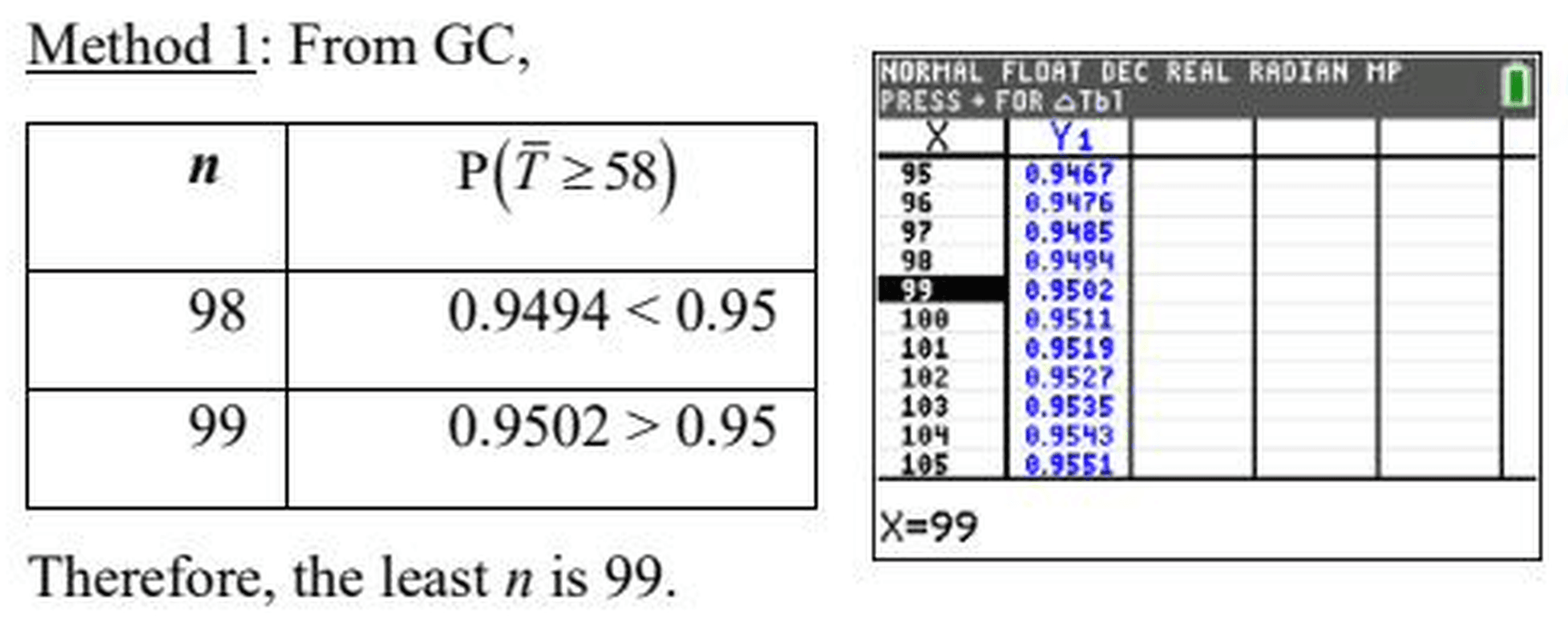
From GC: at \(n=98\), \(\mathrm{P}(\bar{T}\geq 58) = 0.9494 < 0.95\); at \(n=99\), \(\mathrm{P}(\bar{T}\geq 58) = 0.9502 > 0.95\).
Method 2 (Algebraic)
\[\begin{aligned} \mathrm{P}\!\left(Z\geq\frac{58-59.6}{\sqrt{93.429/n}}\right) &\geq 0.95\\ \frac{-1.6\sqrt{n}}{\sqrt{93.429}} &\leq -1.64485\\ \frac{1.6\sqrt{n}}{\sqrt{93.429}} &\geq 1.64485\\ \sqrt{n} &\geq \frac{1.64485\sqrt{93.429}}{1.6} \implies n\geq 98.746 \end{aligned}\](e) The assumption needed is that the marks for the written paper and lab-based practical of a candidate are independent.
This may not be valid in practice as a candidate who performs well on the written paper is likely to have stronger overall ability and hence would also tend to perform well in the lab-based practical.