
Arithmetic & Geometric Progressions: GP application; sum to infinity — TMJC 2025 H2 Math Prelim Paper 1
What this question tests
Question
An arithmetic series has first term \(a\) and common difference \(d\), where \(a\) and \(d\) are non-zero real constants. A convergent geometric series has first term \(b\) and common ratio \(r\), where \(b > 0\) and \(r\) is a non-zero real constant. The sum of the first \(n\) terms of the geometric series is denoted by \(S\).
It is given that the 7th, 10th and 11th terms of the arithmetic series are equal to the 3rd, 6th and 10th terms of the geometric series respectively.
- Show that \(r\) satisfies the equation \(3r^7 - 4r^3 + 1 = 0\). Solve this equation, giving your answer correct to 4 decimal places.
- A new series is formed by taking the even numbered terms of the geometric series. Find the smallest value of \(n\) for which \(S\) differs from the sum to infinity of the new series by at least \(1.78b\).
Show full worked solution▾
(a) The 7th, 10th, 11th terms of the arithmetic series equal the 3rd, 6th, 10th terms of the geometric series: \[\begin{aligned} a + 6d &= br^2 \quad\cdots(1)\\ a + 9d &= br^5 \quad\cdots(2)\\ a + 10d &= br^9 \quad\cdots(3) \end{aligned}\] \((2) - (1):\quad 3d = br^2(r^3 - 1) \quad\cdots(4)\)
\((3) - (2):\quad d = br^5(r^4 - 1) \quad\cdots(5)\)Substituting \((5)\) into \((4)\): \[\begin{aligned} 3br^5(r^4 - 1) &= br^2(r^3 - 1) \\ 3r^3(r^4 - 1) &= r^3 - 1 \quad \text{(since } b, r \neq 0\text{)} \\ 3r^7 - 4r^3 + 1 &= 0 \quad \text{(shown)} \end{aligned}\]
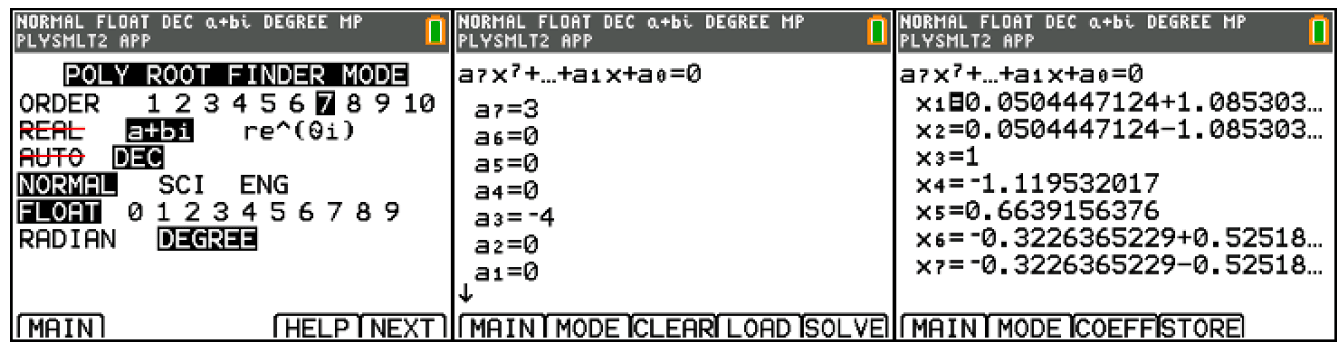
By GC, since the series is convergent, \(|r| < 1\): \[ r = 0.6639 \quad \text{(4 d.p.)} \]
(b) New series: \(br, br^3, br^5, \ldots\) (geometric with first term \(br\), common ratio \(r^2\)).
Sum to infinity of new series: \(\tfrac{br}{1 - r^2}\).
\[ \left|\dfrac{br}{1 - r^2} - S\right| \geq 1.78b \] \[ \left|\dfrac{br}{1 - r^2} - \dfrac{b}{1 - r}(1 - r^n)\right| \geq 1.78b \] Substituting \(r = 0.6639\) and dividing by \(b\) (since \(b > 0\)): \[ \left|\dfrac{0.6639}{1 - 0.6639^2} - \dfrac{1}{1 - 0.6639}(1 - 0.6639^n)\right| \geq 1.78 \]
Using GC: \[\begin{aligned} n = 14:&\quad \text{LHS} = 1.7785 < 1.78\\ n = 15:&\quad \text{LHS} = 1.7818 \geq 1.78 \end{aligned}\]