
Probability: Venn; independence — TMJC 2025 H2 Math Prelim Paper 2
What this question tests
Question
For events \(A\), \(B\) and \(C\), it is given that \(\mathrm{P}(A) = 0.3\), \(\mathrm{P}(B) = 0.4\), \(\mathrm{P}(C) = 0.42\), \(\mathrm{P}(A'\cap B\cap C) = x\) and \(\mathrm{P}(A\cap B\cap C) = 0.02\). It is also given that events \(A\) and \(B\) are independent, and that events \(A\) and \(C\) are independent.
(a) Find \(\mathrm{P}(A\cap B)\) and \(\mathrm{P}(A\cap C)\).
(b) Draw a Venn diagram to represent this situation, showing the probability in each of the eight regions, in terms of \(x\) where necessary.
(c) Find the greatest and least possible values of \(\mathrm{P}(A'\cap B'\cap C)\).
Show full worked solution▾
(a) Since \(A\) and \(B\) are independent, \[ \mathrm{P}(A\cap B) = \mathrm{P}(A)\cdot\mathrm{P}(B) = 0.3 \times 0.4 = 0.12. \] Since \(A\) and \(C\) are independent, \[ \mathrm{P}(A\cap C) = \mathrm{P}(A)\cdot\mathrm{P}(C) = 0.3 \times 0.42 = 0.126. \]
(b) [Optional to show:] Working out the remaining regions: \[\begin{aligned} \mathrm{P}(A\cap B \cap C') &= \mathrm{P}(A\cap B) - \mathrm{P}(A\cap B\cap C) = 0.12 - 0.02 = 0.1,\\ \mathrm{P}(A\cap C \cap B') &= \mathrm{P}(A\cap C) - \mathrm{P}(A\cap B\cap C) = 0.126 - 0.02 = 0.106,\\ \mathrm{P}(A \cap B' \cap C') &= \mathrm{P}(A) - 0.1 - 0.106 - 0.02 = 0.074,\\ \mathrm{P}(B \cap A' \cap C') &= \mathrm{P}(B) - 0.1 - 0.02 - x = 0.28 - x,\\ \mathrm{P}(C \cap A' \cap B') &= \mathrm{P}(C) - 0.106 - 0.02 - x = 0.294 - x,\\ \mathrm{P}(A' \cap B' \cap C') &= 1 - \bigl[0.074 + 0.1 + 0.106 + 0.02 + (0.28-x) + x + (0.294-x)\bigr]\\ &= 0.126 + x. \end{aligned}\]
Figure 3
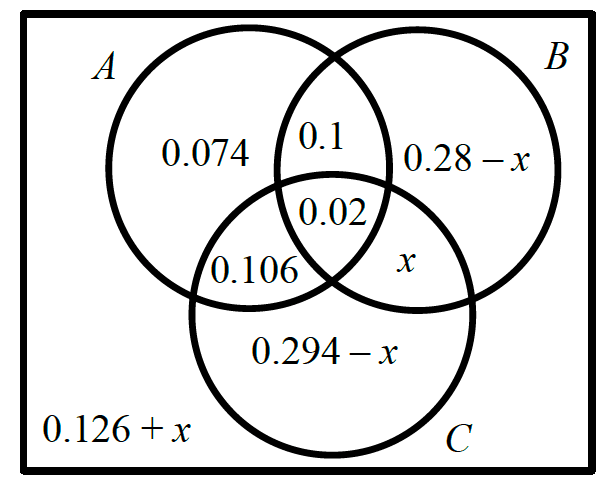
(c) From the Venn diagram, \(\mathrm{P}(A'\cap B'\cap C) = 0.294 - x\). The constraint on \(x\) is that all probabilities are non-negative, in particular \(x \ge 0\) and \(0.28 - x \ge 0\), giving \(0 \le x \le 0.28\).
- For greatest value of \(0.294 - x\), take \(x = 0\): gives \(0.294\).
- For least value of \(0.294 - x\), take \(x = 0.28\): gives \(0.014\).