Differential Equations: Substitution \(y=\ln(u/x)\) — VJC 2025 H2 Math Prelim Paper 1
What this question tests
Question
It is given that \[ 2\frac{\mathrm{d}y}{\mathrm{d}x} + \frac{2}{x} - \ln x = y. \]
(a) Use the substitution \(y = \ln\!\left(\dfrac{u}{x}\right)\) to show that the differential equation can be reduced to \(\dfrac{\mathrm{d}u}{\mathrm{d}x} = \mathrm{f}(u)\), where the function \(\mathrm{f}(u)\) is to be found.
(b) Given that \(y\) has a minimum value at \(x = 3\), solve the differential equation \(2\dfrac{\mathrm{d}y}{\mathrm{d}x} + \dfrac{2}{x} - \ln x = y\), to find the particular solution for \(y\) in terms of \(x\).
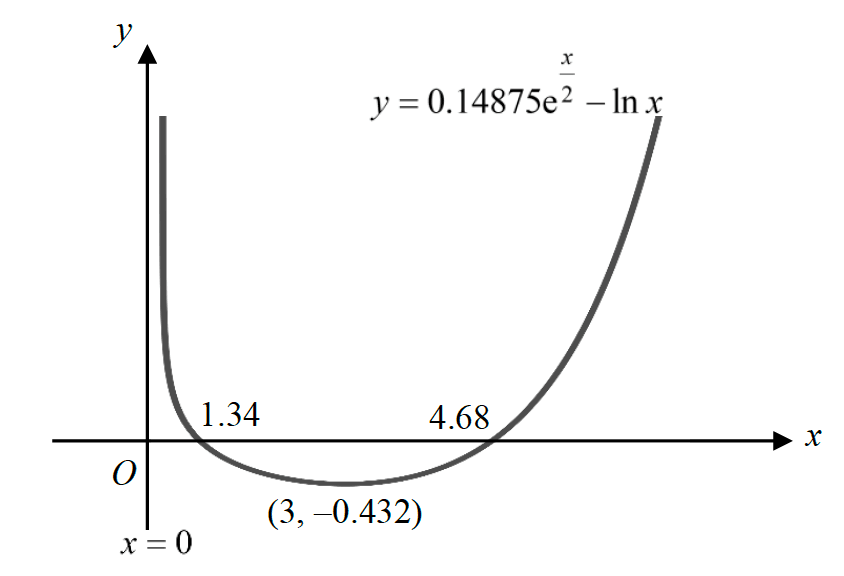
(c) Sketch the graph of this particular solution.
Show full worked solution▾
(a) From \(y = \ln\!\left(\dfrac{u}{x}\right) = \ln u - \ln x\), differentiate w.r.t. \(x\): \[ \frac{\mathrm{d}y}{\mathrm{d}x} = \frac{1}{u}\frac{\mathrm{d}u}{\mathrm{d}x} - \frac{1}{x}. \] Substitute into the given DE \(2\dfrac{\mathrm{d}y}{\mathrm{d}x} + \dfrac{2}{x} - \ln x = y\): \[\begin{aligned} 2\!\left(\frac{1}{u}\frac{\mathrm{d}u}{\mathrm{d}x} - \frac{1}{x}\right) + \frac{2}{x} - \ln x &= \ln u - \ln x\\ \frac{2}{u}\frac{\mathrm{d}u}{\mathrm{d}x} - \frac{2}{x} + \frac{2}{x} - \ln x &= \ln u - \ln x\\ \frac{2}{u}\frac{\mathrm{d}u}{\mathrm{d}x} &= \ln u\\ \frac{\mathrm{d}u}{\mathrm{d}x} &= \tfrac{1}{2}u\ln u. \end{aligned}\] (b) Solve \(\dfrac{\mathrm{d}u}{\mathrm{d}x} = \tfrac{1}{2}u\ln u\) by separation: \[ \int\!\frac{1}{u\ln u}\,\mathrm{d}u = \int\!\frac{1}{2}\,\mathrm{d}x \;\Longrightarrow\; \ln|\ln u| = \tfrac{x}{2} + C. \] Therefore \(\ln u = A\mathrm{e}^{x/2}\) where \(A = \pm\mathrm{e}^C\). From \(y = \ln u - \ln x\): \[ y = A\mathrm{e}^{x/2} - \ln x. \quad(3) \] Differentiating: \(\dfrac{\mathrm{d}y}{\mathrm{d}x} = \tfrac{A}{2}\mathrm{e}^{x/2} - \tfrac{1}{x}\). The minimum at \(x = 3\) requires \(\dfrac{\mathrm{d}y}{\mathrm{d}x}\bigg|_{x=3} = 0\): \[ \tfrac{A}{2}\mathrm{e}^{3/2} - \tfrac{1}{3} = 0 \;\Longrightarrow\; A = \tfrac{2}{3}\mathrm{e}^{-3/2} \approx 0.14875. \]
(c) The curve has vertical asymptote \(x = 0\), crosses the \(x\)-axis at \(x \approx 1.34\) and \(x \approx 4.68\), and has minimum at \((3,\,-0.432)\).