
Graphs & Transformations: Reflection + stretch; graph sketch — VJC 2025 H2 Math Prelim Paper 1
What this question tests
Question
(a) A curve \(C\) with equation \(y = \mathrm{f}(x)\) undergoes in succession, the following transformations.
A: A reflection in the \(x\)-axis.
B: A stretch parallel to the \(x\)-axis with scale factor \(\tfrac{1}{2}\), with the \(y\)-axis invariant.
The resulting curve has equation \(y = ax^2 + \dfrac{b}{x}\), where \(a\) and \(b\) are real constants.
Given that \(\left(-1,\,\tfrac{1}{3}\right)\) is a turning point of \(y = \dfrac{1}{\mathrm{f}(x)}\), find the values of \(a\) and \(b\) and state the equation of \(C\).
(b) The diagram below shows the curve of \(y = \mathrm{g}(x)\). The curve has a minimum point at \((-2,\,-3)\) and crosses the \(x\)-axis at \((-1,\,0)\) and \((-4,\,0)\). The line \(x = 2\) is the vertical asymptote and the line \(y = 3\) is the horizontal asymptote.
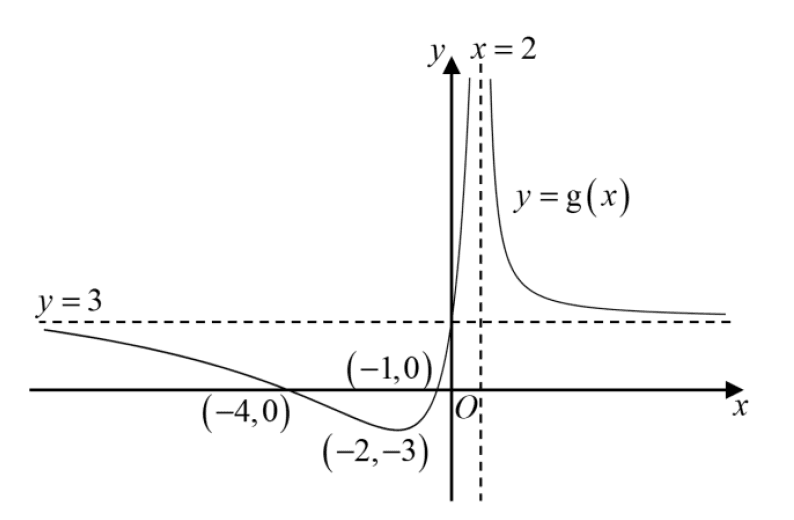
(i) Sketch the graph of \(y = \mathrm{g}'(x)\), labelling the coordinates of all relevant point(s) and state the equations of any asymptotes.
(ii) Find the area of the region bounded by the graph of \(y = \mathrm{g}'(x)\), the lines \(x = -4\), \(x = -2\) and the \(x\)-axis.
Show full worked solution▾
(a) Working backwards from the resulting curve \(y = ax^2 + \dfrac{b}{x}\):
- Reverse B (stretch \({\times 2}\) in \(x\), so replace \(x \to \tfrac{x}{2}\)): \(y = a\!\left(\tfrac{x}{2}\right)^2 + \dfrac{b}{x/2} = \dfrac{ax^2}{4} + \dfrac{2b}{x}\).
- Reverse A (reflect in \(x\)-axis, so replace \(y \to -y\)): \(y = -\dfrac{ax^2}{4} - \dfrac{2b}{x}\).
Therefore the equation of the resulting curve is \(y = -4x^2 + \dfrac{1}{x}\), and reversing the transformations:
- Reverse B: \(y = -x^2 + \dfrac{2}{x}\).
- Reverse A: \(y = x^2 - \dfrac{2}{x}\).
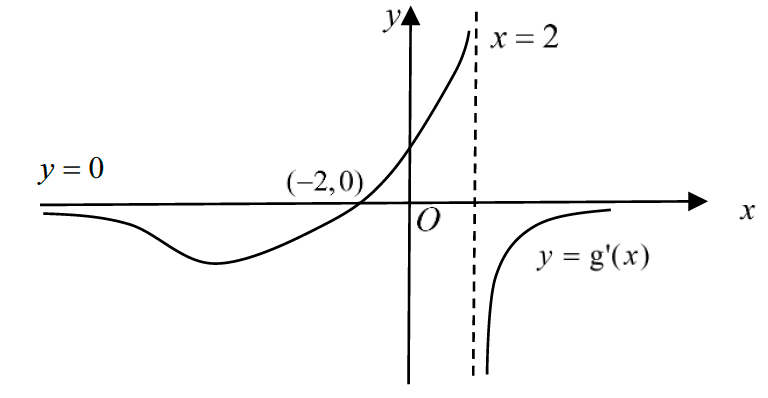
Asymptotes: \(y = 0\) (horizontal) and \(x = 2\) (vertical).
(b)(ii) On \(-4 \le x \le -2\), \(\mathrm{g}'(x) \le 0\) (the curve is decreasing). The required area is \[\begin{aligned} \text{Area} &= -\int_{-4}^{-2} \mathrm{g}'(x)\,\mathrm{d}x\\ &= -\bigl[\mathrm{g}(x)\bigr]_{-4}^{-2}\\ &= -[\mathrm{g}(-2) - \mathrm{g}(-4)]\\ &= -[-3 - 0] = 3. \end{aligned}\]