
Differentiation & Applications: Diff & application — VJC 2025 H2 Math Prelim Paper 2
What this question tests
Question
The following diagram shows the dimensions of a trapezoidal prism with fixed volume \(4k^3\sqrt{3}\) units\(^{3}\), with variables \(x\) and \(y\).
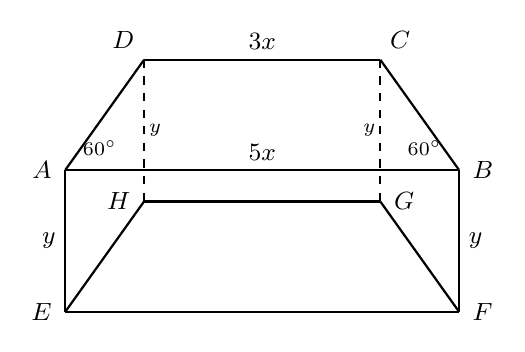
The top surface of the prism, \(ABCD\), is an isosceles trapezoid with \(AB\) of length \(5x\) units, \(DC\) of length \(3x\) units, \(AD = BC\) and \(\angle ABC = \angle BAD = 60^{\circ}\). The rectangular sides \(ABFE\) and \(BCGF\) are perpendicular to both the top surface \(ABCD\) and the bottom surface \(EFGH\), with \(AE = BF = DH = CG = y\) units.
- (a) Show that the total external surface area \(A\) of the trapezoidal prism is given by \(A = 8x^2\sqrt{3} + \dfrac{12k^3}{x}\).
- (b) Using differentiation, find the value of \(x\) in terms of \(k\) at which \(A\) is a minimum.
- (c) It is given instead that the volume of the prism is \(1000\) units\(^{3}\) and its external surface area is \(800\) units\(^{2}\). Find the two possible values of \(x\).
Show full worked solution▾
(a) Let the height of the isosceles trapezoid \(ABCD\) be \(h\), measured from \(AB\) to \(DC\).
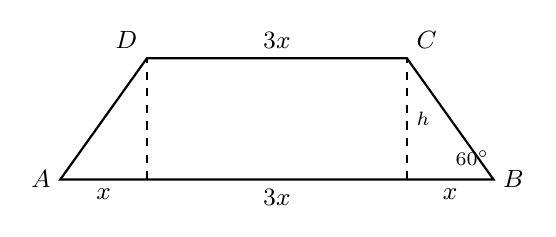
Then \(h = x\tan 60^{\circ} = x\sqrt{3}\) and \(BC = \dfrac{x}{\cos 60^{\circ}} = 2x\).
Volume of the prism: \(V = \dfrac{1}{2}(5x + 3x)(x\sqrt{3})\,y = 4\sqrt{3}\,x^2 y\). Setting \(V = 4k^3\sqrt{3}\) gives \(y = \dfrac{k^3}{x^2}\).
Total external surface area: \[\begin{aligned} A &= 2\cdot\dfrac{1}{2}(5x + 3x)(x\sqrt{3}) + 5xy + 3xy + 2(2xy)\\ &= 8\sqrt{3}\,x^2 + 12xy\\ &= 8\sqrt{3}\,x^2 + \dfrac{12k^3}{x} \quad \text{(shown)} \end{aligned}\]
(b) For minimum \(A\), \(\dfrac{\mathrm{d}A}{\mathrm{d}x} = 0\): \[\begin{aligned} 16\sqrt{3}\,x - \dfrac{12k^3}{x^2} &= 0\\ x^3 &= \dfrac{12k^3}{16\sqrt{3}} = \dfrac{k^3\sqrt{3}}{4}\\ x &= \left(\dfrac{k^3\sqrt{3}}{4}\right)^{\!1/3} \end{aligned}\]
Alternative (for 2nd derivative test)
At \(x = \left(\dfrac{\sqrt{3}}{4}k\right)^{\!\frac{1}{3}}\), \[ \frac{\mathrm{d}^2A}{\mathrm{d}x^2} = 16\sqrt{3} + \frac{24k}{\dfrac{\sqrt{3}k}{4}} = 48\sqrt{3} > 0. \]
Alternative (for 1st derivative test)
| \(x\) | \(0.75k^{\frac{1}{3}}\) | \(\left(\dfrac{\sqrt{3}}{4}k\right)^{\!\frac{1}{3}}\) | \(0.76k^{\frac{1}{3}}\) |
|---|---|---|---|
| \(\dfrac{\mathrm{d}A}{\mathrm{d}x}\) | \(-0.549k^{\frac{1}{3}}\) | \(0\) | \(0.286k^{\frac{1}{3}}\) |
| sign (since \(k > 0\)) | \(-\) | \(0\) | \(+\) |
| slope | \(\searrow\) | \(-\) | \(\nearrow\) |
(c) When \(V = 1000\), \(k^3 = \dfrac{1000}{4\sqrt{3}} = \dfrac{250}{\sqrt{3}}\). The surface area condition gives \[ 8\sqrt{3}\,x^2 + \dfrac{12}{x}\cdot\dfrac{250}{\sqrt{3}} = 800. \] From a graphing calculator, \(x = -8.5102\) (rejected since \(x > 0\)), \(x = 6.10\) or \(x = 2.41\).