
Arithmetic and geometric progressions: SAJC 2024 Promo Q5
What this question tests
Question
Find the range of values of in the interval such that the sum to infinity of the geometric series exists.
Hence find the range of values of for which the sum to infinity of the geometric series is greater than . [5]
The 5th, 9th and 11th terms of a geometric progression are also the 7th, 25th and 50th terms of an arithmetic progression with a non-zero common difference respectively.
Show that , where is the common ratio of the geometric progression and determine if the geometric progression is convergent. [5]
Show full worked solution▾
(a)
For the sum to infinity to exist, For the sum to infinity to be greater than , Since , therefore (final answer).
Alternatively, students can graph .
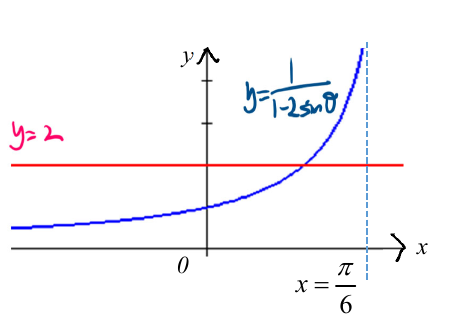
From the graph, .
(b)
Let denote the first term and be the common ratio of the geometric progression respectively.
Likewise, let and denote the first term and common difference of the arithmetic progression. Then Taking and : Dividing by : Solving for :
Taking the positive value (since ), For both values, , so the geometric progression is not convergent.
Alternatively, students can use GC to solve .
The 4 roots are , , , .
However we only need to consider real roots.
Hence or .
The solution’s upper endpoint has been corrected to π/6 (approximately 0.524 radians); the printed value 0.526 was inaccurate.
(a)sum to infinity exists for ; for
(b) or ; since , the progression is not convergent