
Free practice / Secondary 1 Maths
Sec 1 Maths: Functions & Linear Graphs: practice questions & worked solutions
Functions and graphs questions from real Singapore Secondary 1 examination papers, each with a full, step-by-step worked solution.
About this topic & key methods
Practise Cartesian coordinates, drawing and reading straight-line graphs, finding gradients and intercepts, and interpreting linear functions in context. Attempt each complete exam question on paper before opening its worked solution. For guided practice, see our Secondary 1 Maths tuition.
Use graph paper and the scales stated in each question. The on-screen grids resize to fit your device, so their physical centimetre sizes are not fixed.
Key methods
- Cartesian coordinates: read the horizontal coordinate first, then the vertical coordinate.
- Gradient of a straight line: . Use coordinate values, especially when the axes have different scales.
- Equation of a line: in , is the gradient and is the -intercept.
- Drawing a straight-line graph: calculate the table values, plot each point accurately and join them with a ruler.
- Horizontal and vertical lines: is horizontal with gradient ; is vertical and its gradient is undefined.
- Interpreting a linear function: the gradient is the rate of change and the vertical intercept is the value when the horizontal variable is zero.
Questions & worked solutions
Drawing and reading straight-line graphs
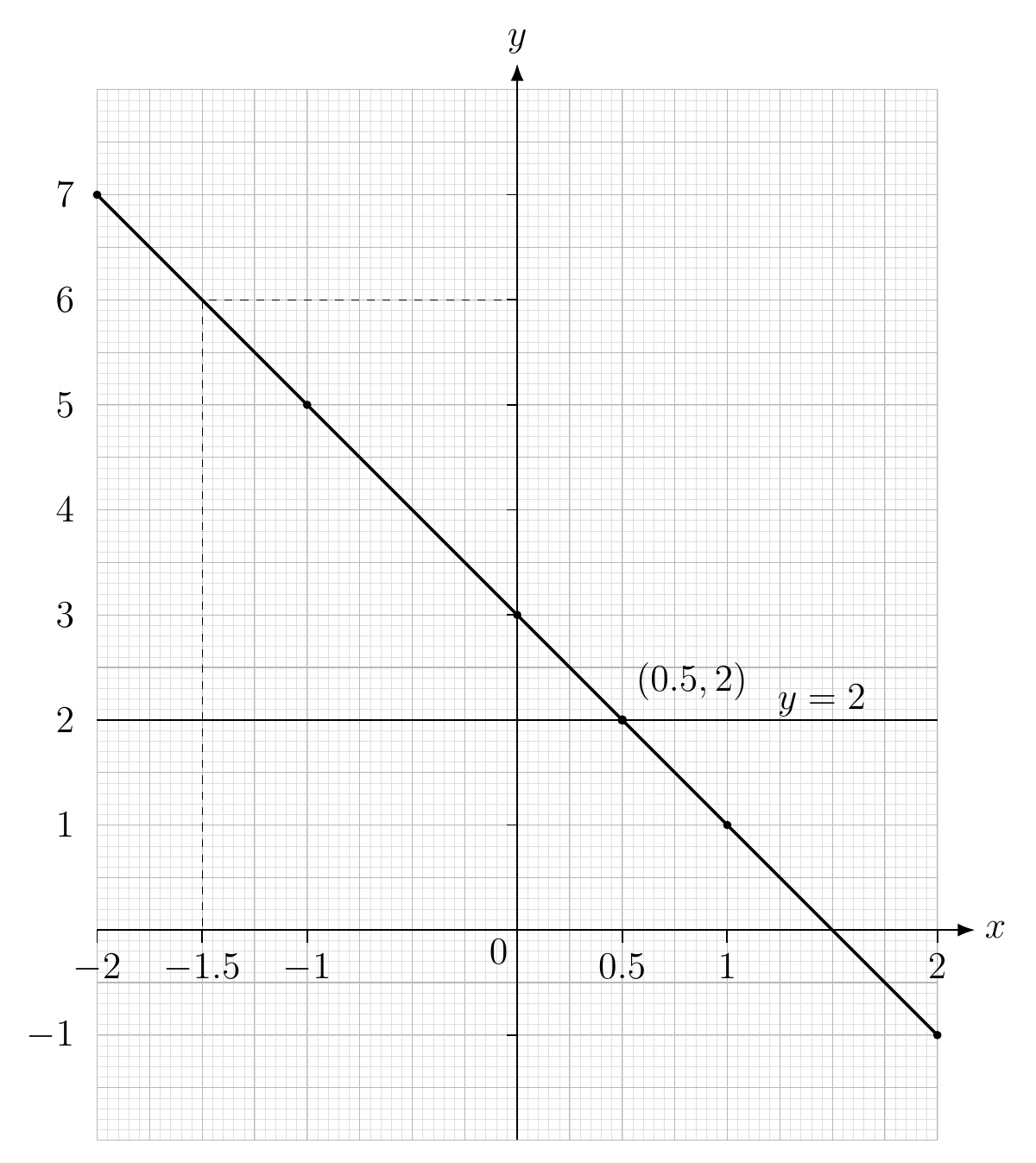
In the grid provided, line has been drawn.
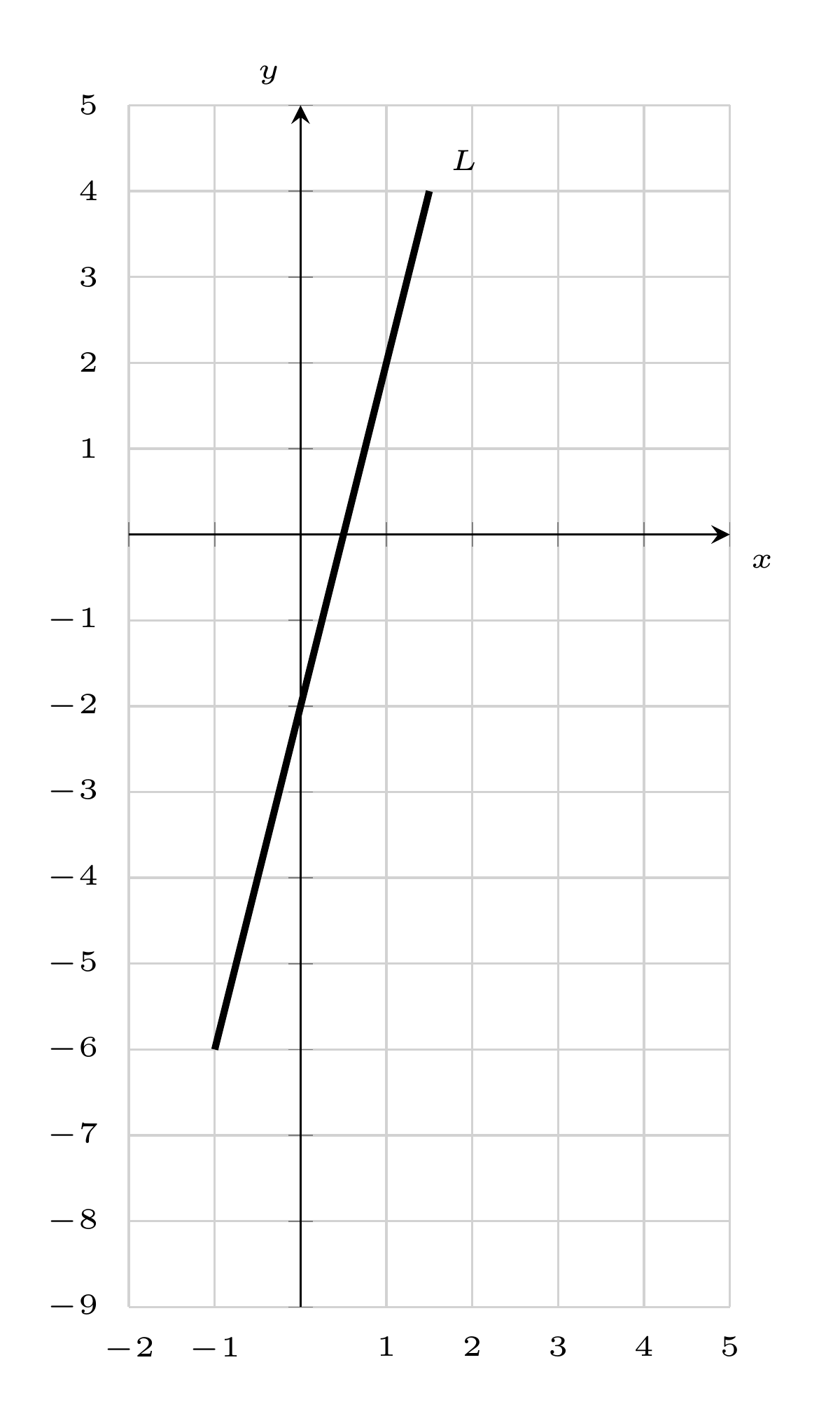
The equation of line is given as . State the value of .
The given table of values for another linear graph, .
Calculate the value of .
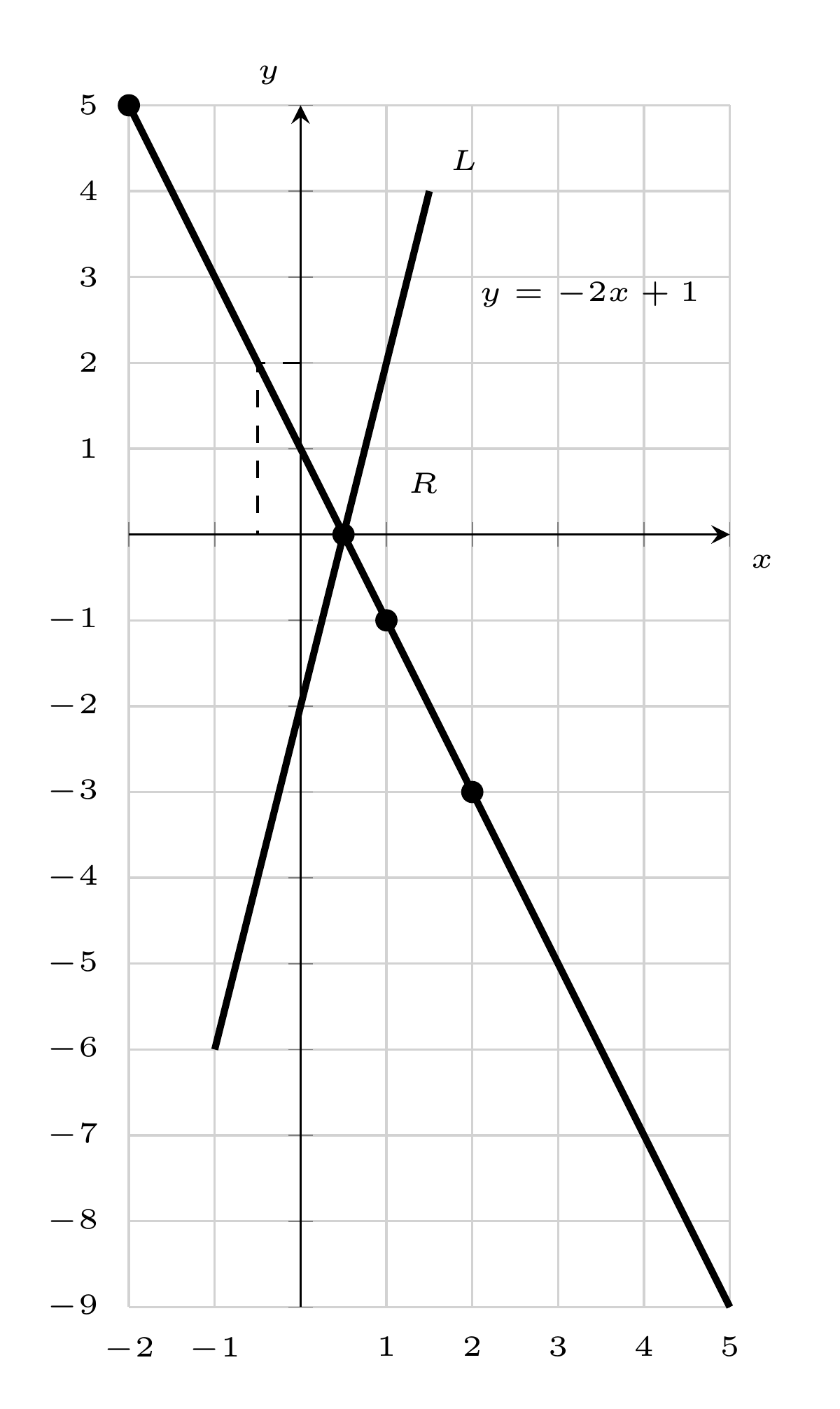
By plotting all the points in table, draw the graph of in the grid provided in the previous page.
Using your graph of , find the value of when .
The point lies on both and line . Label point on the graph and write down the coordinates of the point .
Show worked solution▾
(a) The vertical intercept
Line crosses the -axis at . At , , so and has equation .
(b) Complete the table
(c) Draw the line
Plot , and . Join them with a ruler to draw . The completed graph below shows the line through all three points.
(d) Read the value of x
Read across from to the descending line, then down to the -axis: . Check:
(e) Point of intersection
The two lines meet at . Check by equating their expressions for :
Finding the equation of a line from a table
Answer the whole of this question on a sheet of graph paper.
The values of and shown in the table below are related through a straight line.
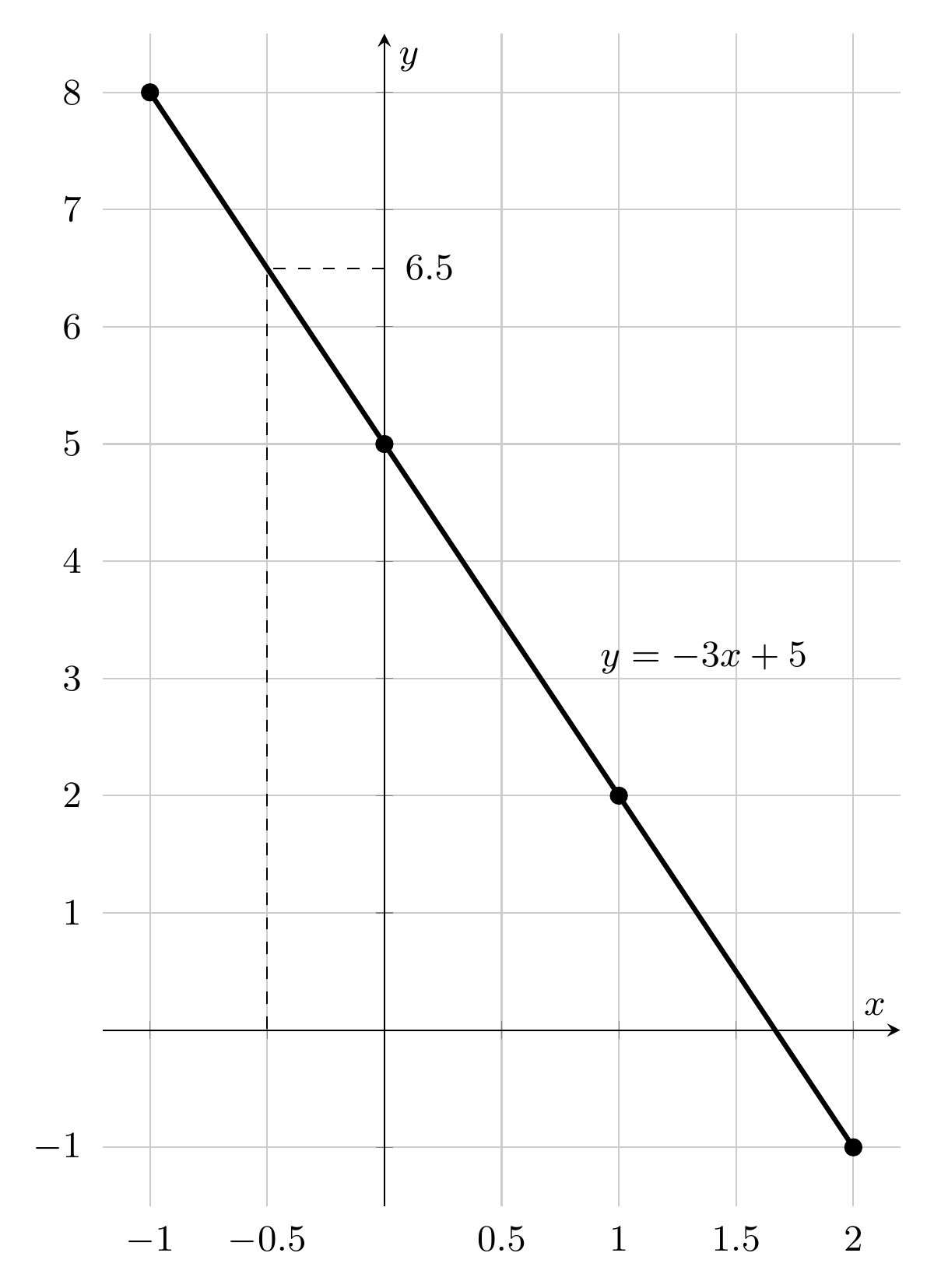
Using a scale of cm to unit on the -axis and cm to unit on the -axis, plot the points given in the table above and join them with a straight line.
The point lies on the graph. Use your graph to find the value of .
Using your graph, find the
gradient of the line,
equation of the line.
Show worked solution▾
(a) Plot the graph
Use the stated scales: one -unit occupies twice the length of one -unit. Plot , , and , then join them with a ruler.
(b) Read a value from the graph
At , the point on the line lies halfway between and vertically. Hence .
(c)(i) Gradient
Use two clear points on the graph, such as and :
(c)(ii) Equation
The graph crosses the -axis at . Substitute and into :
Check the reading in (b): .
Interpreting a decreasing linear function
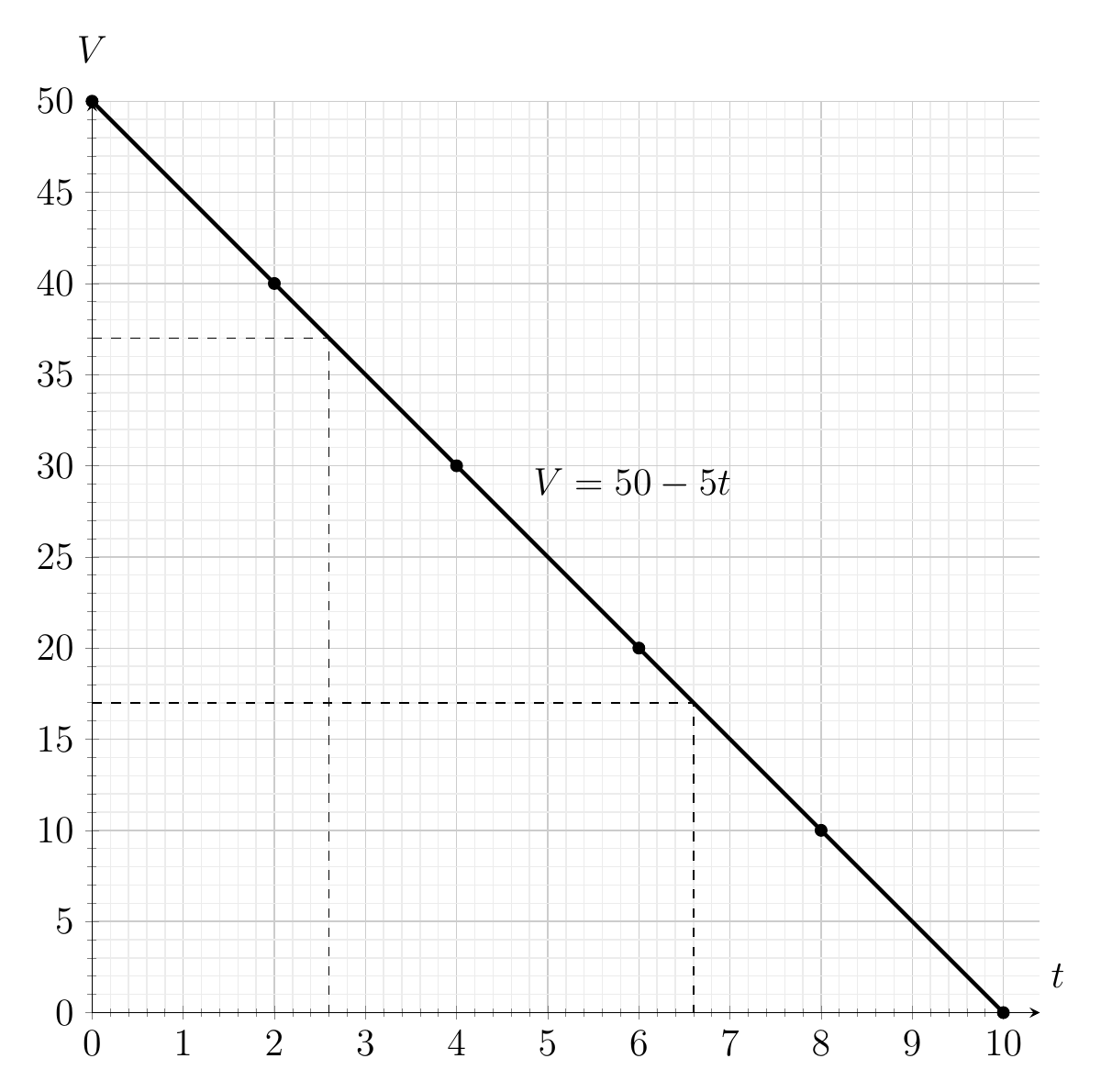
The volume cm, of an ice-cream at time minutes is given by for . Some corresponding values of and are given in the table below.
Calculate the value of .
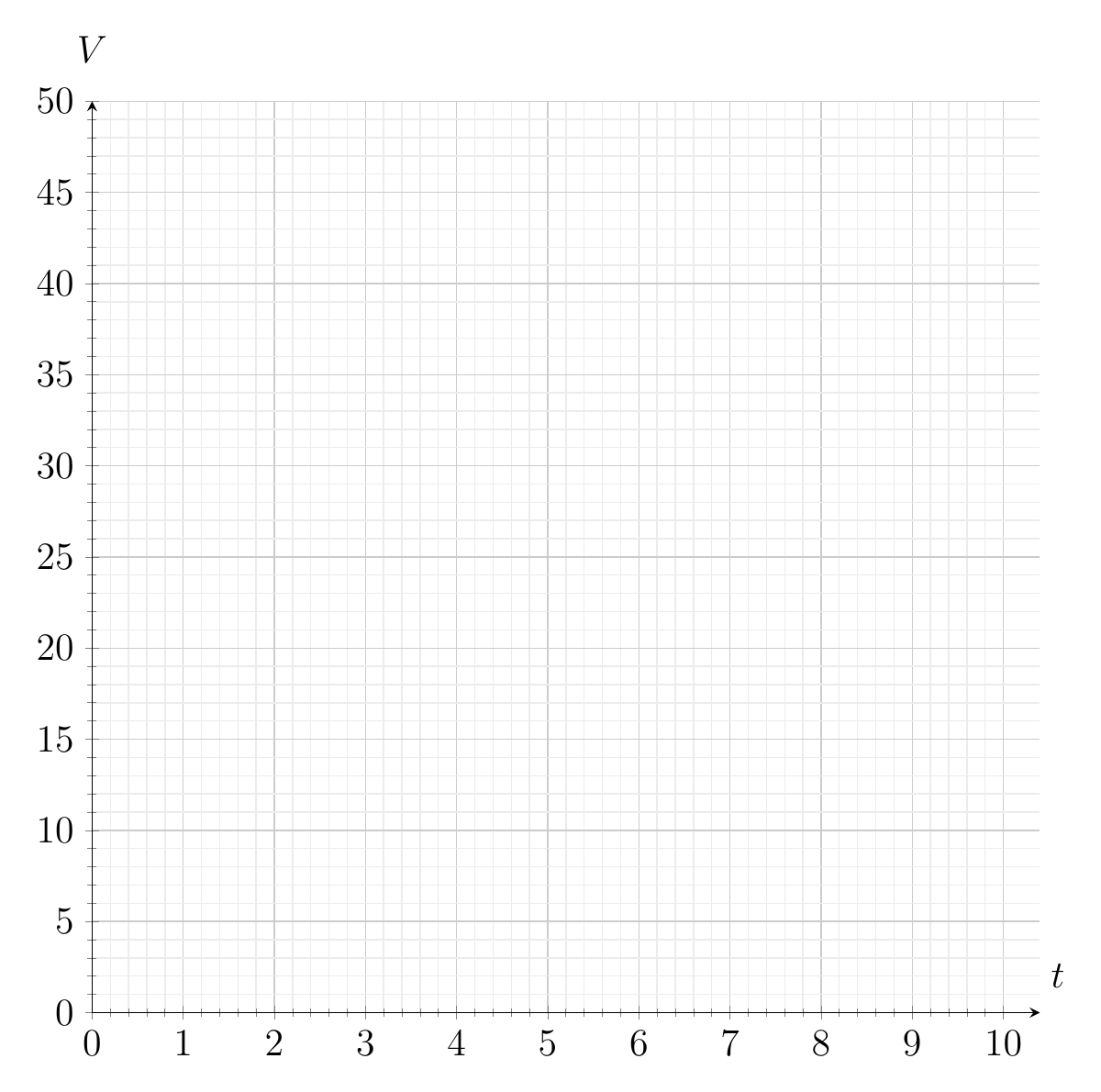
Using a scale of cm to represent unit, draw a horizontal -axis for . Using a scale of cm to represent units, draw a vertical -axis for . On your axes, plot the points given in the table and draw the line for .
State the gradient of the graph.
Using your graph,
find the volume of the ice cream after minutes,
find the time taken for the volume of the ice cream to be cm.
Explain the meaning of the constant term , in the equation .
Explain why the function is not a good representation of the volume of the ice cream after minutes.
Show worked solution▾
(a) Missing table value
(b) Draw the graph
Use the stated scales and plot , , , , and . Join them with a straight line, stopping at and .
(c) Gradient
(d)(i) Volume after 2.6 minutes
Read up from to the line, then across to the -axis: . Check: .
(d)(ii) Time when the volume is 17 cubic centimetres
Read across from to the line, then down to the -axis: minutes. Check:
(e) Meaning of 50
At , . The initial volume of the ice-cream is .
(f) Limitation of the function
At , the volume is zero. For , the formula gives a negative volume, which is physically impossible. The model therefore applies only to .
Gradient and fixed charge in a linear function
A company charges for units of electricity used.
The charge can be represented by the function , where is a constant.
Some corresponding values of and are given in the table below.
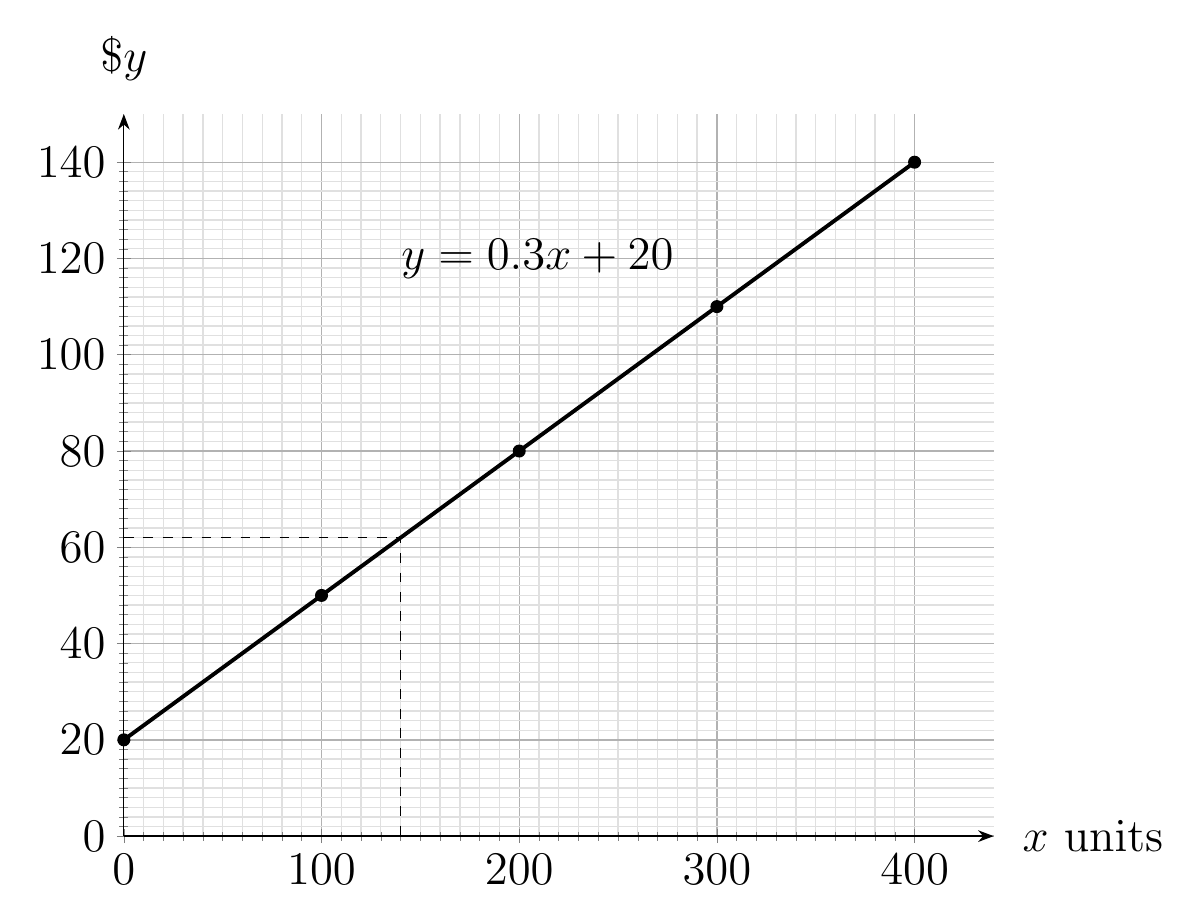
On the grid, draw the graph of for .
Find the total cost if a household uses units of electricity.
What does the constant term, , represent?
Find the value of .
What does the gradient of the graph represent in this context?
Show worked solution▾
(a) Draw the graph
Plot , , , and . Join the points with a ruler for .
(b) Cost for 140 units
Read up from to the line and across to the cost axis. The cost is . To check, the cost rises by per units, so each unit costs :
(c) Constant term
The represents the fixed charge of , payable even when no electricity is used.
(d) Value of u
Using the two points and :
(e) Meaning of the gradient
The gradient is the charge per unit of electricity: per unit, or cents per unit.
Intersection with a horizontal line
Answer the whole of this question on a sheet of graph paper.
The table below shows the corresponding and values for the equation:
Find the values of and .
Using a scale of cm to represent unit on the -axis and cm to represent unit on the -axis, draw the graph of for .
From the graph, find the value of when .
Draw the line and state its gradient.
Find the coordinates of the point where the two graphs intersect.
Show worked solution▾
(a) Complete the table
(b) Draw the graph
Using the stated scales, plot , , , and . Join these points with a straight line for .
(c) Read the value of x
Read across from to the line, then down to the -axis: . Check:
(d) Horizontal line
Draw a horizontal line through , labelled . Every point on this line has the same -coordinate, so the vertical change is zero and the gradient is .
(e) Point of intersection
The graphs meet at . Check by substituting :
Equation of a line y = mx + c
Find the gradient of the line .
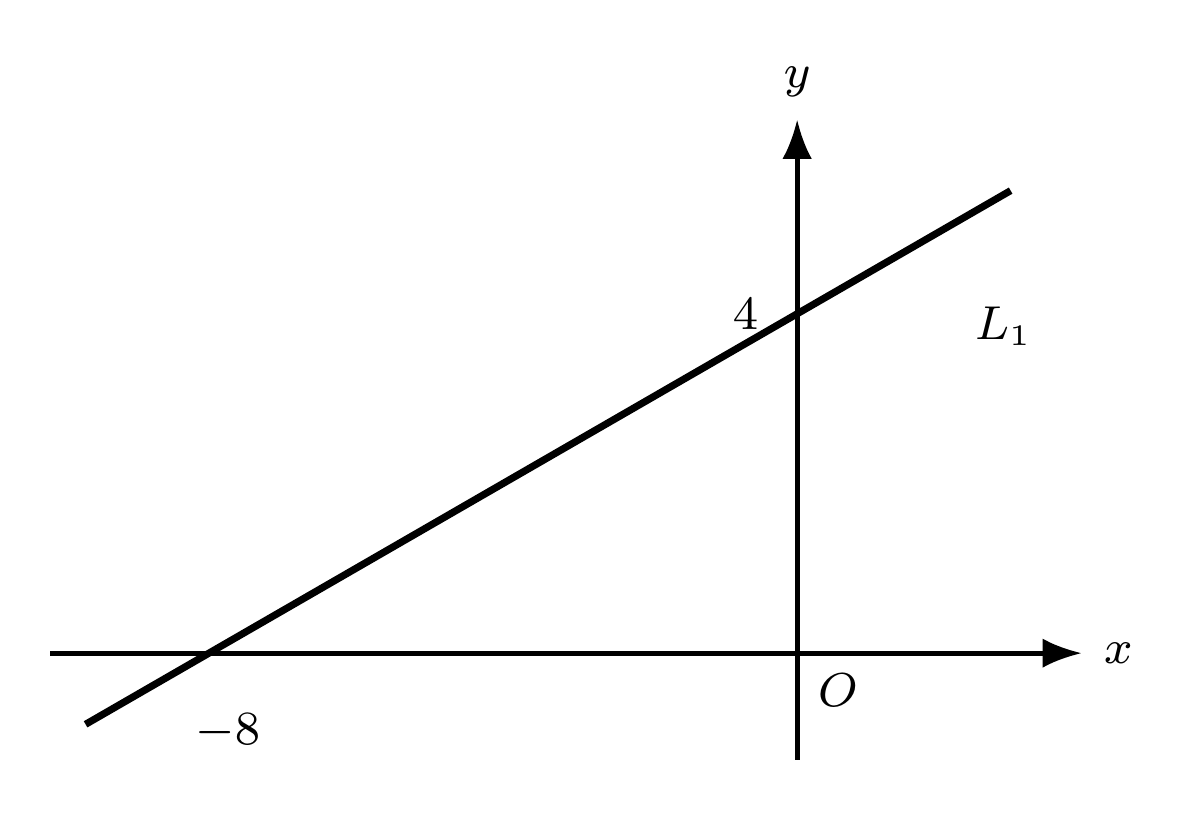
Hence state the equation of .
Show worked solution▾
(a) Gradient
The intercepts give two points on : and .
(b) Equation
The -intercept is . Substitute and into :
Check the other intercept: when , .
Vertical lines and a negative gradient
The diagram shows three points , and .
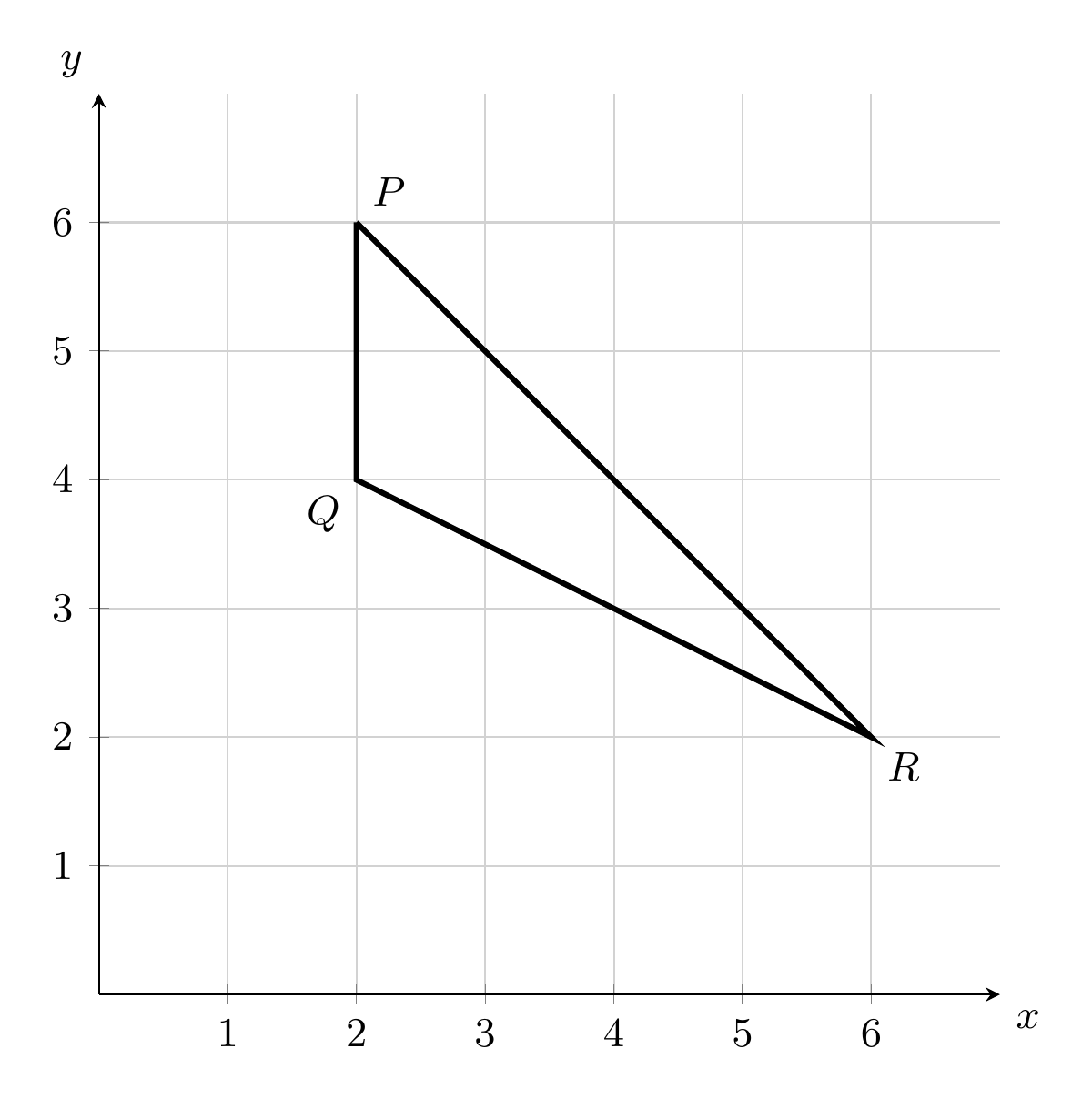
Write down the equation of line .
Find the gradient of line .
The line has an equation . A point lies on the line . Find the value of .
Show worked solution▾
(a) Equation of PQ
Both and have -coordinate . Thus is vertical and its equation is .
(b) Gradient of QR
(c) Point on PR
Substitute into :
Parallel lines and axial intercepts
is the point and the gradient of line is .
Find the equation of the line .
The equation of line is .
Explain why line does not intersect line .
Line passes through the -axis at point and -axis at point .
State the coordinates of
point ,
point .
Show worked solution▾
(a) Equation of AB
Since , the -intercept is . With gradient :
(b) Why the lines do not intersect
Write the equation of in the form :
Both lines have gradient , but their -intercepts are different ( and ). They are distinct parallel lines, so they do not intersect.
(c)(i) x-intercept
On the -axis, :
(c)(ii) y-intercept
On the -axis, :
Checking whether a point lies on a line
It is given that the equation of a line is .
State the -intercept of the line.
Does the line pass through the point ? Explain your answer.
Show worked solution▾
(a) y-intercept
At the -axis, . Hence , so the -intercept is .
(b) Test the point
Substitute the proposed -coordinate, , into the equation:
The corresponding -value is , which is not . Therefore the line does not pass through .
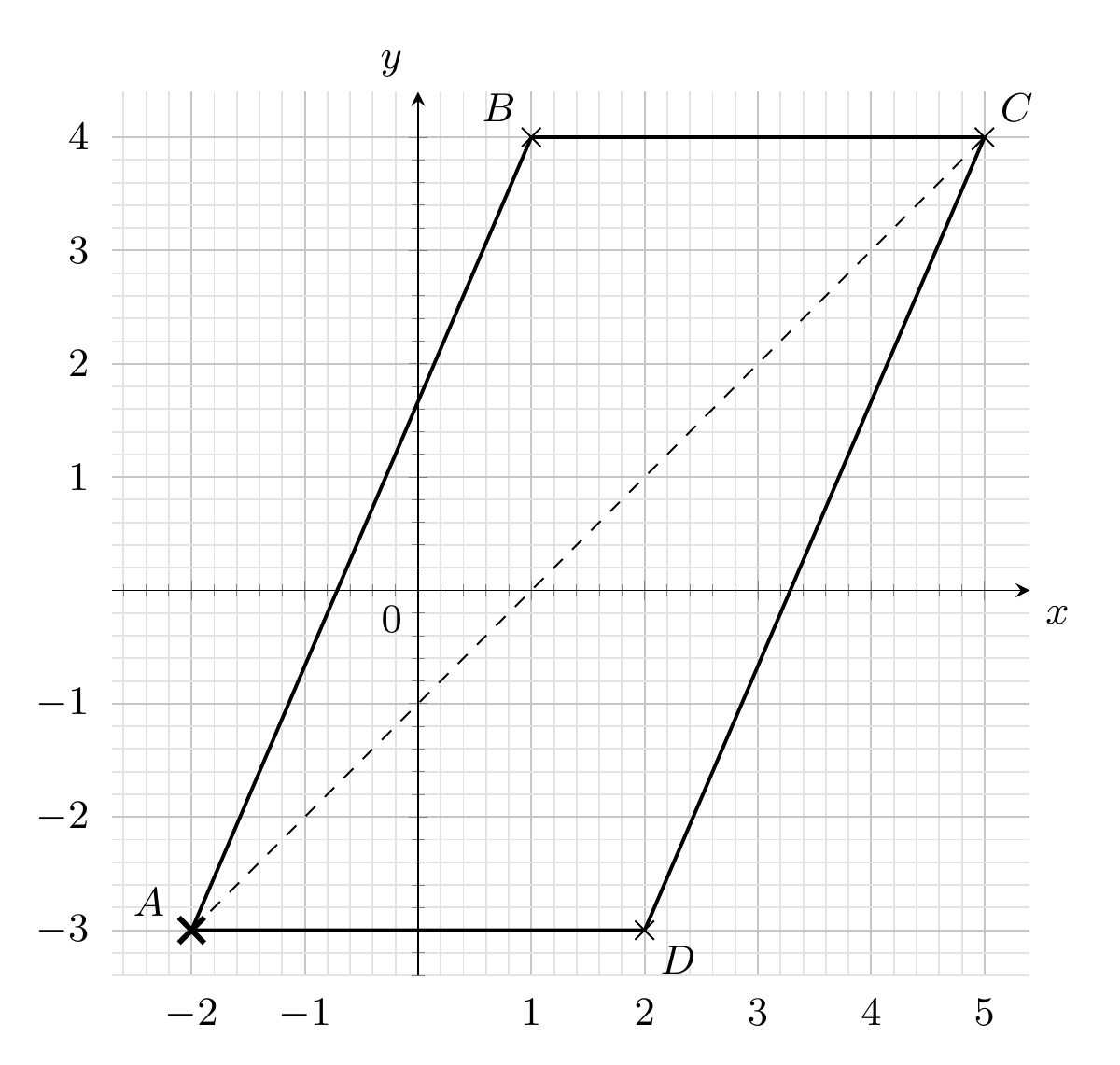
Cartesian coordinates and a parallelogram
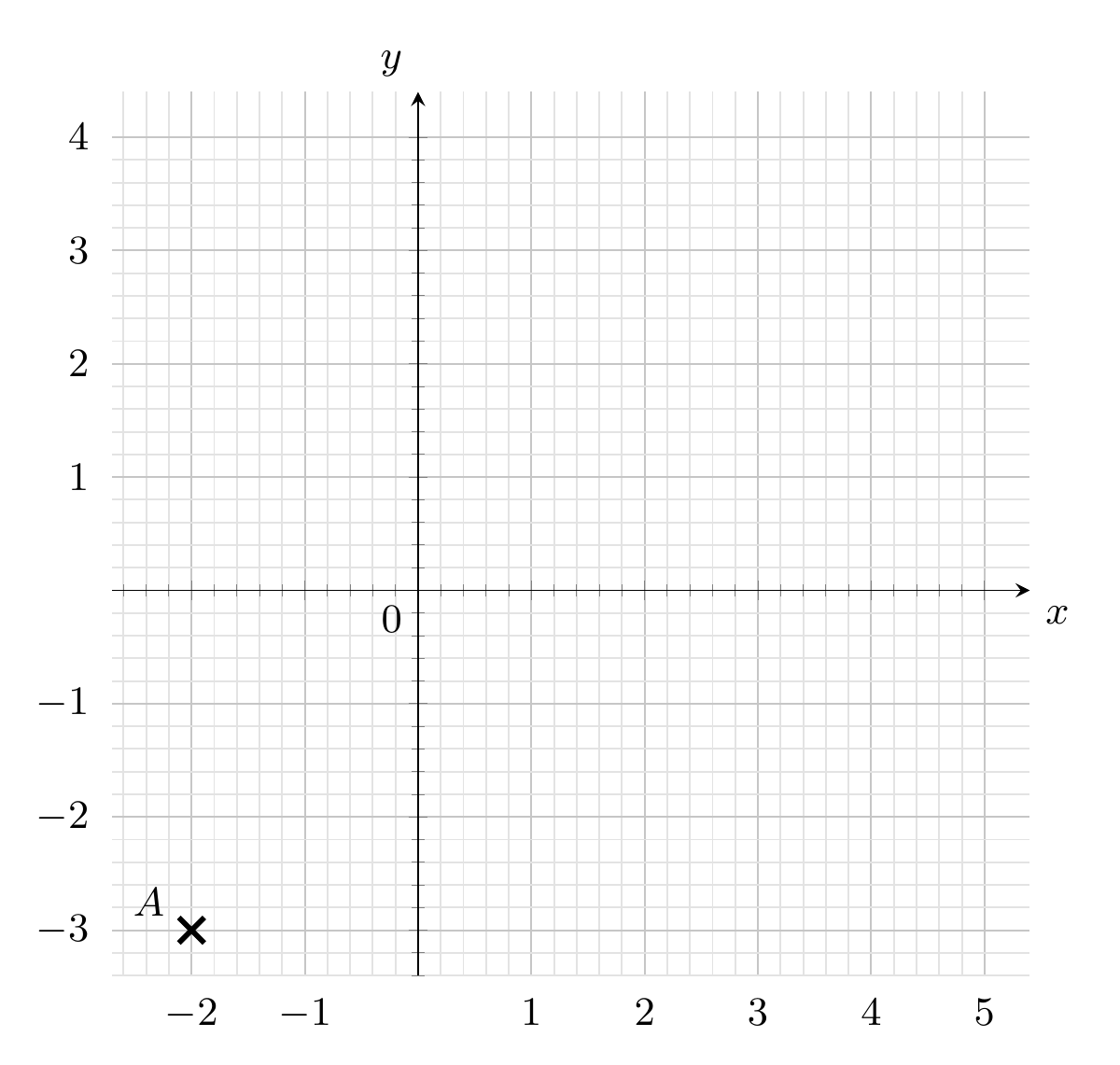
Write down the coordinates of point .
is the point and is the point . Write down the equation of line .
Calculate the area of triangle .
Find the coordinates of the point such that is a parallelogram.
Calculate the area of parallelogram .
Show worked solution▾
(a) Coordinates of A
Point is units left of the origin and units below it, so .
(b) Equation of BC
Both and have -coordinate . The horizontal line has equation .
(c) Area of triangle ABC
The base units. The perpendicular height from to the horizontal line is units.
(d) Coordinates of D
In parallelogram , the move from to is the same as the move from to : units right with no vertical change. Thus
(e) Area of the parallelogram
The base is units and the perpendicular height is units:
Coordinates, gradient and triangle area
and are points on the coordinate plane as shown.
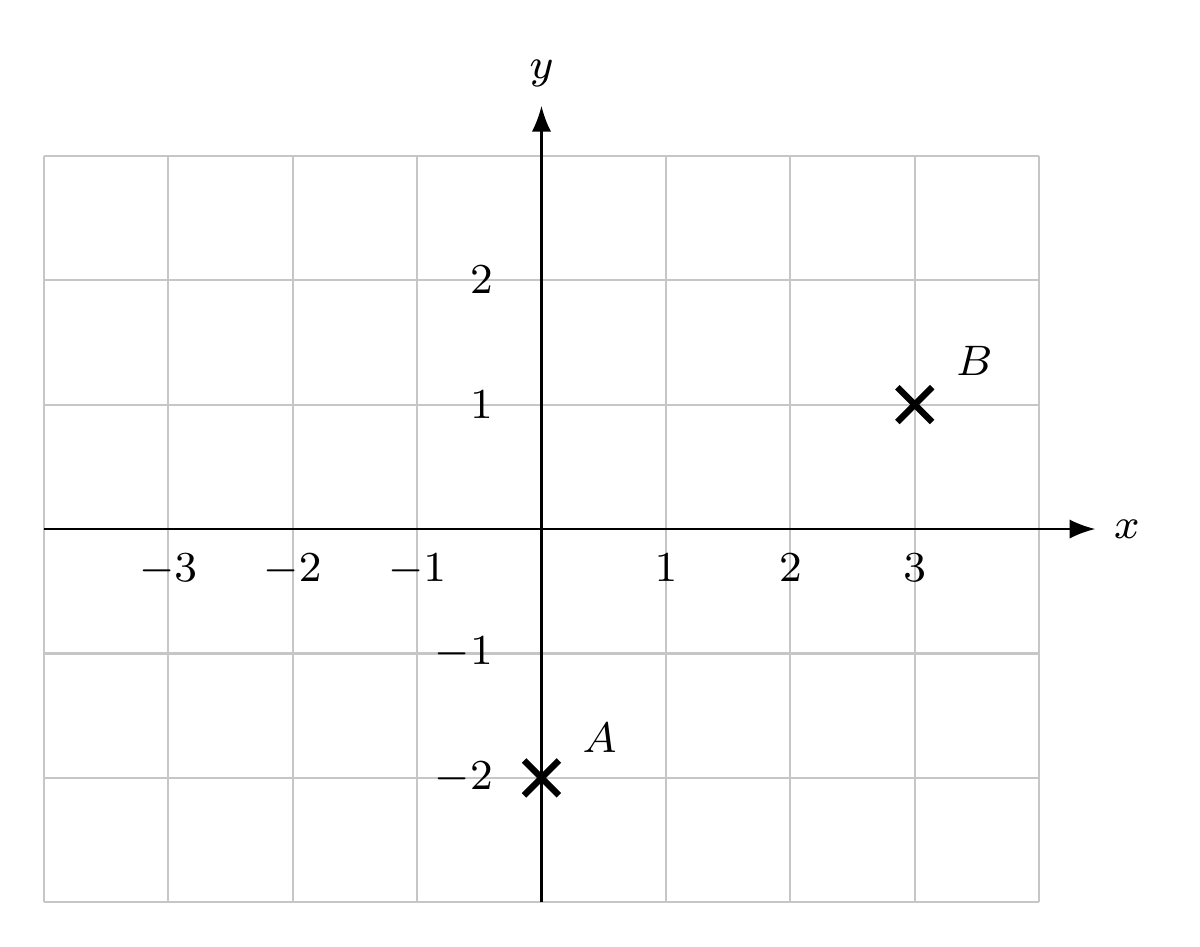
Write down the coordinates of point .
Find the gradient of line , given that .
Given that is a point on the coordinate plane such that the area of triangle is units, find the possible values of .
Show worked solution▾
(a) Coordinates of A
Point lies on the -axis, units below the origin. Hence .
(b) Gradient of AB
(c) Possible values of k
Both and lie on the horizontal line . Use as the base. The perpendicular height from to this line is units.
Point can be units to either side of . Therefore
Both positions give base and height , so both give area .
Linear equations and an isosceles triangle
Solutions to this question using accurate drawing will not be accepted.
State the gradient and the -intercept of the line .
Show that the point does not lie on the line .
The line intersects the -axis at . It is given that the coordinates of is , where and are positive real numbers. The area of isosceles triangle , where , is units. Find the value of and of .
Show worked solution▾
(i) Gradient and y-intercept
Divide every term by :
Hence the gradient is and the -intercept is .
(ii) Test the point (1,3)
When , the line has . Since , the point does not lie on the line.
(iii) Find h and k
The intercept is and , so units. Since , the perpendicular from to the base bisects . Thus is halfway up from to :
The perpendicular distance from to the vertical base is units, since . Use the triangle’s area:
Therefore and . These values were obtained by calculation, as required.