How to Choose a Maths Tuition Centre in Singapore: A Parent’s Checklist
By Mr Ian Ang, Math Academy (NUS, First Class Honours in Mathematics) · 30 October 2026
There are a great many maths tuition centres in Singapore, and most of their websites say similar things. This checklist is for parents of Secondary and JC students who want to compare centres on the points that actually affect their child: how big the class is, who really teaches it, what the materials are like, how progress is tracked, and what to watch out for. It applies to any centre, including ours.
- Ask for the class size and the name of the teacher who will actually teach your child.
- Look at a sample of the notes and worksheets, and check they follow your child’s current syllabus.
- Ask how progress is tracked and how often you will hear about it.
- Treat guaranteed grades, pressure to commit for a long period, and vague answers about who teaches as red flags.
Maths tuition centre checklist for parents
Use this table when you call or visit a centre. Each point is explained below.
| Check | What to ask | What a good answer sounds like |
|---|---|---|
| Class size | What is the maximum number of students in a class? | A specific number, and the class stays at or below it |
| Teacher | Who will teach my child, and will it be the same teacher every week? | A named teacher with a clear background in mathematics |
| Materials | Can I see a sample of your notes and worksheets? | Yes, and they match the current syllabus and level |
| Progress | How will I know whether my child is improving? | Marked work, regular tests, and a way to hear from the teacher |
| First lesson | What happens in the first lesson, and what if it is not a fit? | A clear answer, without pressure |
| Format | Is the class onsite, online, or both? | A format that suits your child’s age and travel time |
Class size: how many students per maths class
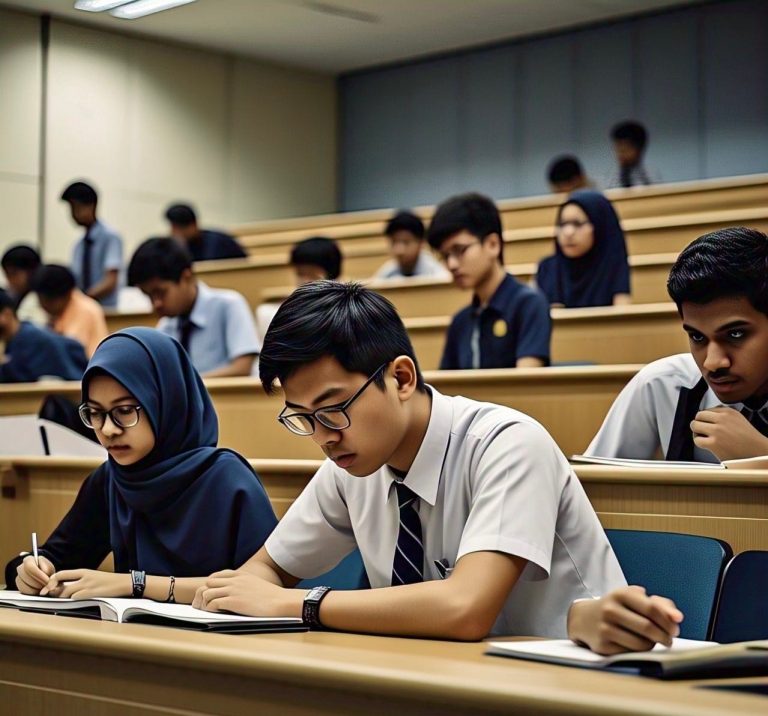
Class size decides how much of the lesson is about your child. In a small class the teacher can look at each student’s working, notice the same mistake twice, and ask a quiet student to explain a step. In a large class, most of the lesson is listening.
There is no official ideal number. What matters is that the centre gives you a real maximum and keeps to it. Ask whether classes are ever combined during busy periods, and whether a new student joins a class already part-way through a topic.
Who actually teaches the class
Many parents choose a centre because of one well-known teacher and later find their child is taught by someone else. Ask directly:
- Which teacher will take my child’s class, by name?
- What is their background in mathematics, and which levels do they usually teach?
- Will the same teacher take the class all year?
- Who covers when the teacher is away?
For upper secondary and JC especially, the teacher’s own command of the subject matters. A Maths and H2 Maths questions often need the teacher to spot, quickly, why a student’s method went wrong.
Notes, worksheets and teaching materials
Good materials save time in every lesson. Ask to see a sample and check three things:
- Do they follow the current syllabus? Secondary maths is now taught at G1, G2 and G3 levels under Full Subject-Based Banding, and from 2027 the O-Levels become the Singapore-Cambridge Secondary Education Certificate (SEC). JC students follow H2 Mathematics syllabus 9758. Materials should match your child’s level.
- Do they explain, or only drill? Look for worked examples that show why each step is taken, not only pages of practice.
- Are the questions at exam standard? Practice should include the kind of mixed questions students meet in school tests and national exams.
How the centre tracks your child’s progress
You should not have to guess whether tuition is working. Ask how written work is marked and returned, how often there are tests or timed practice, and how you will hear about progress. A centre that can show you your child’s marked scripts over a term is giving you something concrete to judge by.
Give it time. A term is a fairer test than a few lessons, especially if your child is rebuilding foundations from an earlier year.
Trial lesson or first lesson: what to look for
Whatever the centre calls it, the first lesson is your best evidence. Afterwards, ask your child:
- Did the teacher look at your working, or only at the board?
- Did you ask a question, and was it answered clearly?
- Did you learn something you could not do before?
- Would you be comfortable going back next week?
Ask the centre in advance what the first lesson involves and what happens if it is not a fit, so there are no surprises.
Onsite or online maths tuition: location and travel time
Travel time comes out of homework and sleep, so it deserves real weight. A centre near home or school is easier to keep up with for a whole year.
Online classes remove the travel, and many older students in Sec 3, Sec 4 and JC manage them well. Younger students often concentrate better in a room with the teacher. If you consider online lessons, ask how the teacher sees and marks students’ working.
Red flags when choosing a maths tuition centre
- Guaranteed results. No one can promise a grade. A centre that does is telling you something about how it sells, not how it teaches.
- Vague answers about who teaches. If you cannot find out who will be in the room, be careful.
- Pressure to commit quickly. Be wary of pressure to pay for a long period before your child has attended a lesson.
- Results without context. A list of top grades says little unless you know how many students the centre teaches and where they started.
- Classes that only repeat school homework. Help with homework has its place, but a good class should also teach and test.
- No feedback. If months pass and you have no idea how your child is doing, ask why.
Math Academy class sizes and teachers
So you can apply the checklist to us too, here are the facts. We offer maths tuition in Singapore for Secondary and JC students from our centre at 372 Bukit Batok Street 31 in Bukit Gombak.
- Sec 1 Maths and Sec 2 Maths: up to 7 students per class, 1.5 hours weekly, at our Bukit Gombak centre. Taught by our Lower Secondary team, Ms Raine Ang and Ms Jolyn Ang.
- Sec 3 and Sec 4 A Maths: up to 9 students per class, taught by co-founders Mr Ian Ang and Ms Jolyn Ang, onsite and online.
- JC H2 Maths: up to 9 students per class, taught by Mr Ian Ang (NUS, First Class Honours in Mathematics), onsite and online.
Whichever centre you choose, our free practice questions with worked solutions for Sec 1, Sec 2, Sec 3 A Maths, Sec 4 A Maths and JC1 H2 Maths are open to every student.
Frequently asked questions
What class size is good for maths tuition?
There is no official number. A class small enough for the teacher to check every student’s working during the lesson is a good test. Ask the centre for its maximum and whether it keeps to it.
How long before I know if a tuition centre is working?
Give it about a term. Look at marked work and test scripts over that period rather than one test result, especially if your child is rebuilding foundations.
Is online maths tuition as effective as onsite classes?
It depends on the student. Many older students in Sec 3, Sec 4 and JC do well online and save travel time. Younger students often focus better in person. Ask how the teacher sees and marks working online.
Should I trust a centre that guarantees an A?
Be cautious. No centre can guarantee a grade, because results depend on the student’s starting point and work as well as the teaching.
Choosing a maths tuition centre: the short version
Ask for the class size and the teacher’s name, look at the materials, find out how progress is tracked, and judge the first lesson by what your child learned. Walk away from guarantees and pressure. A centre that answers these questions plainly is easier to trust, and a few phone calls with this checklist will tell you a lot.