
Arithmetic & Geometric Progressions: AP/GP connection: max sum & convergence — SAJC 2025 H2 Math Prelim Paper 1
What this question tests
Question
An arithmetic progression has first term \(a\) and common difference \(d\), where \(a\) and \(d\) are non-zero. The 3rd, 9th and 11th terms of the arithmetic progression are three distinct consecutive terms of a geometric progression.
(a) Find \(d\) in terms of \(a\).
(b) Let the sum of the first \(n\) terms of the arithmetic progression be \(S_n\) where \(S_1 = 143\). Find the largest possible value of \(S_n\).
The first term of the geometric progression is \(b\), where \(b\) is positive.
(c) Determine whether the geometric series is convergent.
(d) Show that the sum of all terms after the \(n^{\text{th}}\) term of the geometric progression is at most \(\dfrac{1}{2}b\), where \(n\) is a positive integer.
Show full worked solution▾
(a) Let the AP have first term \(a\) and common difference \(d\). The 3rd, 5th, 9th terms form a GP: \[ \frac{a+8d}{a+2d} = \frac{a+10d}{a+8d} \] \[ (a+8d)^2 = (a+2d)(a+10d) \] \[ a^2 + 16ad + 64d^2 = a^2 + 12ad + 20d^2 \] \[ 4ad + 44d^2 = 0 \implies 4d(a+11d) = 0 \] \[ d = 0 \quad\text{(reject, since terms of AP and GP are distinct)} \qquad\text{or}\qquad a + 11d = 0 \]
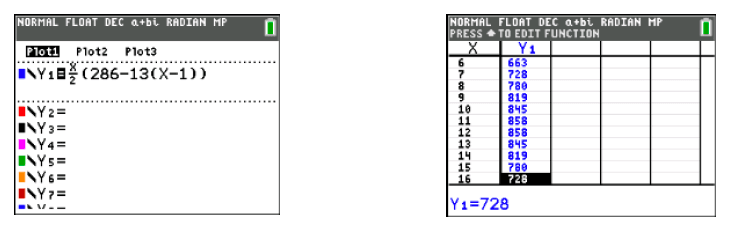
(b) \[ S_1 = a = 143,\qquad d = -\frac{1}{11}(143) = -13 \] \[ S_n = \frac{n}{2}\bigl[2a+(n-1)d\bigr] = \frac{n}{2}\bigl[286 - 13(n-1)\bigr] \] From GC, largest \(S_n\):
(c) Using \(a = -11d\): \[ r = \frac{a+8d}{a+2d} = \frac{-11d+8d}{-11d+2d} = \frac{-3d}{-9d} = \frac{1}{3} \]
(d) Let \(u_n\) be the \(n\)-th term of the geometric progression. \[\begin{aligned} u_{n+1} + u_{n+2} + \cdots &= S_\infty - S_n\\ &= \frac{b}{1-r} - \frac{b(1-r^n)}{1-r}\\ &= \frac{br^n}{1-r}\\ &= \frac{b\!\left(\dfrac{1}{3}\right)^{\!n}}{1-\dfrac{1}{3}} = \frac{3}{2}\cdot b\cdot\left(\frac{1}{3}\right)^{\!n}\\ &= \frac{b}{2}\cdot\left(\frac{1}{3}\right)^{\!n-1} \end{aligned}\]