
Applications of Integration: Area (trig sub); vol. \(y\)-axis — ASRJC 2025 H2 Math Prelim Paper 1
What this question tests
Question
Curve \(C\) is a circle with radius 2 and centre at the origin with equation \(x^2+y^2=4\). Line \(L\) has the equation \(\sqrt{3}\,y = x+2\). The diagram below shows the shaded region \(A\) which is enclosed between \(C\) and \(L\).
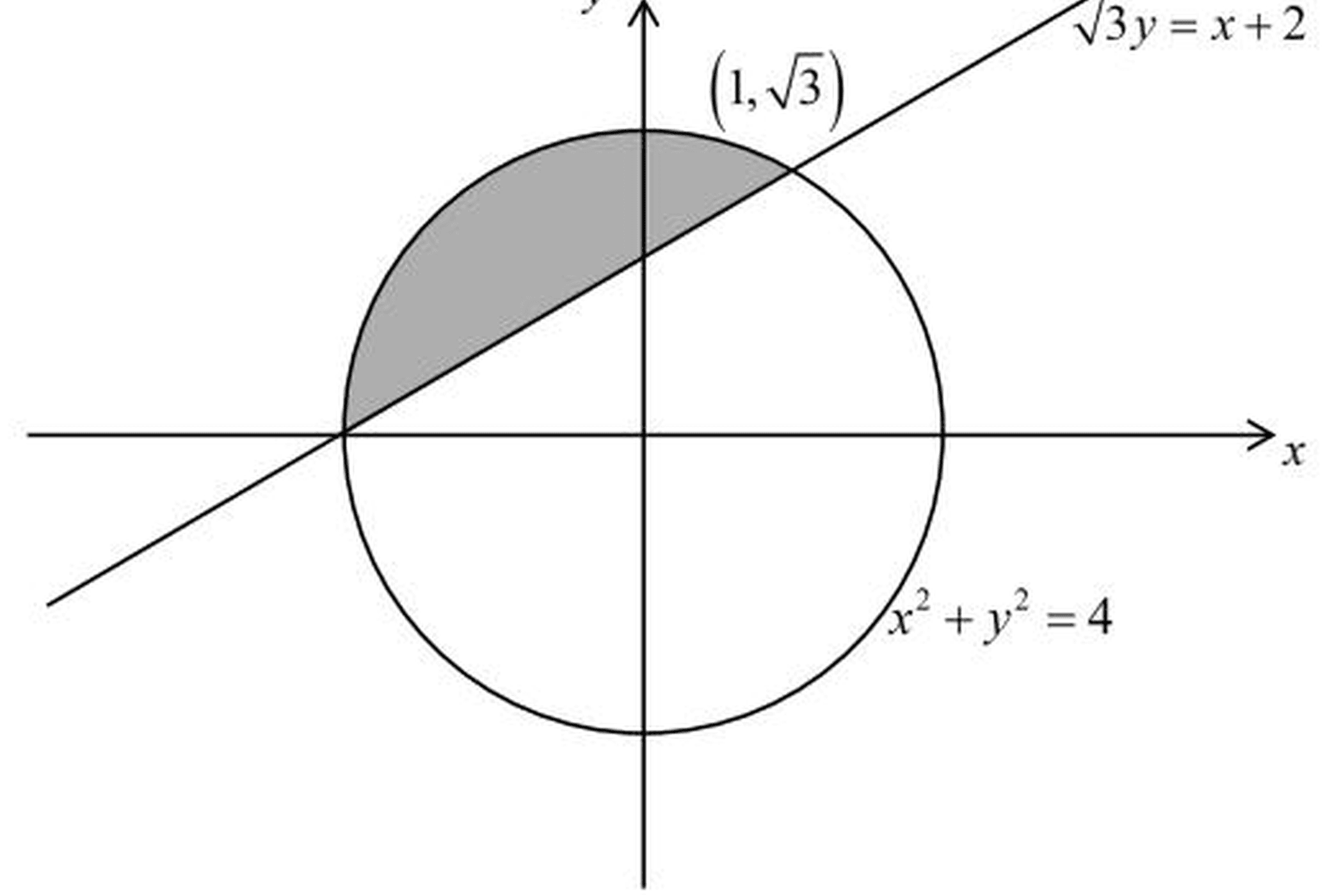
- Use the substitution \(x = 2\sin\theta\) to show that the area of region \(A\) can be written in the expression \(\displaystyle\int_b^a 4\cos^2\theta\;\mathrm{d}\theta - c\), where \(a\), \(b\) and \(c\) are exact constants to be determined. Hence evaluate this area exactly.
- The region \(B\) is bounded by the curve \(C\), the line \(L\) and the line \(x=2\). Find the volume generated when region \(B\) is rotated through \(2\pi\) radians about the \(y\)-axis. Give your answer to two decimal places.
Show full worked solution▾
(a) Area of region \(A\).
The circle \(x^2 + y^2 = 4\) and line \(\sqrt{3}\,y = x + 2\) intersect at \(x = -2\) and \(x = 1\).
Area of region \(A = \displaystyle\int_{-2}^{1}\sqrt{4 - x^2}\;\mathrm{d}x - \text{area of triangle}\)
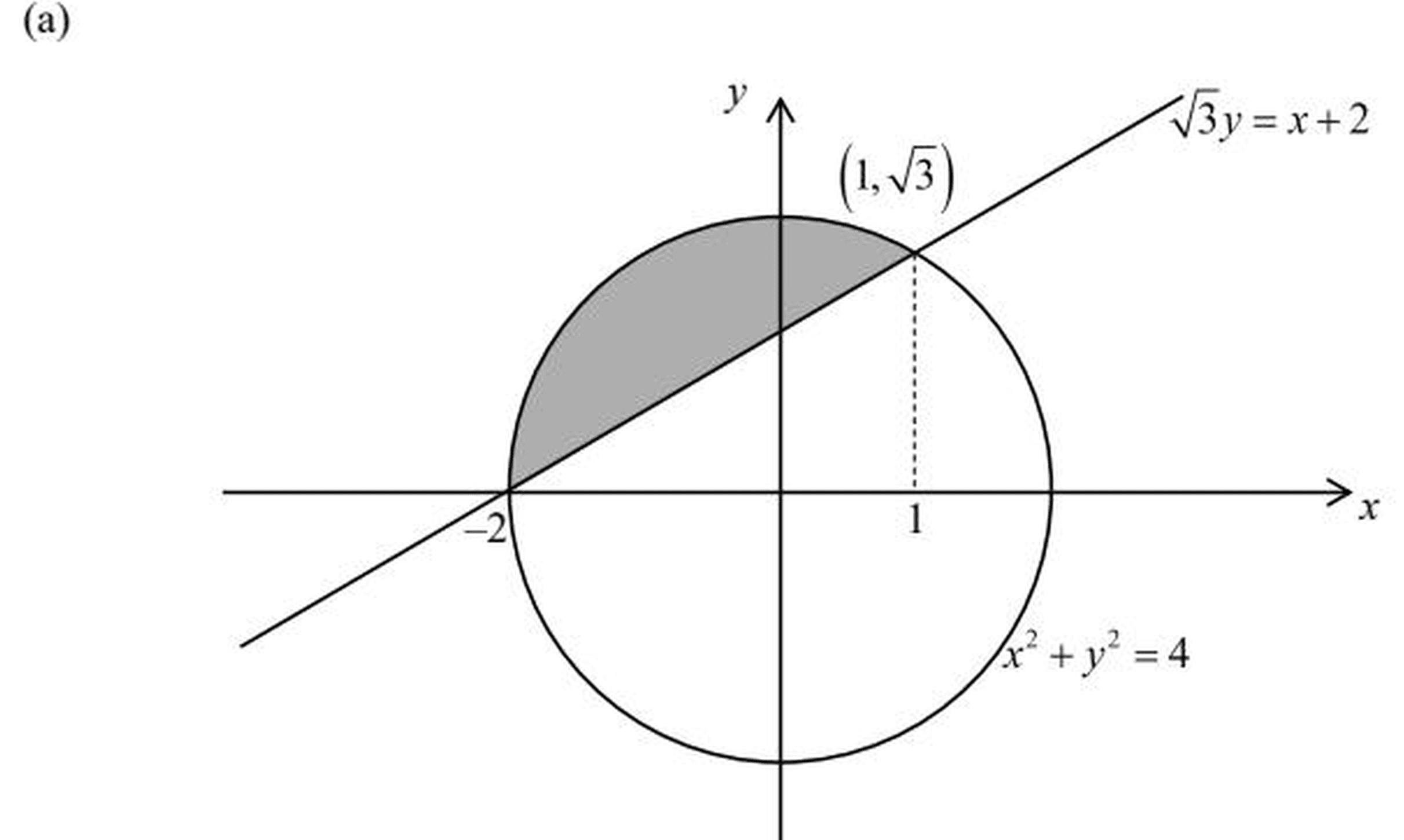
Using \(x = 2\sin\theta\), \(\dfrac{\mathrm{d}x}{\mathrm{d}\theta} = 2\cos\theta\): \[ x = 1 \implies \theta = \sin^{-1}\!\left(\tfrac{1}{2}\right) = \frac{\pi}{6}, \quad x = -2 \implies \theta = \sin^{-1}(-1) = -\frac{\pi}{2} \]
Area of triangle with vertices \((-2,0)\), \((0,0)\), \((1,\sqrt{3})\) \(= \tfrac{1}{2}(3)(\sqrt{3}) = \dfrac{3\sqrt{3}}{2}\).
\[\begin{aligned} A &= \int_{-\pi/2}^{\pi/6}\sqrt{4 - 4\sin^2\theta}\cdot 2\cos\theta\;\mathrm{d}\theta - \frac{3\sqrt{3}}{2} = \int_{-\pi/2}^{\pi/6}4\cos^2\theta\;\mathrm{d}\theta - \frac{3\sqrt{3}}{2} \end{aligned}\]So \(a = \dfrac{\pi}{6}\), \(b = -\dfrac{\pi}{2}\), \(c = \dfrac{3\sqrt{3}}{2}\). (shown)
\[\begin{aligned} 4\int_{-\pi/2}^{\pi/6}\cos^2\theta\;\mathrm{d}\theta &= 2\int_{-\pi/2}^{\pi/6}(\cos 2\theta + 1)\;\mathrm{d}\theta\\ &= 2\left[\frac{\sin 2\theta}{2} + \theta\right]_{-\pi/2}^{\pi/6}\\ &= 2\!\left[\left(\frac{\sqrt{3}}{4} + \frac{\pi}{6}\right) - \left(\frac{1}{2}\sin(-\pi) - \frac{\pi}{2}\right)\right]\\ &= 2\!\left(\frac{\sqrt{3}}{4} + \frac{\pi}{6} + \frac{\pi}{2}\right)\\ &= \frac{\sqrt{3}}{2} + \frac{\pi}{3} + \pi\\ & = \frac{\sqrt{3}}{2} + \frac{4\pi}{3} \end{aligned}\] \[\begin{aligned} A &= \frac{\sqrt{3}}{2} + \frac{4\pi}{3} - \frac{3\sqrt{3}}{2} = \frac{4\pi}{3} - \sqrt{3} \end{aligned}\](b) Volume of region \(B\) rotated about the \(y\)-axis.
Region \(B\) is bounded by \(C\), \(L\) and \(x=2\). The diagram for part (b):
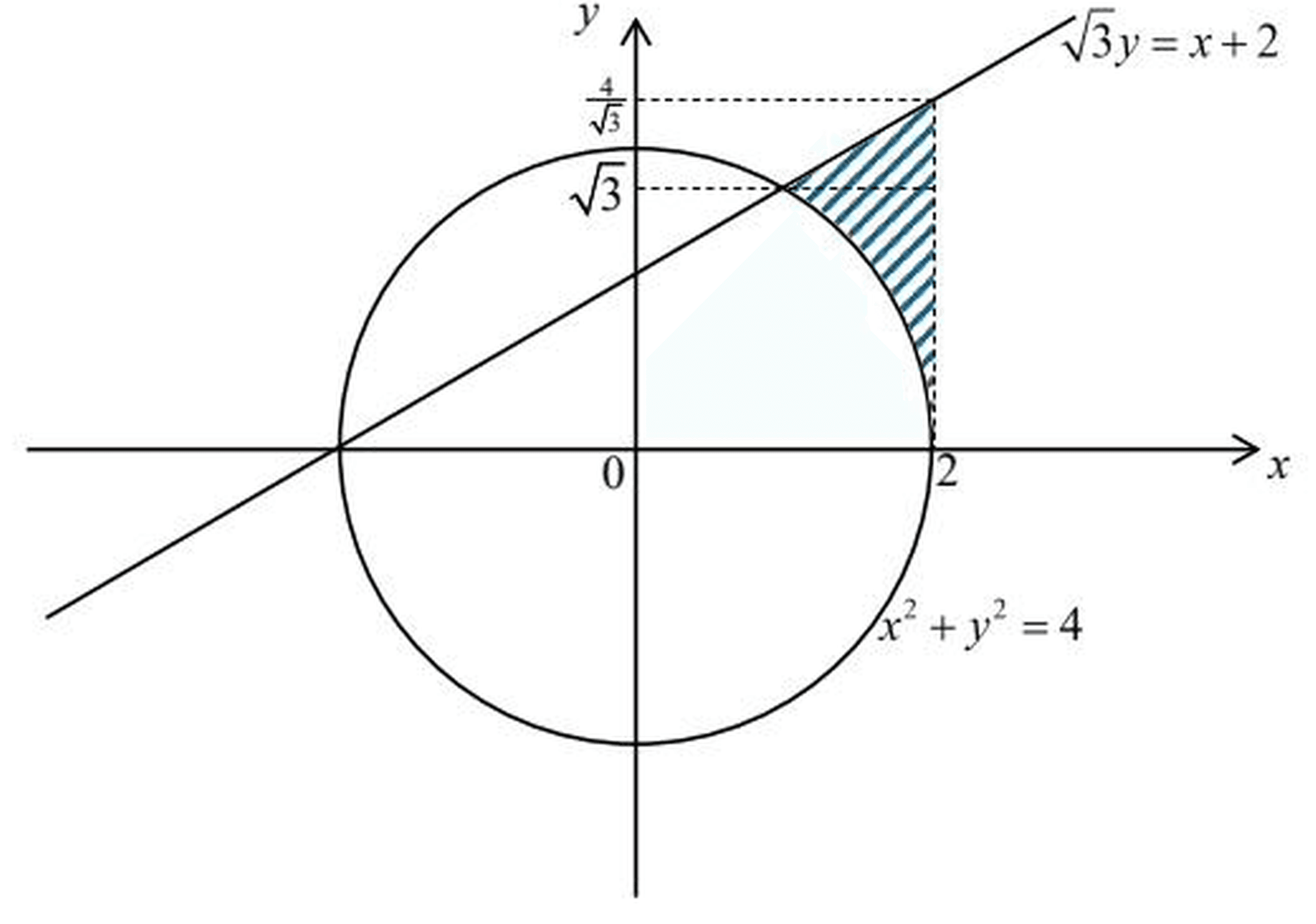
Volume = volume of cylinder \(- \displaystyle\pi\int_{\sqrt{3}}^{4/\sqrt{3}}\!(\sqrt{3}\,y-2)^2\;\mathrm{d}y - \pi\int_0^{\sqrt{3}}\!(4-y^2)\;\mathrm{d}y\)
\[ = \pi(2)^2\!\left(\frac{4}{\sqrt{3}}\right) - \pi\int_{\sqrt{3}}^{4/\sqrt{3}}\!(\sqrt{3}\,y-2)^2\;\mathrm{d}y - \pi\int_0^{\sqrt{3}}\!(4-y^2)\;\mathrm{d}y \approx 8.46 \text{ (2 d.p.)} \]