
Applications of Integration: Substitution; area; vol. \(x\)-axis — RI 2025 H2 Math Prelim Paper 1
What this question tests
Question
- Using the substitution \(u = \sqrt{2x-1}\), show that \(\displaystyle\int \frac{x}{\sqrt{2x-1}}\,\mathrm{d}x = \int \frac{u^2+1}{2}\,\mathrm{d}u\).
- The diagram below shows the graph of \(y = 2 - \dfrac{x}{\sqrt{2x-1}}\).
Indicate on the same diagram in the Printed Answer Booklet, the equation of the asymptote
of the curve and the coordinates of its turning point and points of intersection with
the \(x\)-axis.
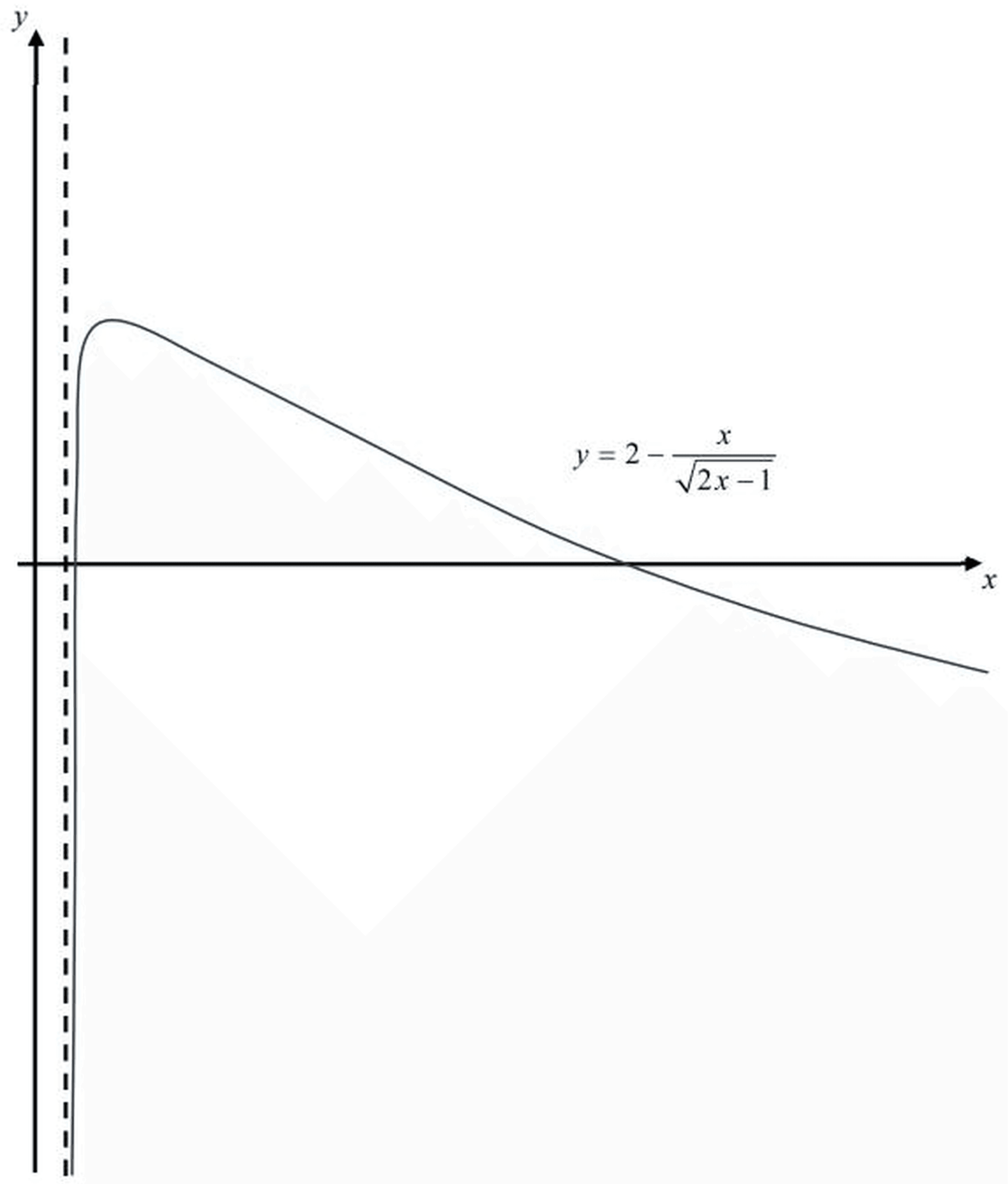
- The region \(R\) is bounded by the curve \(y = 2 - \dfrac{x}{\sqrt{2x-1}}\) and the lines \(x = 1\), \(x = 3\) and \(y = \dfrac{1}{2}\). Find the exact area of \(R\).
- The region \(S\) is bounded by the curves \(y = 2 - \dfrac{x}{\sqrt{2x-1}}\), \(x = 2(y-1)^2 + 1\), the lines \(x = 1\), \(x = 4\) and the \(x\)-axis.
- Express \(x = 2(y-1)^2 + 1\) in the form \(y = \mathrm{f}(x)\).
- On the same diagram as in part (b)(i), sketch the graph of \(x = 2(y-1)^2 + 1\).
- Find the volume of the solid generated when \(S\) is rotated through \(2\pi\) radians about the \(x\)-axis. Give your answer correct to 3 decimal places.
Show full worked solution▾
(a) Let \(u = \sqrt{2x-1}\), so \(u^2 = 2x-1\) and \(u\,\dfrac{\mathrm{d}u}{\mathrm{d}x} = 1\), i.e. \(\dfrac{\mathrm{d}x}{\mathrm{d}u} = u\).
Also \(x = \dfrac{u^2+1}{2}\), so: \[ \int\frac{x}{\sqrt{2x-1}}\,\mathrm{d}x = \int\frac{\,\tfrac{u^2+1}{2}\,}{u}\cdot u\,\mathrm{d}u = \int\frac{u^2+1}{2}\,\mathrm{d}u. \]
(b)(i) The annotated graph of \(y = 2 - \dfrac{x}{\sqrt{2x-1}}\) with asymptote, turning point, and intercepts:
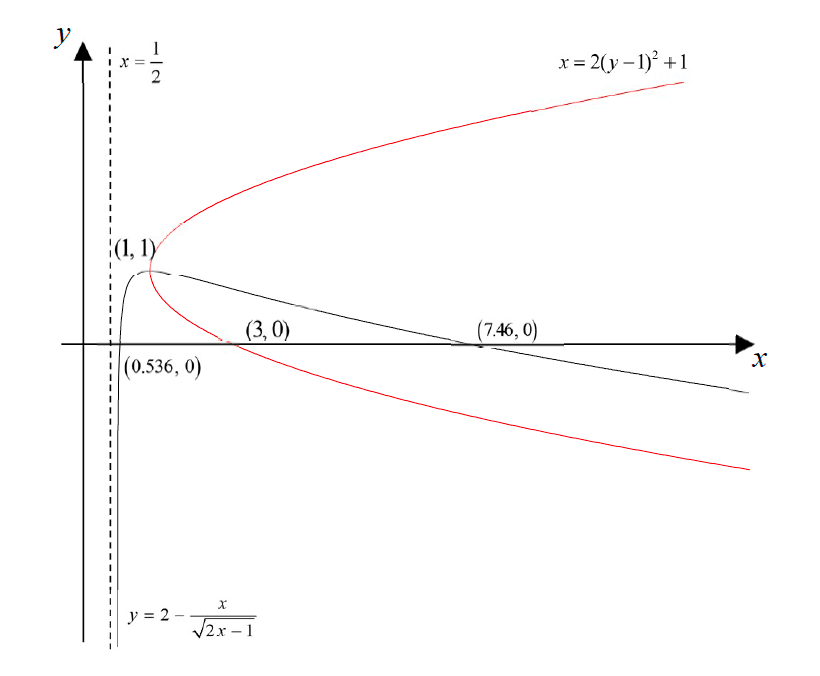
Asymptote: \(x = \tfrac{1}{2}\) (vertical). Turning point: \((1,1)\). \(x\)-intercepts: \(x = 4 - 2\sqrt{3} \approx 0.536\) and \(x = 4+2\sqrt{3} \approx 7.46\).
(b)(ii) GC view of region \(R\):
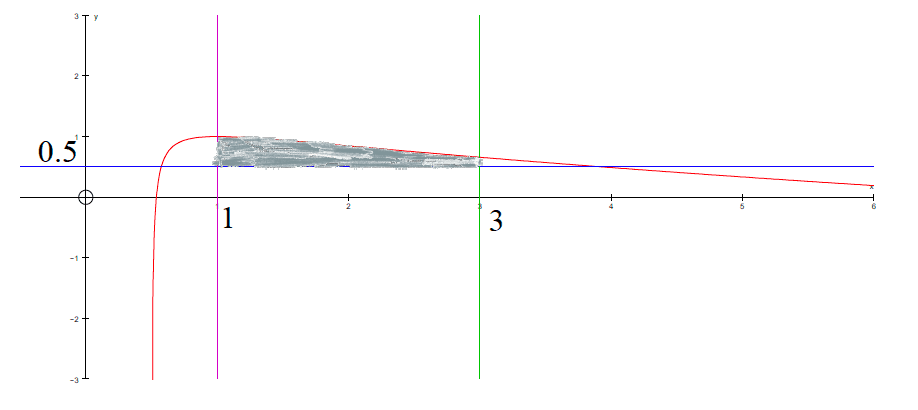
Required area of \(R\) (between curve and \(y = \tfrac{1}{2}\), from \(x=1\) to \(x=3\)): \[\begin{aligned} &= \int_1^3\!\left(2 - \frac{x}{\sqrt{2x-1}} - \frac{1}{2}\right)\mathrm{d}x = \int_1^3\frac{3}{2}\,\mathrm{d}x - \int_1^3\frac{x}{\sqrt{2x-1}}\,\mathrm{d}x \end{aligned}\]
Using \(u = \sqrt{2x-1}\): when \(x=1\), \(u=1\); when \(x=3\), \(u=\sqrt{5}\). \[\begin{aligned} \int_1^3\frac{x}{\sqrt{2x-1}}\,\mathrm{d}x &= \int_1^{\sqrt{5}}\frac{u^2+1}{2}\,\mathrm{d}u = \frac{1}{2}\!\left[\frac{u^3}{3}+u\right]_1^{\sqrt{5}} = \frac{1}{2}\!\left[\frac{5\sqrt{5}}{3}+\sqrt{5}-\frac{1}{3}-1\right]\\ &= \frac{1}{2}\!\left[\frac{8\sqrt{5}-4}{3}\right] = \frac{4\sqrt{5}-2}{3} \end{aligned}\]
\[\begin{aligned} \text{Area} &= \frac{3}{2}[x]_1^3 - \frac{4\sqrt{5}-2}{3} = 3 - \frac{4\sqrt{5}-2}{3} = \frac{9 - 4\sqrt{5}+2}{3} = \frac{11-4\sqrt{5}}{3} \end{aligned}\](c)(i) \[\begin{aligned} x &= 2(y-1)^2 + 1\\ (y-1)^2 &= \frac{x-1}{2}\\ y &= 1 \pm \sqrt{\frac{x-1}{2}} \end{aligned}\]
(c)(ii) The graph of \(x = 2(y-1)^2+1\) is shown in teal/red in the diagram above ? a parabola with vertex at \((1,1)\), two branches.
(c)(iii) GC view of region \(S\):
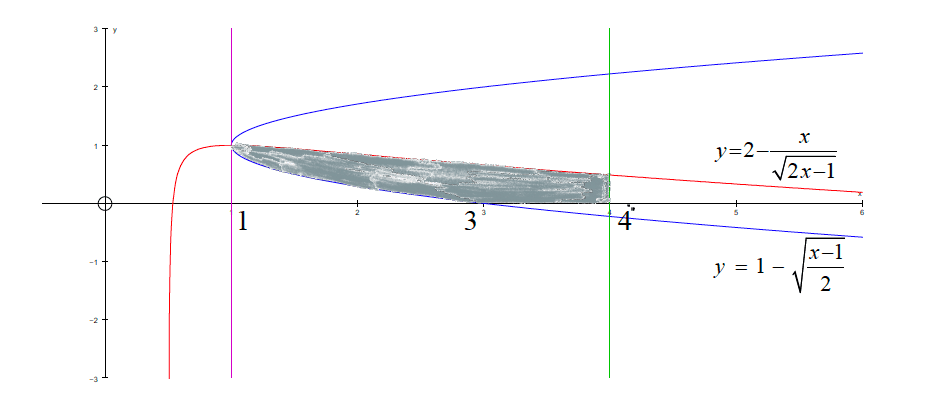
Volume of solid when \(S\) is rotated \(2\pi\) about the \(x\)-axis: \[\begin{aligned} V &= \pi\int_1^4\!\left(2-\frac{x}{\sqrt{2x-1}}\right)^{\!2}\mathrm{d}x - \pi\int_1^4\!\left(1-\sqrt{\frac{x-1}{2}}\right)^{\!2}\mathrm{d}x\\ &= 4.518334\ldots\\ &= 4.518 \text{ units}^3 \text{ (3 d.p.)} \end{aligned}\]