Free practice / JC2 H2 Maths Prelim
Applications of Integration: Area; vol. \(x\)-axis; parabola — VJC 2025 H2 Math Prelim Paper 1
Attempt the question on paper, then open the worked solution to check your method.
What this question tests
Question
In the diagram below, the region \(R\) is bounded by the curve \(C\) with equation \(x = 6 - (y-2)^2\), the lines \(y = 8\), \(y = 2 - x\) and the \(y\)-axis. The region \(S\) is bounded by \(C\) and the line \(y = 2 - x\).
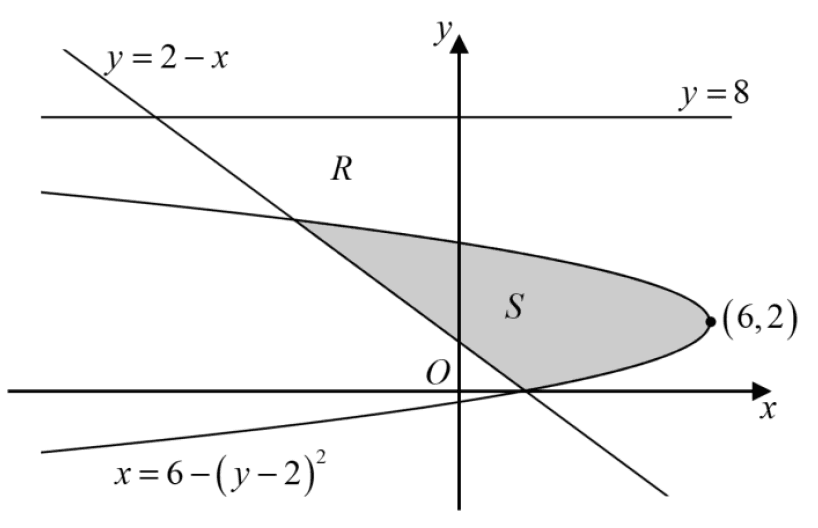
(a) Find the exact area of region \(R\).
(b) Find the volume of the solid of revolution formed when region \(S\) is rotated through \(360^\circ\) about the \(x\)-axis, leaving your answer to 2 decimal places.
Show full worked solution▾
(a) Intersection of \(C\) and \(y = 2 - x\): \[\begin{aligned} 2 - y &= 6 - (y-2)^2\\ 2 - y &= 6 - y^2 + 4y - 4\\ y^2 - 5y &= 0 \end{aligned}\] giving \(y = 0\) or \(y = 5\), so \(x = 2\) or \(x = -3\).
Intersection of \(C\) with the \(y\)-axis (\(x = 0\)): \[ 0 = 6 - (y-2)^2 \;\Longrightarrow\; y = 2 \pm \sqrt{6}. \] For region \(R\) (bounded by \(C\), \(y = 8\), \(y = 2 - x\), \(y\)-axis), integrate w.r.t. \(y\): \[\begin{aligned} \text{Area of } R &= -\!\int_{2+\sqrt{6}}^{5}\!\!\bigl[6 - (y-2)^2\bigr]\,\mathrm{d}y \;-\; \int_{5}^{8}(2 - y)\,\mathrm{d}y\\ &= -\!\left[6y - \frac{(y-2)^3}{3}\right]_{2+\sqrt{6}}^{5} \;-\; \left[2y - \frac{y^2}{2}\right]_{5}^{8}. \end{aligned}\] Evaluating the first bracket at the endpoints: \[\begin{aligned} \left[6y - \tfrac{(y-2)^3}{3}\right]_{2+\sqrt{6}}^{5} &= \left(30 - \tfrac{27}{3}\right) - \left(6(2+\sqrt{6}) - \tfrac{(\sqrt{6})^3}{3}\right)\\ &= (30 - 9) - (12 + 6\sqrt{6} - 2\sqrt{6})\\ &= 21 - 12 - 4\sqrt{6} = 9 - 4\sqrt{6}. \end{aligned}\] The second bracket: \(\left[2y - \tfrac{y^2}{2}\right]_{5}^{8} = (16 - 32) - (10 - 12.5) = -16 + 2.5 = -13.5\).
Combining (with the negative sign): \[ \text{Area of }R = -(9 - 4\sqrt{6}) - (-13.5) = -9 + 4\sqrt{6} + 13.5 = \tfrac{9}{2} + 4\sqrt{6}. \] (b)
\[\begin{aligned} x &= 6-(y-2)^2 \\ y &= 2 \pm \sqrt{6-x} \end{aligned}\] \[\begin{aligned} \text{Volume of solid} &= \pi\int_{-3}^{6}\!\left(2+\sqrt{6-x}\right)^2\mathrm{d}x - \pi\int_{-3}^{2}\!\left(2-x\right)^2\mathrm{d}x - \pi\int_{2}^{6}\!\left(2-\sqrt{6-x}\right)^2\mathrm{d}x \\ &= 327.25 \text{ units}^3 \end{aligned}\]