Binomial Expansion: Binomial with restriction — TMJC 2025 H2 Math Prelim Paper 2
What this question tests
Question
A manufacturer produces mystery boxes, each containing either a regular or a seasonal toy. On average, \(p\%\) of the mystery boxes contain a seasonal toy.
Amber orders \(n\) mystery boxes from the manufacturer. The number of seasonal toys that Amber gets is the random variable \(S\).
(a) State, in the context of the question, two assumptions needed for \(S\) to be well modelled by a binomial distribution.
You are now given that \(S\) can be modelled by a binomial distribution.
(b) Given that \(\mathrm{P}(S = 2) = \mathrm{P}(S = 3)\) and \(\mathrm{E}(S) = 2.96\), find the value of \(p\).
Assume now that \(p = 5\).
The manufacturer now packs the mystery boxes into cartons of \(12\) each for sale. Each carton is checked for quality control. If there is at most \(1\) mystery box containing a seasonal toy, the carton is accepted. Otherwise, the carton is rejected.
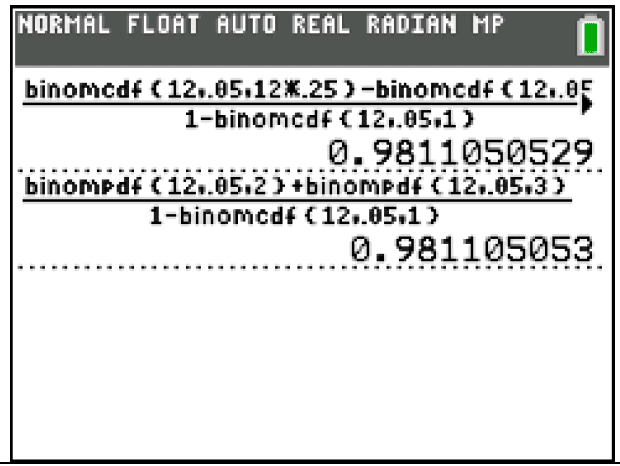
(c) Given that a randomly chosen carton is rejected, find the probability that no more than \(30\%\) of the boxes in the carton each contains a seasonal toy.
Show full worked solution▾
(a) Two assumptions for \(S\) to be well modelled by \(\mathrm{B}\!\left(n,\tfrac{p}{100}\right)\):
- Whether a randomly chosen mystery box contains a seasonal toy is independent of all other mystery boxes.
- The probability that a randomly chosen mystery box contains a seasonal toy is constant at \(\tfrac{p}{100}\) throughout the sample.
(b) Let \(q = \tfrac{p}{100}\). Then \(S\sim\mathrm{B}(n,q)\). From \(\mathrm{P}(S=2) = \mathrm{P}(S=3)\): \[\begin{aligned} \binom{n}{2}q^2(1-q)^{n-2} &= \binom{n}{3}q^3(1-q)^{n-3}\\ \frac{n!}{2!(n-2)!}(1-q) &= \frac{n!}{3!(n-3)!}\,q \quad\text{(since $q>0,\;1-q>0$)}\\ \frac{1}{n-2}(1-q) &= \frac{1}{3}q \quad\text{(since $n>0$)}\\ 3 - 3q &= (n-2)q\\ nq &= 3 - q. \end{aligned}\] Using \(\mathrm{E}(S) = nq = 2.96\): \[\begin{aligned} 2.96 &= 3 - q\\ q &= 0.04\\ p &= 4 \end{aligned}\]
(c) Let \(X\) be the number of mystery boxes, out of \(12\), that contain a seasonal toy. Then \(X\sim\mathrm{B}(12,\,0.05)\).
“No more than \(30\%\) of \(12\) boxes” means at most \(0.3\times 12 = 3.6\), i.e. \(X \le 3\) (integer). The carton is rejected iff \(X \ge 2\). \[\begin{aligned} \mathrm{P}(X\le 3.6 \mid X\ge 2) &= \frac{\mathrm{P}(X\le 3 \cap X\ge 2)}{\mathrm{P}(X\ge 2)}\\ &= \frac{\mathrm{P}(2\le X\le 3)}{\mathrm{P}(X\ge 2)}\\ &= \frac{\mathrm{P}(X=2) + \mathrm{P}(X=3)}{1 - \mathrm{P}(X\le 1)}\\ &= 0.981 \quad\text{(3 s.f.)}. \end{aligned}\]
Figure 4