
Complex Numbers: Real cubic; find roots — TMJC 2025 H2 Math Prelim Paper 1
What this question tests
Question
It is given that \(-2 + 2\mathrm{i}\) is a root of the equation \[ z^3 + az^2 + bz - 16\sqrt{2} = 0, \] where \(a\) and \(b\) are real numbers.
- Find the values of \(a\) and \(b\) and the other two roots. Leave your answers in the exact form.
- In an Argand diagram with origin \(O\), the three roots are represented by points \(A\), \(B\) and \(C\) where \(A\) represents \(-2 + 2\mathrm{i}\) and \(C\) represents the real root. Label these points on an Argand diagram, indicating clearly the modulus and argument of each root. State also a geometrical relationship between \(A\) and \(B\).
- Hence, prove that \(\tan\dfrac{3\pi}{8} = 1 + \sqrt{2}\).
Show full worked solution▾
(a) Since the equation has real coefficients, \(-2 + 2\mathrm{i}\) being a root implies \(-2 - 2\mathrm{i}\) is also a root. Consider \[\begin{aligned} [z - (-2 + 2\mathrm{i})][z - (-2 - 2\mathrm{i})] &= [(z + 2) - 2\mathrm{i}][(z + 2) + 2\mathrm{i}] \\ &= (z + 2)^2 - (2\mathrm{i})^2 \\ &= z^2 + 4z + 4 + 4 \\ &= z^2 + 4z + 8. \end{aligned}\]
Writing the cubic as \((z^2 + 4z + 8)(pz + q)\):
- Coefficient of \(z^3\): \(p = 1\).
- Constant: \(8q = -16\sqrt{2} \Rightarrow q = -2\sqrt{2}\).
So \(z^3 + az^2 + bz - 16\sqrt{2} = (z^2 + 4z + 8)(z - 2\sqrt{2})\).
- Coefficient of \(z^2\): \(a = -2\sqrt{2} + 4 = 4 - 2\sqrt{2}\).
- Coefficient of \(z\): \(b = -8\sqrt{2} + 8 = 8 - 8\sqrt{2}\).
Therefore \(a = 4 - 2\sqrt{2}\), \(b = 8 - 8\sqrt{2}\), and the other two roots are \(-2 - 2\mathrm{i}\) and \(2\sqrt{2}\).
(b) Let \(z_1 = -2 + 2\mathrm{i}\) (2nd quadrant): \[\begin{aligned} |z_1| &= \sqrt{(-2)^2 + 2^2} = 2\sqrt{2},\\ \arg(z_1) &= \pi - \tan^{-1}\!\left(\tfrac{2}{2}\right) = \pi - \dfrac{\pi}{4} = \dfrac{3\pi}{4}. \end{aligned}\]
Let \(z_2 = -2 - 2\mathrm{i}\) (3rd quadrant): \[\begin{aligned} |z_2| &= 2\sqrt{2},\\ \arg(z_2) &= -\pi + \tan^{-1}\!\left(\tfrac{2}{2}\right) = -\pi + \dfrac{\pi}{4} = -\dfrac{3\pi}{4}. \end{aligned}\]
Let \(z_3 = 2\sqrt{2}\): \(|z_3| = 2\sqrt{2}\) and \(\arg(z_3) = 0\).
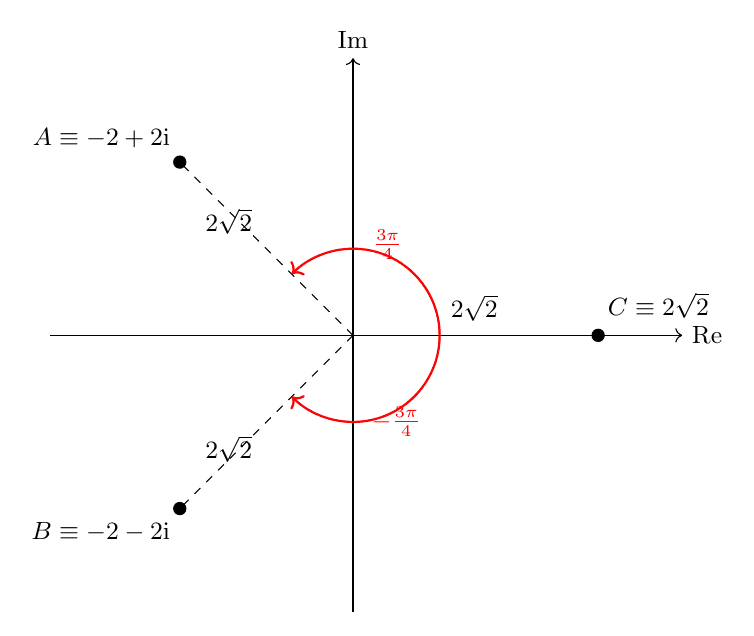
Geometrical relationship: \(B\) is the reflection of \(A\) in the real axis (equivalently, \(B\) is the \(90^\circ\) anti-clockwise rotation of \(A\) about \(O\), since \(\mathrm{i}A = \mathrm{i}(-2 + 2\mathrm{i}) = -2 - 2\mathrm{i} = B\)).
(c) Since \(OA = OC = 2\sqrt{2}\), consider the point \(D\) such that \(OADC\) is a rhombus. Then \(OD\) bisects \(\angle AOC\).
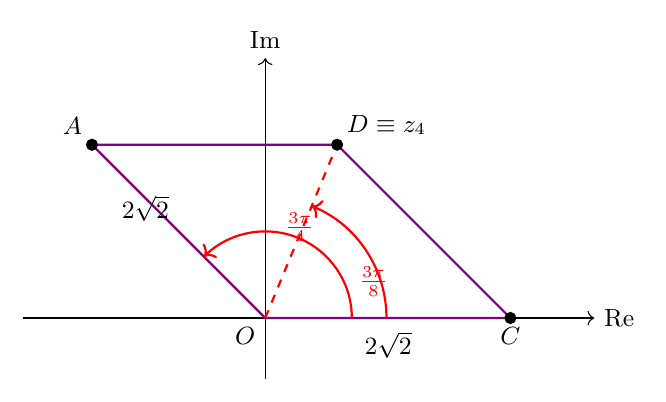
Thus \(\angle DOC = \tfrac{1}{2}\cdot\tfrac{3\pi}{4} = \tfrac{3\pi}{8}\).
Let \(D \equiv z_4\) where \[ z_4 = (-2 + 2\mathrm{i}) + 2\sqrt{2} = (-2 + 2\sqrt{2}) + 2\mathrm{i}. \]
Since \(z_4\) lies in the 1st quadrant, \(\arg(z_4) = \tfrac{3\pi}{8}\): \[\begin{aligned} \tan\dfrac{3\pi}{8} &= \dfrac{2}{-2 + 2\sqrt{2}} \\ &= \dfrac{1}{-1 + \sqrt{2}} \times \dfrac{-1 - \sqrt{2}}{-1 - \sqrt{2}} \\ &= \dfrac{-1 - \sqrt{2}}{(-1)^2 - (\sqrt{2})^2} \\ &= \dfrac{-1 - \sqrt{2}}{1 - 2} \\ &= 1 + \sqrt{2} \quad \text{(shown)}. \end{aligned}\]