Complex Numbers: Modulus-argument form — VJC 2025 H2 Math Prelim Paper 2
What this question tests
Question
Do not use a calculator in answering this question.
The complex number \(z\) has modulus \(1\) and argument \(\theta\), where \(\dfrac{\pi}{2} < \theta < \pi\), and the complex number \(w\) is given by \(w = \mathrm{i}\sqrt{3}\,z\). The point \(P\) on the Argand diagram represents \(z\).
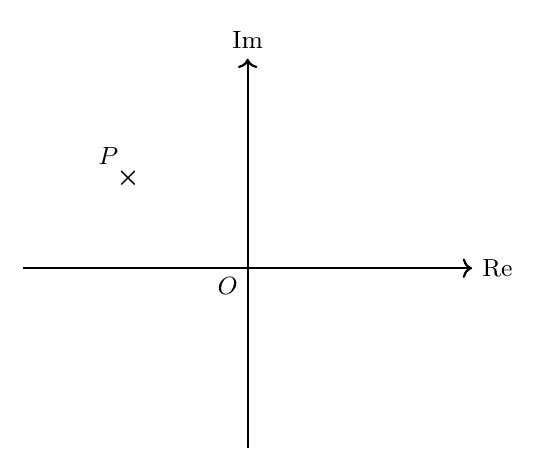
- (a) On the copy of the Argand diagram with origin \(O\) in the Printed Answer Booklet, plot the points \(Q\) and \(R\) to represent \(w\) and \(z - w\) respectively. Show clearly the geometrical relationship between the points \(P\), \(Q\) and \(R\).
- (b) Find the area of the quadrilateral \(ORPQ\).
- (c) Find \(z\) in the form \(x + y\mathrm{i}\), where \(x\) and \(y\) are real numbers.
- (d) Show that \(z - w = k\!\left[\left(\sqrt{3}-1\right) + \left(\sqrt{3}+1\right)\mathrm{i}\right]\), where \(k\) is a constant to be determined.
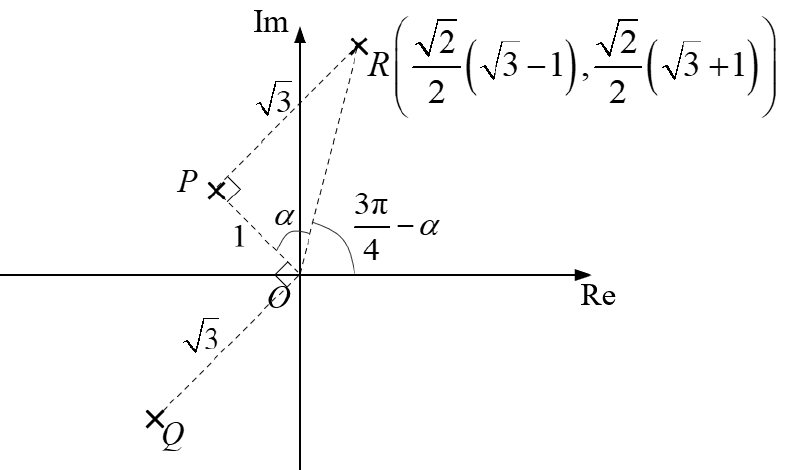
- (e) Hence show that \(\tan\dfrac{5\pi}{12} = \dfrac{\sqrt{3}+1}{\sqrt{3}-1}\).
Show full worked solution▾
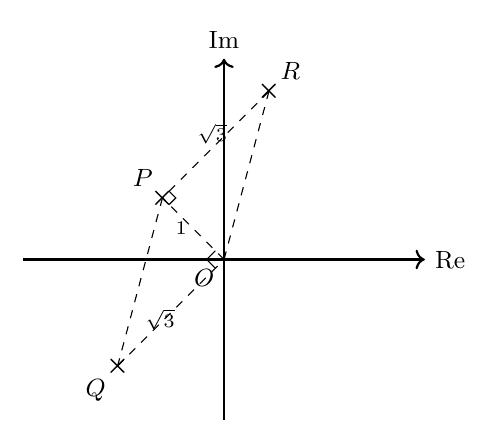
(a) Since \(w = \mathrm{i}\sqrt{3}\,z\), we have \(|w| = \sqrt{3}\) and \(\arg w = \arg z + \dfrac{\pi}{2}\), so \(OQ \perp OP\) at \(O\) with \(|OP| = 1\) and \(|OQ| = \sqrt{3}\). Also \(z - w = z(1 - \mathrm{i}\sqrt{3})\) with \(|1 - \mathrm{i}\sqrt{3}| = 2\), so \(|OR| = 2\); and \(\overrightarrow{PR} = -\overrightarrow{OQ}\), so \(PR \perp OP\) at \(P\) with \(|PR| = \sqrt{3}\). Hence \(R\) and \(Q\) lie on opposite sides of line \(OP\), each at perpendicular distance \(\sqrt{3}\) from \(OP\).
(b)
\[ \text{Area}(ORPQ) = \dfrac{1}{2}(1)(\sqrt{3} + \sqrt{3}) = \sqrt{3}. \](c)
\[\begin{aligned} \text{Length } x &= 1\cos\frac{\pi}{4} = \frac{1}{\sqrt{2}} \\ \text{Length } y &= 1\sin\frac{\pi}{4} = \frac{1}{\sqrt{2}} \end{aligned}\] \[ \therefore z = -\frac{1}{\sqrt{2}} + \frac{1}{\sqrt{2}}\,\mathrm{i} \](d) \[\begin{aligned} z - w &= z(1 - \mathrm{i}\sqrt{3}) = \left(-\dfrac{1}{\sqrt{2}} + \dfrac{1}{\sqrt{2}}\mathrm{i}\right)(1 - \mathrm{i}\sqrt{3})\\ &= \dfrac{1}{\sqrt{2}}(-1 + \mathrm{i})(1 - \mathrm{i}\sqrt{3})\\ &= \dfrac{1}{\sqrt{2}}\!\left(-1 + \mathrm{i}\sqrt{3} + \mathrm{i} + \sqrt{3}\right)\\ &= \dfrac{1}{\sqrt{2}}\!\left[(\sqrt{3} - 1) + (\sqrt{3} + 1)\mathrm{i}\right] \end{aligned}\] Hence \(k = \dfrac{1}{\sqrt{2}}\).
(e)