
Differential Equations: Subst. \(w=x^2y\); pest model — TJC 2025 H2 Math Prelim Paper 1
What this question tests
Question
- Show, by means of the substitution \(w = x^2 y\), that the differential equation
\[
2y + x\frac{\mathrm{d}y}{\mathrm{d}x} = \frac{x^4 y^2}{\sqrt{x^2 + 1}}
\]
can be reduced to the form \(\dfrac{\mathrm{d}w}{\mathrm{d}x} = \dfrac{w^2 x}{\sqrt{x^2 + 1}}\).
Hence find the general solution of the differential equation \(2y + x\dfrac{\mathrm{d}y}{\mathrm{d}x} = \dfrac{x^4 y^2}{\sqrt{x^2 + 1}}\), leaving your answer in the form \(y = \mathrm{f}(x)\).
- At a durian plantation, mature durians are susceptible to pests' infection. The spread of pests at the plantation resulted in durians being classified into two categories, either they are bad durians that have been infected by the pests or good durians that have not been infected. It is given that \(x\) denotes the number of bad durians, in thousands, in a fixed population size \(P\), in thousands, where \(P > 4\). The rate of spread of infection, \(\dfrac{\mathrm{d}x}{\mathrm{d}t}\), where \(t\) represents the time taken in days, can be modelled as being proportional to the product of the number of bad durians and good durians that have not been infected. It is given that \(x = 4\) and \(\dfrac{\mathrm{d}x}{\mathrm{d}t} = P - 4\) when \(t = 0\).
- Write down the differential equation involving \(\dfrac{\mathrm{d}x}{\mathrm{d}t}\), \(x\) and \(P\).
- Solve the differential equation in part (i) and find \(x\) in terms of \(P\) and \(t\).
- By using an appropriate graph, explain in context, the long-term implications if no additional measures are carried out to control the spread of the pests' infection.
Show full worked solution▾
(a)
Differentiate \(w = x^2 y\) with respect to \(x\), \[ \frac{\mathrm{d}w}{\mathrm{d}x} = 2xy + x^2\frac{\mathrm{d}y}{\mathrm{d}x} \quad(1) \]
Multiply \(x\) to given D.E., we have \(2xy + x^2\dfrac{\mathrm{d}y}{\mathrm{d}x} = \dfrac{x^5 y^2}{\sqrt{x^2+1}}\) (2)
Subst. (1) into (2) and replace \(x^4 y^2\) by \(w^2\): \[\begin{aligned} \frac{\mathrm{d}w}{\mathrm{d}x} &= \frac{w^2 x}{\sqrt{x^2+1}} \\[6pt] \int \frac{1}{w^2}\,\mathrm{d}w &= \int \frac{x}{\sqrt{x^2+1}}\,\mathrm{d}x \\[6pt] \int w^{-2}\,\mathrm{d}w &= \frac{1}{2}\int 2x\left(x^2+1\right)^{-\frac{1}{2}}\mathrm{d}x \\[6pt] \frac{w^{-1}}{-1} &= \frac{1}{2}\cdot\frac{\left(x^2+1\right)^{\frac{1}{2}}}{\left(\dfrac{1}{2}\right)} + C \quad \text{where $C$ is arb.\ constant} \\[6pt] -\frac{1}{w} &= \sqrt{x^2+1} + C \\[6pt] -\frac{1}{x^2 y} &= \sqrt{x^2+1} + C \\[6pt] y &= -\frac{1}{x^2\!\left(\sqrt{x^2+1}+C\right)} \end{aligned}\]
(b)(i) Given \(\dfrac{\mathrm{d}x}{\mathrm{d}t} = kx(P-x)\) with \(x=4\) and \(\dfrac{\mathrm{d}x}{\mathrm{d}t} = P-4\): \[ P-4 = k\cdot 4\cdot(P-4) \implies k = \frac{1}{4} \]
(b)(ii) Separating variables: \[ \int\frac{1}{x(P-x)}\,\mathrm{d}x = \int\frac{1}{4}\,\mathrm{d}t \] \[ \frac{1}{P}\int\!\left(\frac{1}{x}+\frac{1}{P-x}\right)\mathrm{d}x = \frac{t}{4} \] \[ \ln|x| - \ln|P-x| = \frac{P}{4}t + C \] \[ \frac{x}{P-x} = Ae^{\frac{P}{4}t}, \quad A = e^C > 0 \] \[ \frac{P-x}{x} = Be^{-\frac{P}{4}t},\quad B = \frac{1}{A} \] \[ x = \frac{P}{1+Be^{-\frac{P}{4}t}} \]
When \(t=0\), \(x=4\): \(B = \dfrac{P}{4}-1 = \dfrac{P-4}{4}\).
(b)(iii)
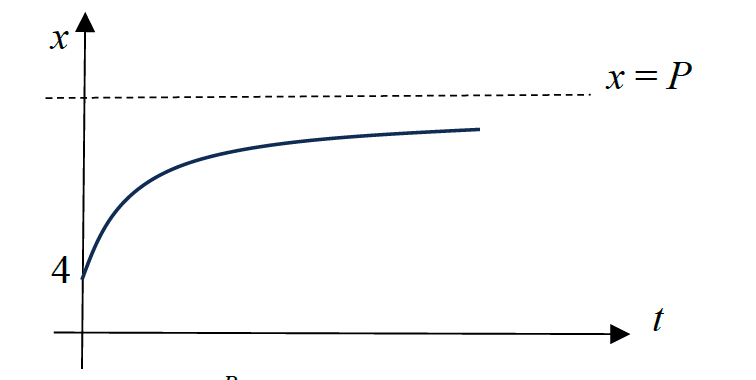
As \(t\to\infty\), \(e^{-\frac{P}{4}t}\to 0\), so \(x\to P\).
In the long term, all the durians in the plantation will be infected and become bad durians.