
Differentiation & Applications: Differentiation — RVHS 2025 H2 Math Prelim Paper 1
What this question tests
Question
The curve \(C\) is defined by the parametric equations \(x = 6t - 5\) and \(y = 2t^2 + 1\), where \(t \geq \tfrac{5}{6}\).
- Sketch the curve \(C\), labelling the exact coordinates of any axial intercept(s).
- Find the equation of the normal to \(C\) at the point \(P\) where \(t = 1\).
- Find the acute angle between the normal to \(C\) at the point \(P\) where \(t = 1\) and the tangent to \(C\) at the point \(M\) where \(t = 3\).
- The curve \(C\) is translated 5 units in the positive \(x\)-direction and translated 3 units in the negative \(y\)-direction, to form the curve \(D\). Find the equation of \(D\) in parametric form.
The curve \(E\) is defined by the parametric equations \(x = 7u\) and \(y = \dfrac{9}{u}\), where \(u \neq 0\).
- Show that at the point of intersection of the curves \(C\) and \(E\), \(6t^3 - 5t^2 + 3t - 34 = 0\). Deduce that there is only one point of intersection and find the coordinates of this point.
Show full worked solution▾
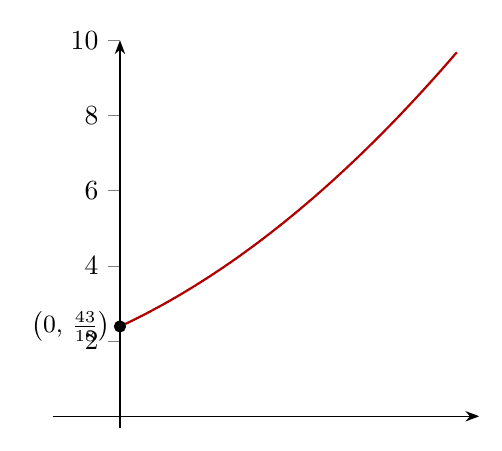
(a) Sketch of \(C\): \(x = 6t-5\), \(y = 2t^2+1\), \(t \geq \tfrac{5}{6}\).
Eliminating \(t\): \(t = \tfrac{x+5}{6}\), so \(y = \tfrac{1}{18}(x+5)^2 + 1\), a parabola opening upward.
At \(t = \tfrac{5}{6}\): \(x = 0\), \(y = 2\!\cdot\!\tfrac{25}{36}+1 = \tfrac{43}{18}\). So curve starts at \(\left(0,\,\tfrac{43}{18}\right)\).
(b) Normal to \(C\) at \(P\) where \(t=1\).
\(\dfrac{\mathrm{d}x}{\mathrm{d}t} = 6\), \(\dfrac{\mathrm{d}y}{\mathrm{d}t} = 4t\), so \(\dfrac{\mathrm{d}y}{\mathrm{d}x} = \dfrac{2t}{3}\).
At \(t=1\): gradient of tangent \(= \tfrac{2}{3}\), so gradient of normal \(= -\tfrac{3}{2}\).
At \(t=1\): \(x=1\), \(y=3\).
(c) Acute angle between normal at \(P\) (\(t=1\)) and tangent at \(M\) (\(t=3\)).
At \(t=3\): gradient of tangent \(= \tfrac{2}{3}(3) = 2\).
Let \(\theta_1 = \tan^{-1}(2)\) (angle of tangent at \(M\)), \(\theta_2 = -\tan^{-1}\!\left(\tfrac{3}{2}\right)\) (angle of normal at \(P\)).
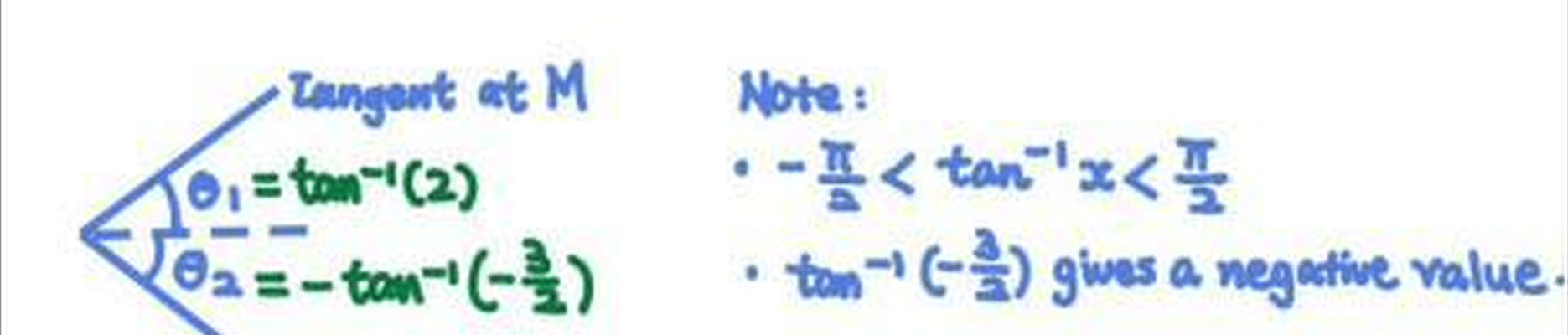
\(\theta_1 + \theta_2 = \tan^{-1}(2) - \tan^{-1}\!\!\left(-\tfrac{3}{2}\right) = \tan^{-1}(2) + \tan^{-1}\!\!\left(\tfrac{3}{2}\right) \approx 2.0899\) rad
Required acute angle \(= \pi - 2.0899 = 1.05\) rad or \(60.3°\).
(d) Curve \(D\) (translate \(C\) by \(+5\) in \(x\), \(-3\) in \(y\)):
(e) Point of intersection of \(C\) and \(E\).
On \(C\): \(x = 6t-5\), \(y = 2t^2+1\). On \(E\): \(x = 7u\), \(y = \tfrac{9}{u}\).
Equating \(x\)-coordinates: \(6t-5 = 7u \Rightarrow u = \dfrac{6t-5}{7}\).
Equating \(y\)-coordinates: \(2t^2+1 = \dfrac{9}{u} = \dfrac{63}{6t-5}\).
\((2t^2+1)(6t-5) = 63 \Rightarrow 12t^3 - 10t^2 + 6t - 5 = 63 \Rightarrow 12t^3 - 10t^2 + 6t - 68 = 0\)\(6t^3 - 5t^2 + 3t - 34 = 0\) (Shown) \( \)
\((t-2)(6t^2 + 7t + 17) = 0\)For \(6t^2+7t+17\): discriminant \(= 49 - 4(6)(17) = 49 - 408 = -359 < 0\), so no real roots.
Therefore \(t=2\) is the only real root, giving one point of intersection.
At \(t=2\): \(x = 6(2)-5 = 7\), \(y = 2(4)+1 = 9\).