
Functions: Inverse, area & composite — ASRJC 2025 H2 Math Prelim Paper 1
What this question tests
Question
The function \(\mathrm{f}\) is defined by \[ \mathrm{f}: x \mapsto 2x - \frac{1}{2x},\quad 0 < x < 2. \] It is given that \(\mathrm{f}^{-1}\) exists.
- Define \(\mathrm{f}^{-1}\) in a similar form.
- Sketch the graphs of \(y=\mathrm{f}(x)\) and \(y=\mathrm{f}^{-1}(x)\) on the same diagram.
- The region \(R\) is bounded by the curve \(y=\mathrm{f}^{-1}(x)\), \(y=x\) and the \(y\)-axis. Find the exact area of \(R\).
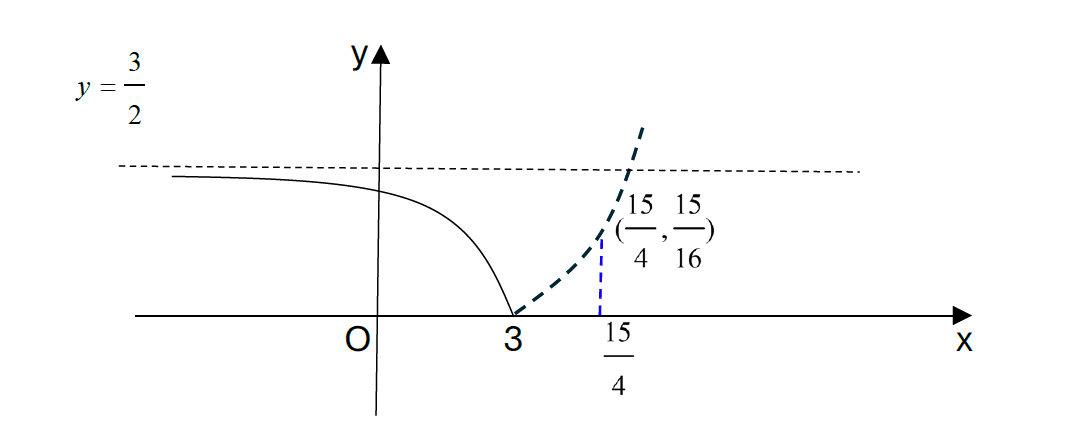
- Another function \(\mathrm{g}\) is defined by \[ \mathrm{g}: x \mapsto \begin{cases} \dfrac{3}{2} + \dfrac{3}{3x-11} & \text{for } x \leq 3, \\[6pt] \left|x - \dfrac{1}{3}x^2\right| & \text{for } 3 < x \leq 5. \end{cases} \] Show that the composite function \(\mathrm{gf}\) exists and find the range of \(\mathrm{gf}\).
Show full worked solution▾
(a)
Let \(y = 2x - \dfrac{1}{2x}\)
\[\begin{aligned} 4x^2 - 2xy - 1 &= 0 \\ \left(2x - \frac{y}{2}\right)^2 &= 1 + \frac{y^2}{4} \\ x &= \frac{y}{4} \pm \frac{1}{4}\sqrt{y^2 + 4} \end{aligned}\]Since \(0 < x < 2\), \(\therefore x = \dfrac{y}{4} + \dfrac{1}{4}\sqrt{y^2 + 4}\)
Hence, \(\mathrm{f}^{-1} : x \to \dfrac{x}{4} + \dfrac{1}{4}\sqrt{x^2 + 4}\), \(\ x < \dfrac{15}{4}\)
(b) Sketch of \(y = \mathrm{f}(x)\) and \(y = \mathrm{f}^{-1}(x)\).
The curves are reflections of each other in the line \(y = x\). Open circles at \((2, 15/4)\) on \(y = f(x)\) and \((15/4, 2)\) on \(y = f^{-1}(x)\).
(c) Exact area of region \(R\).
Area bounded by \(y = \mathrm{f}^{-1}(x)\), \(y = x\) and the \(y\)-axis equals area bounded by \(y = \mathrm{f}(x)\), \(y = x\) and the \(x\)-axis (by symmetry in \(y = x\)).
For the region \(R'\) (bounded by \(y = \mathrm{f}(x)\), \(y = x\), \(x\)-axis): \(\mathrm{f}(x) = 0\) when \(x = \dfrac{1}{2}\), and \(\mathrm{f}(x) = x\) when \(x = \dfrac{1}{\sqrt{2}}\). On \(\left(\dfrac{1}{2}, \dfrac{1}{\sqrt{2}}\right)\), \(y = x\) lies above \(y = \mathrm{f}(x)\).
\[\begin{aligned} \text{Area of } R &= \int_0^{1/\sqrt{2}} x\;\mathrm{d}x - \int_{1/2}^{1/\sqrt{2}}\!\!\left(2x - \frac{1}{2x}\right)\mathrm{d}x\\[4pt] &= \frac{1}{2}\!\left(\frac{1}{\sqrt{2}}\right)^{\!2} - \left[x^2 - \frac{1}{2}\ln x\right]_{1/2}^{1/\sqrt{2}}\\[4pt] &= \frac{1}{4} - \left[\left(\frac{1}{2} - \frac{1}{2}\ln\frac{1}{\sqrt{2}}\right) - \left(\frac{1}{4} - \frac{1}{2}\ln\frac{1}{2}\right)\right]\\[4pt] &= \frac{1}{4} - \frac{1}{4} + \frac{1}{2}\ln\frac{1}{\sqrt{2}} - \frac{1}{2}\ln\frac{1}{2}\\[4pt] &= -\frac{1}{4}\ln 2 + \frac{1}{2}\ln 2 = \frac{1}{4}\ln 2 \end{aligned}\](d)
\(\mathrm{R_f} = \left(-\infty, \dfrac{15}{4}\right)\), \(\quad \mathrm{D_g} = (-\infty, 5]\)
Since \(\mathrm{R_f} \subseteq \mathrm{D_g}\), \(\mathrm{gf}\) exists.