
Functions: One-to-one & composite — CJC 2025 H2 Math Prelim Paper 2
What this question tests
Question
Functions \(\mathrm{f}\) and \(\mathrm{g}\) are defined by \[ \mathrm{f}: x \mapsto \frac{4}{(x-4)^2},\quad x\in\mathbb{R},\ x\neq 4, \] \[ \mathrm{g}: x \mapsto \ln\!\left(1+\frac{1}{x}\right),\quad x\in\mathbb{R},\ x>0. \]
- Sketch the graph of \(y=\mathrm{f}(x)\), stating the equations of any asymptotes, the coordinates of the points where it crosses the axes and the coordinates of the turning points, if any.
- Show that \(\mathrm{gf}\) exists. Hence find the rule, domain and range of \(\mathrm{gf}\).
- If the domain of \(\mathrm{f}\) is further restricted to \(x<k\), state the largest value of \(k\) for which the function \(\mathrm{f}^{-1}\) exists.
- Using the restricted domain found in part (c), find \(\mathrm{f}^{-1}\) in a similar form.
Show full worked solution▾
(a) Graph of \(y=\mathrm{f}(x)\):
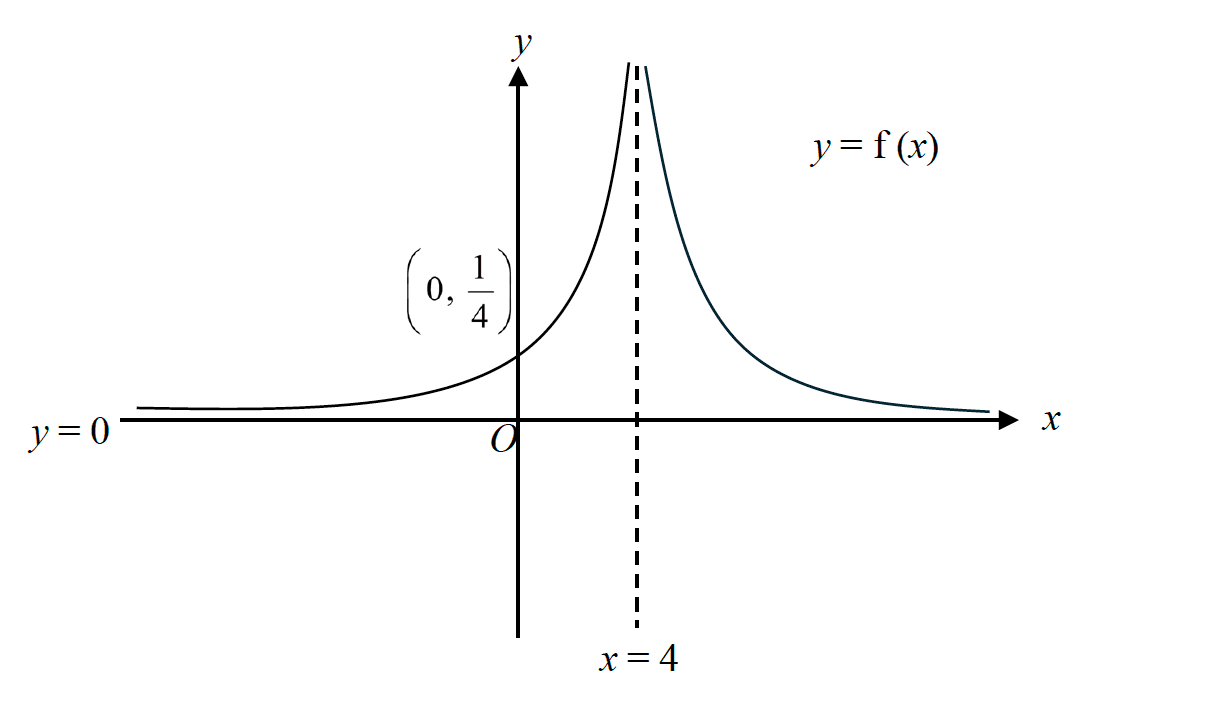
(b) For \(\mathrm{gf}\) to exist, \(R_\mathrm{f} \subseteq D_\mathrm{g}\). \[\begin{aligned} R_\mathrm{f} &= (0,\infty)\\ D_\mathrm{g} &= (0,\infty) \end{aligned}\] Since \(R_\mathrm{f} \subseteq D_\mathrm{g}\), \(\mathrm{gf}\) exists. (shown) \[\begin{aligned} \mathrm{gf}(x) &= \mathrm{g}\!\left[\frac{4}{(x-4)^2}\right]\\ &= \ln\!\left(1 + \frac{1}{\dfrac{4}{(x-4)^2}}\right)\\ &= \ln\!\left(1 + \frac{(x-4)^2}{4}\right) \end{aligned}\]
\(D_\mathrm{gf} = D_\mathrm{f} = \mathbb{R}\setminus\{4\}\) \(R_\mathrm{gf} = (0,\infty)\)(c) The largest value of \(k\) is \(\mathbf{4}\).
(d) Let \(y = \dfrac{4}{(x-4)^2}\). \[\begin{aligned} (x-4)^2 &= \frac{4}{y}\\ x-4 &= \pm\frac{2}{\sqrt{y}}\\ x &= 4+\frac{2}{\sqrt{y}} \quad \text{(rejected, since } x<4\text{)} \quad\text{or}\quad x = 4-\frac{2}{\sqrt{y}} \end{aligned}\] \(D_{\mathrm{f}^{-1}} = R_\mathrm{f} = (0,\infty)\).