
Functions: Composite fg — DHS 2025 H2 Math Prelim Paper 1
What this question tests
Question
The function \(\mathrm{f}\) is defined by \[ \mathrm{f}: x \mapsto e^x + \frac{1}{2x+2} \quad \text{for } x \in \mathbb{R},\ x \neq -1. \] A function \(\mathrm{g}\), defined for \(x \in \mathbb{R}\), \(x \geq 1\), is such that \(y \to \infty\) as \(x\) increases. It is also given that \(\mathrm{g}(1) = -0.5\).
- Explain why the composite function \(\mathrm{fg}\) exists and find the corresponding range of \(\mathrm{fg}\).
- Given that \(\mathrm{fg}(x) = \dfrac{x}{\sqrt{e}} + \dfrac{1}{2\ln x + 1}\), find an expression for \(\mathrm{g}(x)\) in terms of \(x\).
- The domain of \(\mathrm{f}\) is now further restricted to \(x > k\). State the least value of integer \(k\) for which the function \(\mathrm{f}^{-1}\) exists.
For the rest of the question, use the value of \(k\) found in part (c).
- Without finding \(\mathrm{f}^{-1}\),
- sketch, on the same diagram, the graphs of \(\mathrm{f}\), \(\mathrm{f}^{-1}\) and \(\mathrm{ff}^{-1}\) showing clearly the relationships between the graphs,
- find the gradient of the tangent to the graph of \(y = \mathrm{f}^{-1}(x)\) at \(x = e + \dfrac{1}{4}\).
Show full worked solution▾
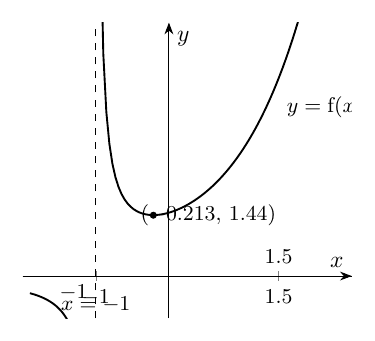
(a) Since \(\mathrm{g}'(x) > 0\) for all \(x \geq 1\) and \(\mathrm{g}(1) = -0.5\), the minimum value of \(\mathrm{g}\) is \(-0.5\) and \(\mathrm{g}\) increases without bound. So \(R_\mathrm{g} = [-0.5, \infty) \subseteq D_\mathrm{f} = \mathbb{R}\setminus\{-1\}\). Hence \(\mathrm{fg}\) exists.
Since \(R_\mathrm{g} = [-0.5, \infty)\) and \(\mathrm{f}\) is applied:
\(R_\mathrm{fg} = [1.5,\,\infty)\) (using the restricted domain from part (c))
Note: the range of \(\mathrm{fg}\) depends on the domain of \(\mathrm{g}\). Full credit was awarded to all students for this part.
(b)
Given \(\mathrm{f}(x) = e^x + \dfrac{1}{2x+2}\), \[ \mathrm{fg}(x) = \mathrm{f}[\mathrm{g}(x)] = e^{\mathrm{g}(x)} + \frac{1}{2\mathrm{g}(x)+2}. \]
Hence, \(e^{\mathrm{g}(x)} + \dfrac{1}{2\mathrm{g}(x)+2} = \dfrac{x}{\sqrt{e}} + \dfrac{1}{2\ln x + 1}\).
Comparing \(\ln\) terms, \[\begin{aligned} 2\mathrm{g}(x) + 2 &= 2\ln x + 1 \\ \mathrm{g}(x) &= \ln x - \frac{1}{2} \end{aligned}\]
Check: \(e^{\mathrm{g}(x)} = e^{\ln x - \frac{1}{2}} = \dfrac{x}{\sqrt{e}}\)
\(\therefore\ \mathrm{g}(x) = \ln x - \dfrac{1}{2}\). (Equivalently \(\mathrm{g}(x) = \ln\dfrac{x}{\sqrt{e}}\).) \(\mathrm{g}(x) = \ln x - \dfrac{1}{2}\)
(c) For \(\mathrm{f}^{-1}\) to exist, \(\mathrm{f}\) must be one-to-one. From the graph, the minimum turning point of \(\mathrm{f}\) is at approximately \((-0.213,\, 1.44)\). For \(x > k\) to give a one-to-one function:
Least integer value of \(k\) is \(\mathbf{0}\).
(d)(i) With domain restricted to \(x > 0\) (so \(k = 0\)):
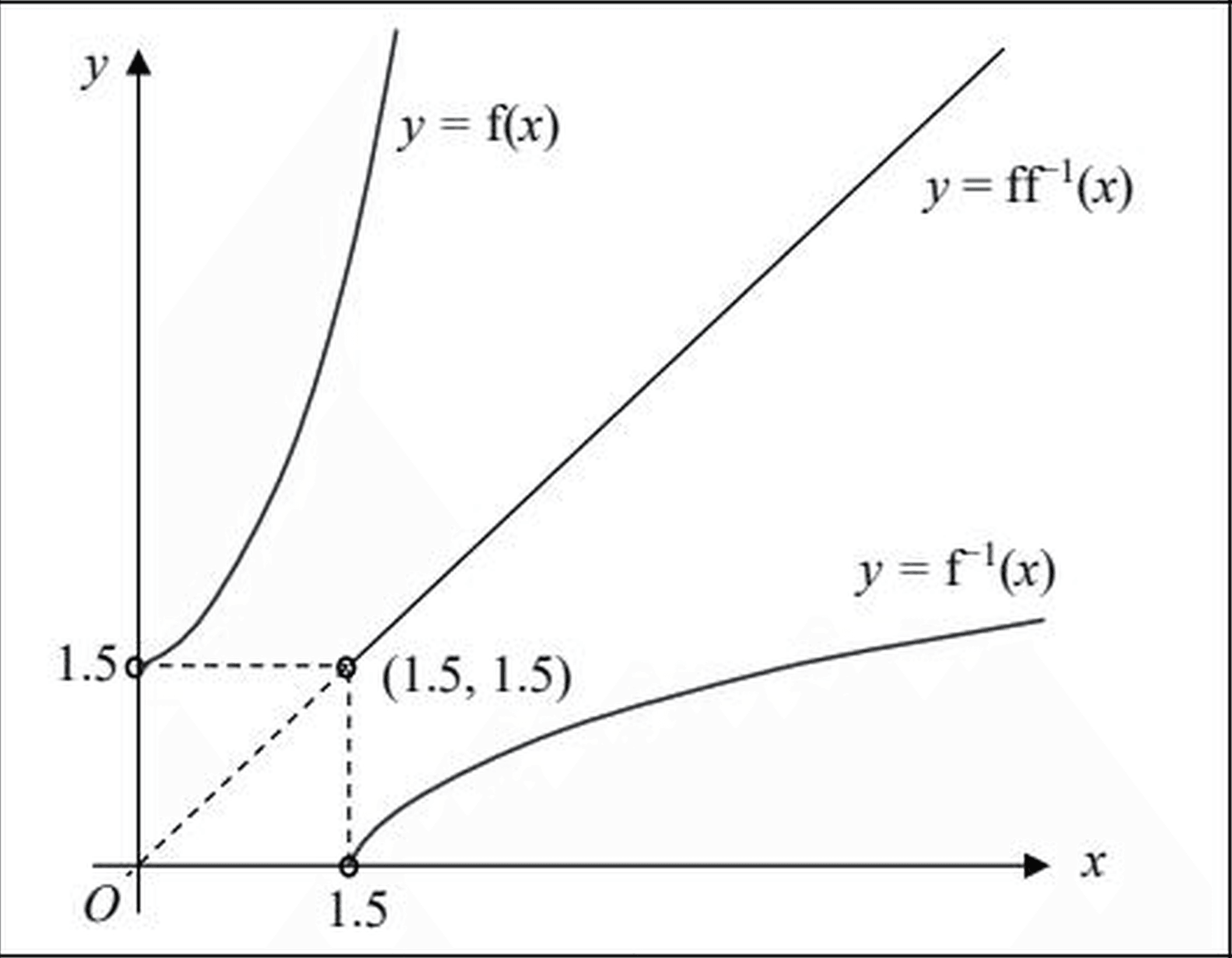
(d)(ii) Since \(e + \dfrac{1}{4} = e^1 + \dfrac{1}{2(1)+2}\), this corresponds to \(\mathrm{f}\) evaluated at \(x = 1\). So on \(\mathrm{f}^{-1}\), the point \(\left(e+\frac{1}{4},\, 1\right)\) lies on the graph.
Let \(y = e^x + \dfrac{1}{2x+2}\) (expression for f).
An expression for \(\mathrm{f}^{-1}\) is \(x = e^y + \dfrac{1}{2y+2}\).
(Note: From here, \(y\) refers to the graph of \(\mathrm{f}^{-1}\).)
Differentiate wrt \(x\), \[\begin{aligned} 1 &= e^y \cdot \frac{dy}{dx} + (-1)(2y+2)^{-2}(2)\frac{dy}{dx} \\[6pt] \frac{dy}{dx} &= \frac{1}{e^y - \dfrac{2}{(2y+2)^2}} \end{aligned}\]
At point \(\left(e + \dfrac{1}{4},\ 1\right)\), \[ \frac{dy}{dx} = \frac{1}{e^1 - \dfrac{2}{(2[1]+2)^2}} = \frac{1}{e - \dfrac{1}{8}} = \frac{8}{8e-1} = 0.386 \text{ (to 3 s.f.)} \]