Graphs & Transformations: Infer f(x) from f(\(|\)x\(|\)) & \(f'(x)\) — CJC 2025 H2 Math Prelim Paper 2
What this question tests
Question
The diagram shows the graphs of \(y = \mathrm{f}\!\left(|x|\right)\) and \(y = \mathrm{f}'(x)\).
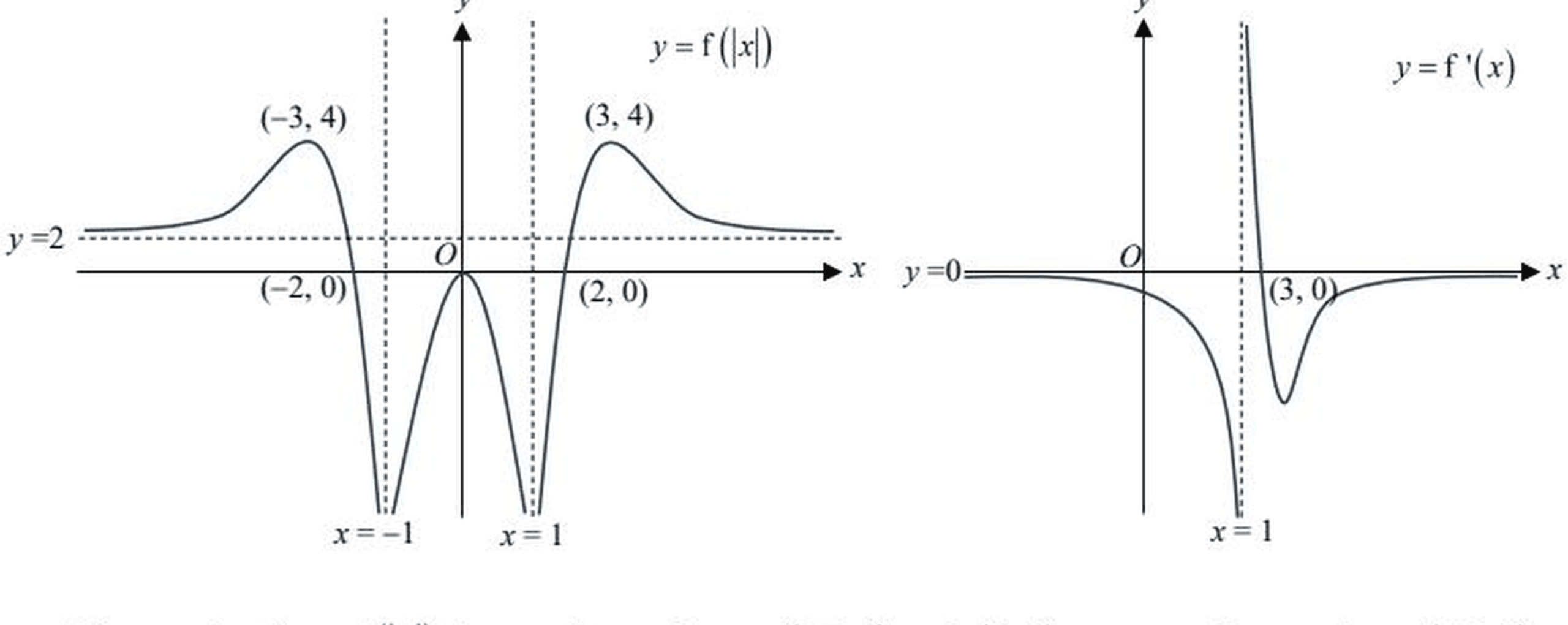
The graph of \(y = \mathrm{f}(|x|)\) has turning points at \((-3,\,4)\) and \((3,\,4)\), crosses the \(x\)-axis at \((-2,\,0)\) and \((2,\,0)\), and the equations of asymptotes are \(x=-1\), \(x=1\) and \(y=2\). The graph of \(y=\mathrm{f}'(x)\) crosses the \(x\)-axis at \((3,\,0)\), and the equations of asymptotes are \(x=1\) and \(y=0\).
On separate diagrams, sketch the graphs of
- \(y = \mathrm{f}(x)\),
- \(y = \dfrac{1}{\mathrm{f}'(x)}\),
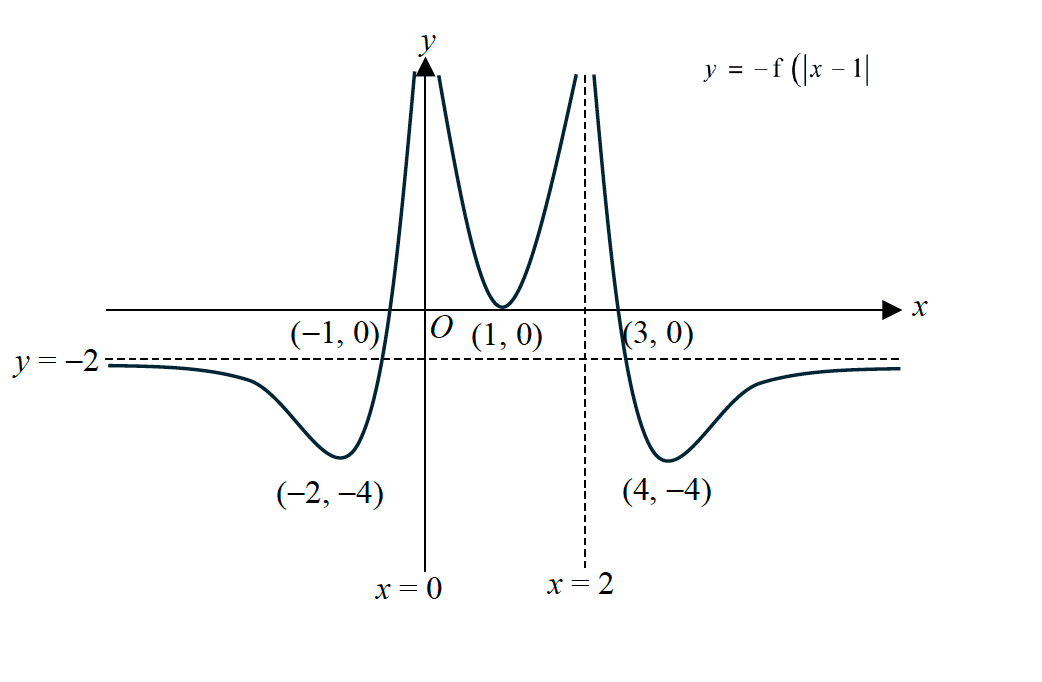
- \(y = -\mathrm{f}(|x-1|)\),
Show full worked solution▾
(a) Sketch of \(y=\mathrm{f}(x)\):
Since \(y=\mathrm{f}(|x|)\) is an even function obtained from \(y=\mathrm{f}(x)\) by reflecting the left half in the \(y\)-axis, \(y=\mathrm{f}(x)\) is the right half of \(y=\mathrm{f}(|x|)\), extended to include the left portion (for \(x<0\)) which is not the mirror image.
From \(y=\mathrm{f}(|x|)\): the right-half gives turning point \((3,4)\), \(x\)-intercept \((2,0)\), asymptotes \(x=1\), \(y=2\). For the graph of \(y=\mathrm{f}(x)\): the left portion (\(x<0\)) comes from the original \(\mathrm{f}\) (not reflected), so the right-half shape is kept for \(x>0\) and a distinct shape appears for \(x<0\).
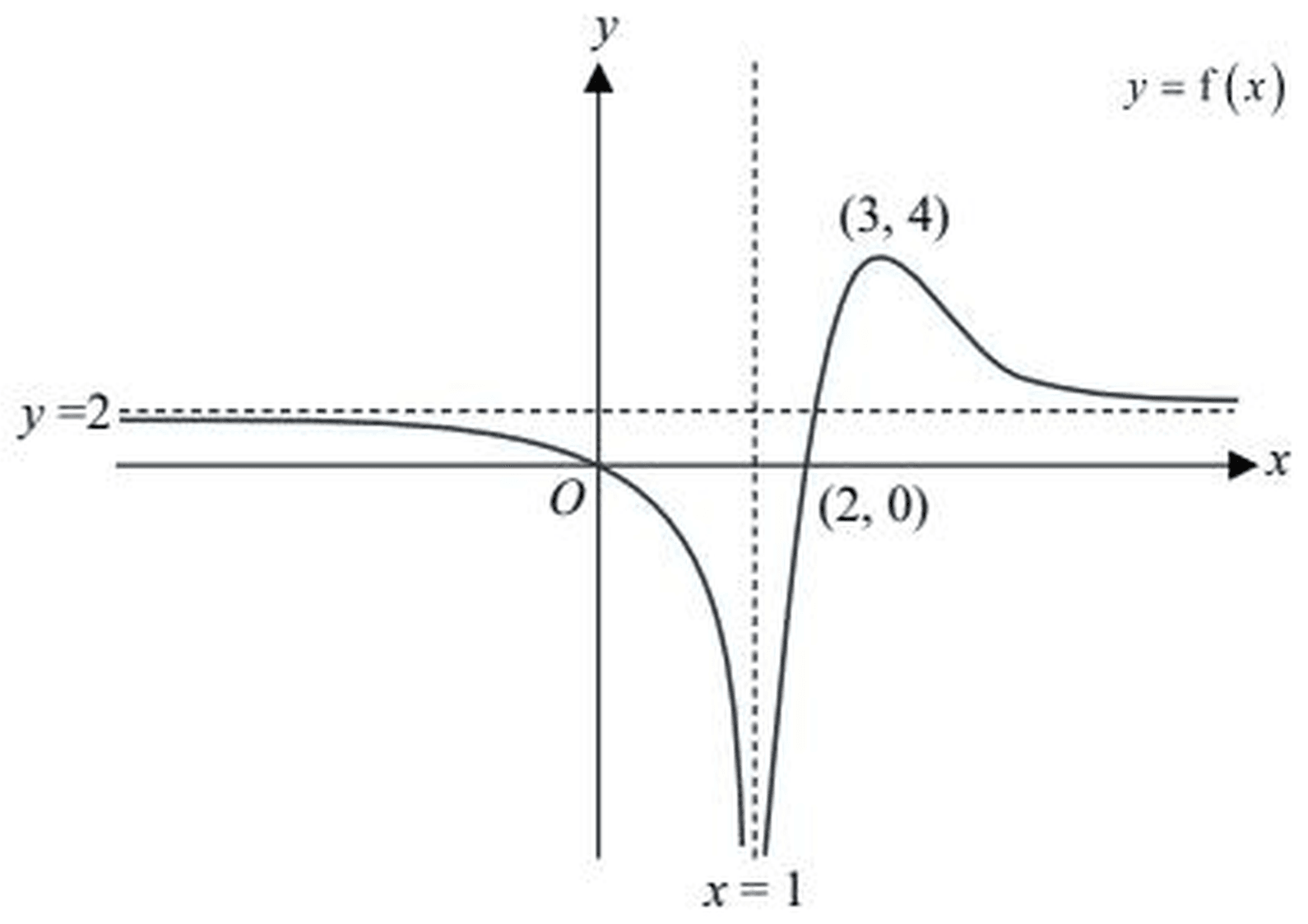
Key features: turning point \((3,4)\); \(x\)-intercept \((2,0)\); asymptotes \(x=1\), \(y=2\).
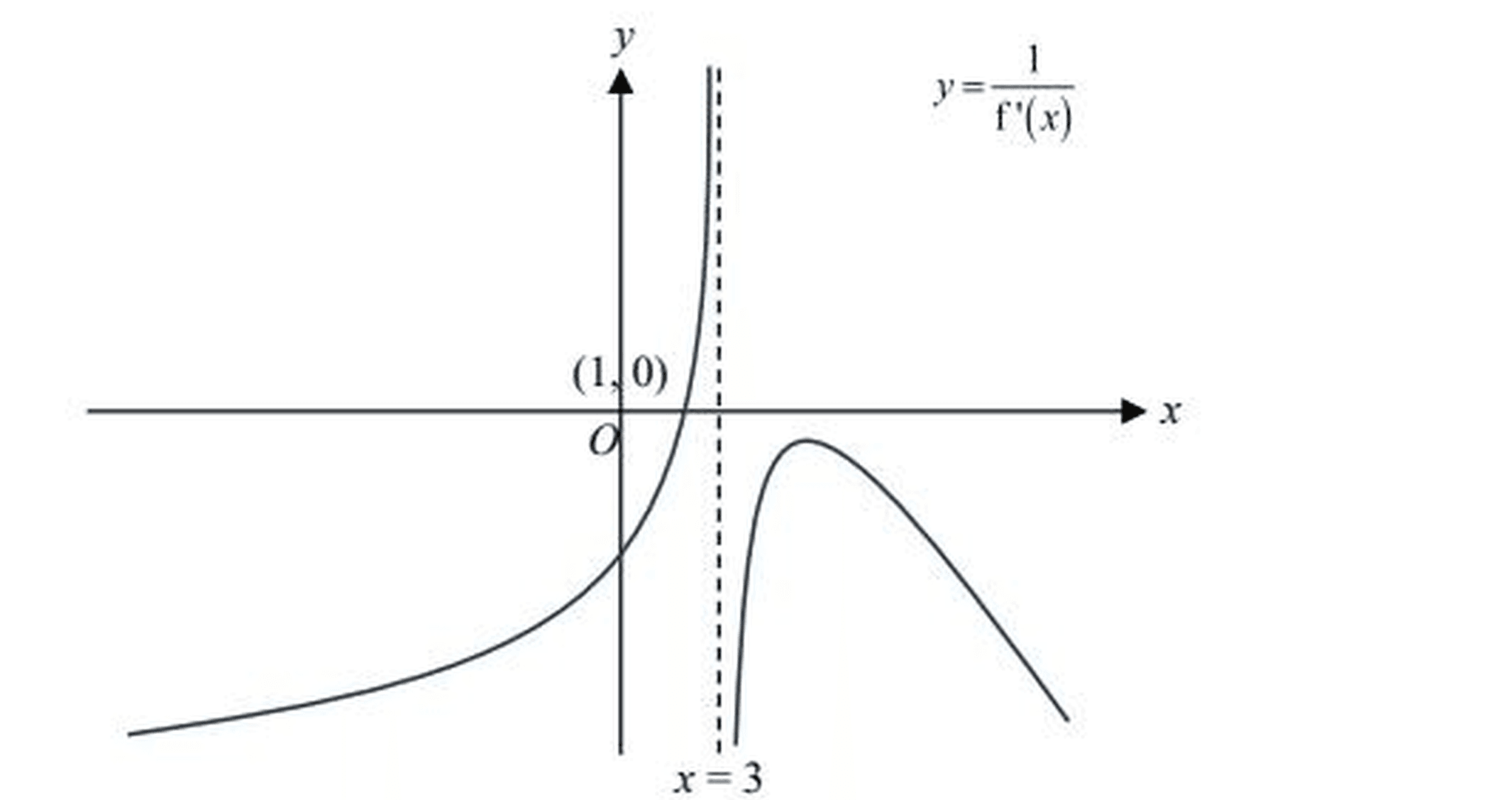
(b) Sketch of \(y = \dfrac{1}{\mathrm{f}'(x)}\):
From \(y=\mathrm{f}'(x)\): asymptotes \(x=1\), \(y=0\); \(x\)-intercept \((3,0)\).
For \(y=\dfrac{1}{\mathrm{f}'(x)}\): where \(\mathrm{f}'(x)\to 0^+\), \(\tfrac{1}{\mathrm{f}'(x)}\to+\infty\); where \(\mathrm{f}'(x)\to 0^-\), \(\tfrac{1}{\mathrm{f}'(x)}\to-\infty\); where \(\mathrm{f}'(x)\) has a zero at \(x=3\), \(\tfrac{1}{\mathrm{f}'(x)}\) has a vertical asymptote \(x=3\). The asymptote \(y=0\) of \(\mathrm{f}'(x)\) becomes no horizontal asymptote of \(\tfrac{1}{\mathrm{f}'(x)}\) (the curve has asymptote \(y=0\) on the original zero, now asymptote at \(x=3\)).
(c) Sketch of \(y = -\mathrm{f}(|x-1|)\):
Starting from \(y=\mathrm{f}(|x|)\): translate 1 unit in positive \(x\)-direction to get \(y=\mathrm{f}(|x-1|)\), then reflect in the \(x\)-axis to get \(y=-\mathrm{f}(|x-1|)\).