
Normal Distribution: Sum and difference — ACJC 2025 H2 Math Prelim Paper 2
What this question tests
Question
In this question you should state the parameters of any distribution you use.
A customer service call centre categorises incoming calls for follow-up resolution of the issues. The time taken to categorise an incoming call, \(T\) minutes, follows a normal distribution \(\mathrm{N}(2, 0.2^2)\). Incoming calls are categorised as routine or complex calls. The time taken to resolve a routine call, \(X\) minutes, follows a normal distribution \(\mathrm{N}(5, k)\) and the time taken to resolve a complex call, \(Y\) minutes, follows a normal distribution \(\mathrm{N}(20, 6^2)\). You may assume that any incoming call is first categorised as either routine or complex and is immediately followed up with the resolution of the issue. The duration of the call is taken to be the sum of the time taken to categorise the call and then to resolve the issue.
- Sketch the distribution for the time taken to categorise an incoming call, and shade clearly the area representing the probability that it took between 1.2 minutes and 2.8 minutes to categorise a randomly chosen incoming call.
- For a randomly chosen incoming call that is categorised as routine and then resolved,
there is a probability of 0.254 that the duration of the call is more than 8 minutes.
Show that \(k = 2.24\) correct to 2 decimal places.
- On a weekday morning where there are 20 incoming calls, \(n\) calls are categorised as complex calls. Given that there is a probability of at most 0.01 that the mean time taken to resolve the \(n\) complex calls exceeds 24 mins, find the set of values of \(n\).
- There is a review of the resolution processes such that the time taken to resolve a
complex call is now reduced by 20%.
Find the probability that the time taken to resolve 2 complex calls is more than twice the time taken to resolve a routine call.
Show full worked solution▾
Let \(T \sim \mathrm{N}(2,\,0.2^2)\) be the time (min) to categorise a call; \(X \sim \mathrm{N}(5,\,k)\) to resolve a routine call; \(Y \sim \mathrm{N}(20,\,6^2)\) to resolve a complex call.
Part (a)
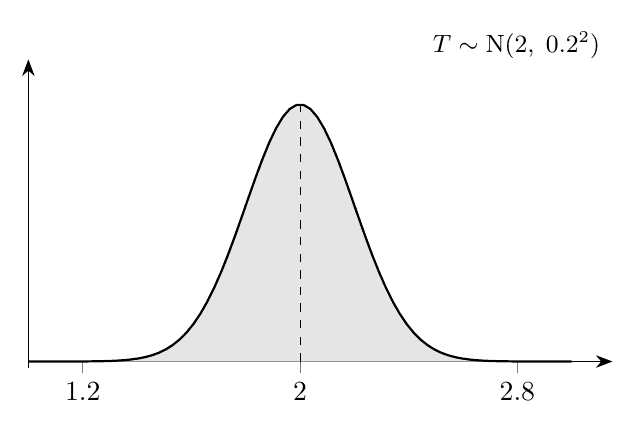
Note: \(\mathrm{P}(1.2 < T < 2.8) = 0.99994\), so the shaded region extends almost to the horizontal axis at \(1.2\) and \(2.8\), and the tiny unshaded tails are negligible.
Part (b)
\(T + X \sim \mathrm{N}(7,\; k + 0.2^2)\).
Given \(\mathrm{P}(T + X > 8) = 0.254\): \[ \mathrm{P}\!\left(Z > \frac{8-7}{\sqrt{k+0.04}}\right) = 0.254 \;\Rightarrow\; \frac{1}{\sqrt{k+0.04}} = 0.66196 \] \[ k + 0.04 = \frac{1}{0.66196^2} = 2.283 \;\Rightarrow\; k = 2.283 - 0.04 = 2.24 \text{ (3 s.f.)} \]
Part (c)
\(\bar{Y} = \dfrac{Y_1+Y_2+\cdots+Y_n}{n} \sim \mathrm{N}\!\left(20,\,\dfrac{36}{n}\right)\).
We need \(\mathrm{P}(\bar{Y} > 24) \leq 0.01\): \[ \mathrm{P}\!\left(Z > \frac{24-20}{\sqrt{36/n}}\right) \leq 0.01 \;\Rightarrow\; \frac{4\sqrt{n}}{6} \geq 2.32635 \;\Rightarrow\; \sqrt{n} \geq 3.489 \;\Rightarrow\; n \geq 12.18 \]
So \(n \geq 13\). Since \(n \leq 20\):
Part (d)
Let \(W = 0.8(Y_1+Y_2) - 2X\).
\[\begin{aligned} \mathrm{E}(W) &= 0.8(2)(20) - 2(5) = 32 - 10 = 22\\ \mathrm{Var}(W) &= 0.8^2(2)(36) + 2^2(2.24) = 0.64\times 72 + 4\times 2.24 = 46.08 + 8.96 = 55.04 \end{aligned}\]\(W \sim \mathrm{N}(22,\;55.04)\).
\[ \mathrm{P}(W > 0) = \mathrm{P}\!\left(Z > \frac{0-22}{\sqrt{55.04}}\right) = \mathrm{P}(Z > -2.965) = 0.998 \text{ (3 s.f.)} \]