
Summation of Series: worked solution — NYJC 2025 H2 Math Prelim Paper 1
Question
The \(n\)th term of a series G is given by \(g_n = 3n^2 - 17n + 17\), where \(n \ge 1\).
(a) Given that \(\displaystyle\sum_{r=1}^{n} r^2 = \dfrac{n}{6}(n+1)(2n+1)\), find \(\displaystyle\sum_{r=m+1}^{n} g_r\). (You need not simplify your answer.)
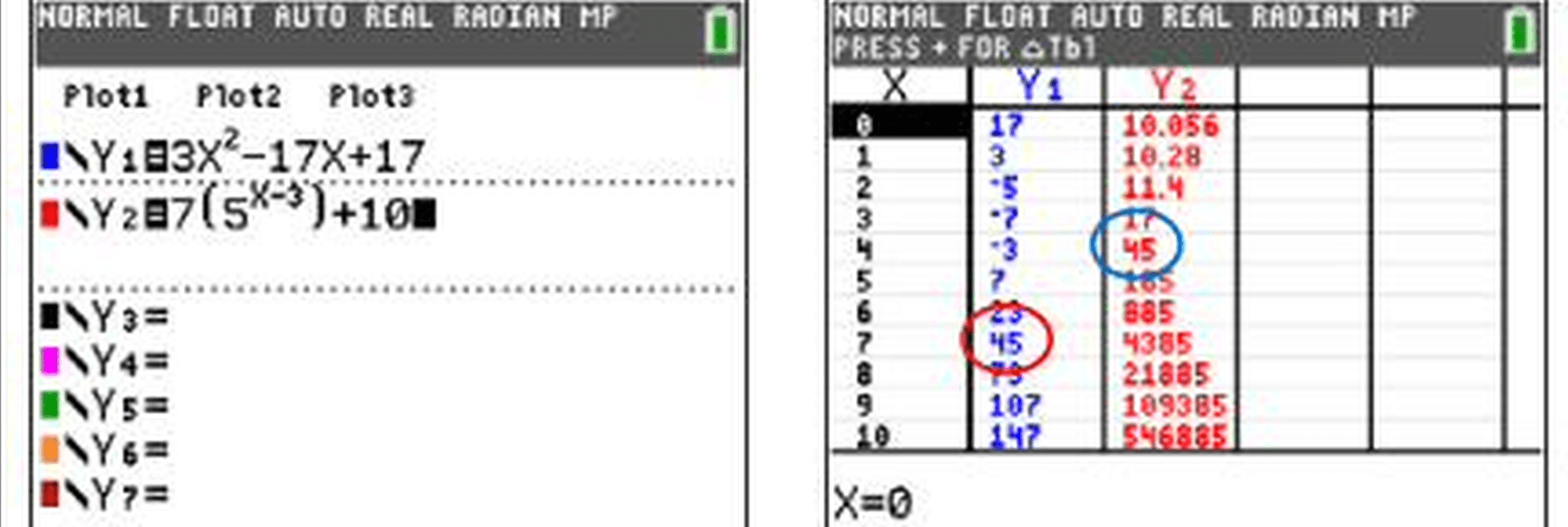
The \(n\)th term of a series H is given by \(h_n = 7(5^{n-3}) + 10\), where \(n \ge 1\).
(b) State the smallest number that can be found in both series H and G.
The sum of the first \(n\) terms of a series J is given by \(\dfrac{b}{2}(3^n - 1)\), where \(b\) is a positive odd integer.
(c) By finding the \(n\)th term of series J, explain why each of the terms in series J is a term of the arithmetic progression with first term 1 and common difference 2.
Show full worked solution▾
(a) \[\begin{aligned} \sum_{r=m+1}^{n}(3r^2-17r+17) &= 3\sum_{r=m+1}^{n}r^2 + \sum_{r=m+1}^{n}(-17r+17)\\ &= 3\!\left(\sum_{r=1}^{n}r^2 - \sum_{r=1}^{m}r^2\right) + 17\sum_{r=m+1}^{n}(-r+1)\\ &= 3\!\left[\frac{n}{6}(n+1)(2n+1) - \frac{m}{6}(m+1)(2m+1)\right]\\ &\quad + 17\left[\frac{n-m}{2}\bigl(-m+(-n+1)\bigr)\right]\\ &= \frac{n}{2}(n+1)(2n+1) - \frac{m}{2}(m+1)(2m+1)\\ &\quad + 17\left[\frac{n-m}{2}(1-m-n)\right] \end{aligned}\]
(b) From GC, the term 45 can be found in both series G and H.
(c) The \(n\)th term of J: \[\begin{aligned} j_n &= \frac{b}{2}(3^n-1) - \frac{b}{2}(3^{n-1}-1)\\ &= \frac{b}{2}(3^n - 3^{n-1})\\ &= \frac{b}{2}(3^{n-1})(3-1)\\ &= b \cdot 3^{n-1} \end{aligned}\]
Since \(b\) is a positive odd integer and \(3^{n-1}\) is odd for all \(n \ge 1\), \(j_n = b \cdot 3^{n-1}\) is a positive odd integer. The arithmetic progression \(1, 3, 5, \ldots\) is the set of all positive odd integers, so each \(j_n\) must be a term of it.