
Vectors: Right angle; cross product — NYJC 2025 H2 Math Prelim Paper 1
What this question tests
Question
(a) A triangle \(ABC\) is such that \(AB^2 + BC^2 = AC^2\).
By considering \(\overrightarrow{AB} + \overrightarrow{BC} = \overrightarrow{AC}\) and using the fact that \(|\mathbf{v}|^2 = \mathbf{v} \cdot \mathbf{v}\) for any vector \(\mathbf{v}\), prove that \(\angle ABC\) is a right-angle.
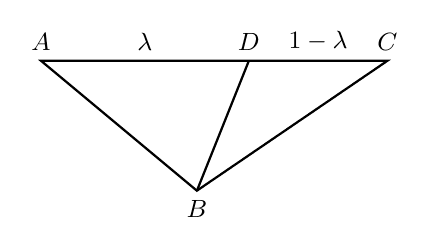
(b) In a triangle \(ABC\), the point \(D\) divides \(AC\) in the ratio \(\lambda : 1-\lambda\), where \(0 < \lambda < 1\).
Let the position vectors of \(A\), \(B\), \(C\) and \(D\) be denoted by \(\mathbf{a}\), \(\mathbf{b}\), \(\mathbf{c}\) and \(\mathbf{d}\) respectively.
Show that the area of triangle \(ABD\) is given by \[ k\,|\mathbf{a} \times \mathbf{b} + \mathbf{b} \times \mathbf{c} + \mathbf{c} \times \mathbf{a}| \] where \(k\) is to be determined in terms of \(\lambda\).
Show full worked solution▾
(a)
Method 1
\[\begin{aligned} \overrightarrow{AB} + \overrightarrow{BC} = \overrightarrow{AC} &\implies \left|\overrightarrow{AB} + \overrightarrow{BC}\right|^2 = \left|\overrightarrow{AC}\right|^2\\ &\implies \left(\overrightarrow{AB}+\overrightarrow{BC}\right)\cdot\left(\overrightarrow{AB}+\overrightarrow{BC}\right) = \overrightarrow{AC}\cdot\overrightarrow{AC} \quad(\because|\mathbf{v}|^2 = \mathbf{v}\cdot\mathbf{v})\\ &\implies \overrightarrow{AB}\cdot\overrightarrow{AB} + 2\!\left(\overrightarrow{AB}\cdot\overrightarrow{BC}\right) + \overrightarrow{BC}\cdot\overrightarrow{BC} = \overrightarrow{AC}\cdot\overrightarrow{AC}\\ &\implies AB^2 + BC^2 + 2\!\left(\overrightarrow{AB}\cdot\overrightarrow{BC}\right) = AC^2\\ &\implies AC^2 + 2\!\left(\overrightarrow{AB}\cdot\overrightarrow{BC}\right) = AC^2 \quad\text{since }AB^2 + BC^2 = AC^2\\ &\implies \overrightarrow{AB}\cdot\overrightarrow{BC} = 0 \end{aligned}\]So \(AB\) is perpendicular to \(BC\) and hence \(\angle ABC = 90°\).
Method 2
\[\begin{aligned} AB^2 + BC^2 = AC^2 &\implies \left|\overrightarrow{AB}\right|^2 + \left|\overrightarrow{BC}\right|^2 = \left|\overrightarrow{AC}\right|^2 = \left|\overrightarrow{AB}+\overrightarrow{BC}\right|^2\\ &\implies \left|\overrightarrow{AB}\right|^2 + \left|\overrightarrow{BC}\right|^2 = \left(\overrightarrow{AB}+\overrightarrow{BC}\right)\cdot\left(\overrightarrow{AB}+\overrightarrow{BC}\right)\\ &\implies \left|\overrightarrow{AB}\right|^2 + \left|\overrightarrow{BC}\right|^2 = \left|\overrightarrow{AB}\right|^2 + \left|\overrightarrow{BC}\right|^2 + 2\!\left(\overrightarrow{AB}\cdot\overrightarrow{BC}\right)\\ &\implies \overrightarrow{AB}\cdot\overrightarrow{BC} = 0 \end{aligned}\]So \(AB\) is perpendicular to \(BC\) and hence \(\angle ABC = 90°\).
(b)
Method 1
By the ratio theorem, \[ \mathbf{d} = \overrightarrow{OD} = (1-\lambda)\overrightarrow{OA} + \lambda\overrightarrow{OC} = (1-\lambda)\mathbf{a} + \lambda\mathbf{c}. \]
Area of triangle \(ABD\): \[\begin{aligned} &= \tfrac{1}{2}\left|\overrightarrow{AB}\times\overrightarrow{BD}\right|\\ &= \tfrac{1}{2}\left|(\mathbf{b}-\mathbf{a})\times(\mathbf{d}-\mathbf{b})\right|\\ &= \tfrac{1}{2}\left|(\mathbf{b}-\mathbf{a})\times\!\left((1-\lambda)\mathbf{a}+\lambda\mathbf{c}-\mathbf{b}\right)\right|\\ &= \tfrac{1}{2}\left|(1-\lambda)(\mathbf{b}\times\mathbf{a})+\lambda(\mathbf{b}\times\mathbf{c}) -\lambda(\mathbf{a}\times\mathbf{c})+\mathbf{a}\times\mathbf{b}\right|\\ &= \tfrac{1}{2}\left|(\lambda-1)(\mathbf{a}\times\mathbf{b})+\lambda(\mathbf{b}\times\mathbf{c}) -\lambda(\mathbf{a}\times\mathbf{c})\right|\quad\text{since }\mathbf{b}\times\mathbf{a}=-\mathbf{a}\times\mathbf{b}\\ &= \tfrac{1}{2}\left|\lambda(\mathbf{a}\times\mathbf{b})+\lambda(\mathbf{b}\times\mathbf{c}) -\lambda(\mathbf{a}\times\mathbf{c})\right|\\ &= \frac{\lambda}{2}\left|\mathbf{a}\times\mathbf{b}+\mathbf{b}\times\mathbf{c}+\mathbf{c}\times\mathbf{a}\right| \quad\text{since }0<\lambda<1. \end{aligned}\] So \(k = \dfrac{\lambda}{2}\).
Method 2
Since triangles \(ABD\) and \(ABC\) share the same height, \[\begin{aligned} \text{Area of triangle }ABD &= \frac{\lambda}{\lambda+(1-\lambda)}\!\left(\text{Area of triangle }ABC\right)\\ &= \lambda\!\left(\tfrac{1}{2}\left|\overrightarrow{AB}\times\overrightarrow{AC}\right|\right)\\ &= \frac{\lambda}{2}\left|(\mathbf{b}-\mathbf{a})\times(\mathbf{c}-\mathbf{a})\right|\\ &= \frac{\lambda}{2}\left|\mathbf{b}\times\mathbf{c}-\mathbf{b}\times\mathbf{a}-\mathbf{a}\times\mathbf{c}\right|\\ &= \frac{\lambda}{2}\left|\mathbf{a}\times\mathbf{b}+\mathbf{b}\times\mathbf{c}+\mathbf{c}\times\mathbf{a}\right| \end{aligned}\]
So \(k = \dfrac{\lambda}{2}\).