
Free practice / Secondary 4 A Maths
Sec 4 A Math: Kinematics, practice questions & worked solutions
Kinematics practice questions selected from 2025 Singapore school A Math prelim papers, each with a full worked solution.
About this topic & key methods
These questions support Secondary 4 and O-Level Additional Mathematics revision.
Attempt each question on paper before opening its worked solution. Keep the source question number when checking against the original paper.
Key methods
- Differentiate displacement to find velocity and acceleration.
- Integrate velocity or acceleration and use initial conditions.
- Identify rest, direction changes and turning points.
- Distinguish total distance travelled from displacement.
For guided practice, see our Sec 4 A Maths tuition programme.
Questions & worked solutions
Unless the question specifies otherwise, give numerical answers to 3 significant figures and angles in degrees to 1 decimal place. Angles in radians are stated explicitly.
Kinematics
A cyclist starts from rest from a point and travels in a straight line until she comes to a rest at a point . During the motion, her velocity, m/s, is given by , where is the time in seconds after leaving .
Find the time taken for the cyclist to travel from to .
Find the distance .
Find the acceleration of the cyclist when .
Show worked solution▾
(a)
(b)
(c)
Kinematics
A particle moves in a straight line so that, seconds after passing through a fixed point , its velocity, m/s, is given by , where is a constant. When , the acceleration is .
Find the value of .
The particle is first at rest at point . Find the value of when the particle is at point .
Find the distance travelled by the particle from to .
Show worked solution▾
(a)
When
(b)
At rest
(c)
Alternative
At , At ,
Kinematics
An object starts from rest from a point . Its velocity, cm/s, seconds after leaving , is such that . After 5 seconds, the object reaches a point .
Find its velocity at .
Find the distance .
On reaching , the object then slows so that its velocity cm/s, seconds after leaving , is such that , where is a constant.
Given that the object’s velocity at a point where is 26 cm/s, show that .
Show worked solution▾
(a)
When , ; When , .
Velocity m/s
(b)
When , ; When , .
Distance cm
(c)
When ,
Kinematics
A particle moves in a straight line with a fixed point . The velocity of the particle, m/s, is given by where is time in seconds after passing .
Explain why the particle never changes its direction of motion and will eventually travel at a speed close to 10 m/s.
Find the acceleration of the particle at .
Calculate the distance travelled by the particle in the fifth second of its motion.
Show worked solution▾
(a)
Since , and hence . Therefore particle will never change its direction.
As increases, decreases and approaches / becomes very small.
Therefore particle will eventually travel at a speed close to m/s.
(b)
(c)
When , , .
Kinematics
A particle, , travels in a straight line so that at time seconds, its velocity, m/s, is given by The initial displacement of from a fixed point is m.
Find the initial velocity of , giving your answer in exact value.
Find the first two values of when comes to instantaneous rest.
Find the distance travelled by in the first 4 seconds.
Show worked solution▾
(a)
When ,
(b)
When ,
(c)
When , , When m
Kinematics
A particle starts from rest and travels in a straight line such that seconds after leaving a fixed point , the acceleration m/s, is given by . Find
the velocity of the particle when ,
the distance of the particle from when it comes to an instantaneous rest,
the total distance travelled by the particle in the first 5 seconds. Leave your answer in exact form.
Show worked solution▾
(a)
At , , .
(b)
At , , . The distance is m.
(c)
Kinematics
A particle starts from a point and moves in a straight line so that its velocity, m/s, is given by where is the time in seconds after leaving .
Find the value of at which the particle is instantaneously at rest.
Calculate the distance travelled by the particle in the first second.
Explain why the velocity of the particle cannot exceed a certain value.
Show worked solution▾
(a)
(b)
Distance in the first second
(c)
As approaches , approaches . The particle’s velocity cannot exceed 5 m/s, and this is the greatest velocity attained.
Kinematics
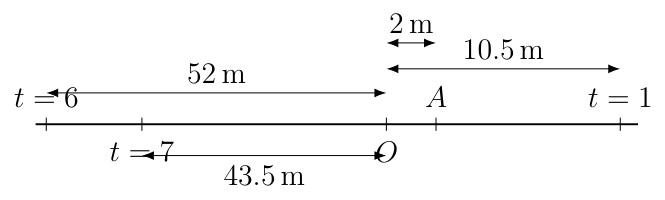
A particle travels in a straight line such that at time seconds after leaving a point , which has a displacement of 2 metres from a fixed point , its velocity, is given by Find,
the minimum velocity of the particle,
the time(s) at which the particle is instantaneously at rest,
the total distance travelled in the first 7 seconds.
Show worked solution▾
(a)
Therefore, is the minimum velocity.
(b)
(c)
At , , therefore, At , At , At ,
Kinematics (Trigonometric Functions)
A particle moves in a straight line so that, at time seconds after passing a fixed point , its velocity is m/s, where . Find
the velocity of the particle at the instant it passes ,
the least value of the particle’s acceleration,
the values of , in terms of , when the particle is at rest for ,
the distance travelled in the first 2 seconds.
Show worked solution▾
(a)
When particle passes , ,
Hence,
(b)
Least acceleration
(c)
When particle is at rest, Basic angle
For , lies in Q2, Q3
(d)
Or
Kinematics
A particle moves in a straight line so that seconds after leaving a fixed point , its velocity m/s is given by . Find
the time when the particle reaches its greatest distance from ,
the value of the greatest distance from ,
the minimum velocity of the particle.
Show worked solution▾
(a)
When ,
(b)
When , , . when , m.
(c)
when , When , m/s.