
Free practice / Secondary 4 A Maths
Sec 4 A Math: Quadratic Functions & Inequalities, practice questions & worked solutions
Quadratic Functions & Inequalities practice questions selected from 2025 Singapore school A Math prelim papers, each with a full worked solution.
About this topic & key methods
These questions support Secondary 4 and O-Level Additional Mathematics revision.
Attempt each question on paper before opening its worked solution. Keep the source question number when checking against the original paper.
Key methods
- Complete the square to find a turning point and a maximum or minimum.
- Use the discriminant to determine the number of real roots or intersections.
- Solve quadratic inequalities and check the relevant intervals.
- Form and solve simultaneous equations involving a line and a curve.
For guided practice, see our Sec 4 A Maths tuition programme.
Questions & worked solutions
Unless the question specifies otherwise, give numerical answers to 3 significant figures and angles in degrees to 1 decimal place. Angles in radians are stated explicitly.
Quadratic Functions
Express in the form and hence explain why is negative for all real values of .
Show worked solution▾
Since , for all real values of .
Therefore is negative for all real values of .
Simultaneous Equations
The line intersects the curve at points and . Calculate the exact length of the line segment .
Show worked solution▾
Subst (2) into (1) Subst respective values into [1],
Quadratic Functions
A quadratic function is given by .
Express in the form , where , and are constants and .
Sketch the graph of , indicating clearly he turning point and the -intercept.
Hence find the range of values of for which the equation has at most one root.
Show worked solution▾
(a)
(b)
Turning point ; -intercept .
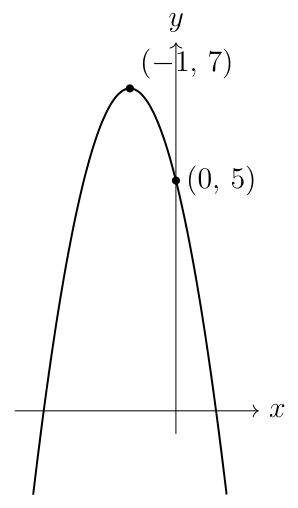
(c)
Quadratic Functions
The equation of a curve is , where is a constant.
Given that , by completing the square, find the minimum value of . Express your answer in the form , where and are integers.
Given instead that , find the coordinates of the maximum point in terms of .
Show worked solution▾
(a)
Hence, the minimum value of is .
(b)
Quadratic Functions
Find the range of values of the constant for which the curve lies completely above the -axis.
Show worked solution▾
Therefore .
Quadratic Functions
Find the set of values of the constant for which the curve lies entirely above the -axis.
Show worked solution▾
Quadratic Functions
Find the range of values of the constant such that is always positive for all real values of .
Show worked solution▾
for to be always positive,
Simultaneous Equations
A line that is not parallel to the -axis has the equation , where and are constants. A curve has the equation . Given that the line and the curve intersect at the point , find the value of and of .
Show worked solution▾
When , ,
From (1), , :–(3).
From (2), :–(4).
Substitute (3) into (4),
Quadratic Functions
The equation of a curve is , where is a constant. The curve has a maximum point and intersects the line . Find the range of values of .
Show worked solution▾
Since the curve intersects the line, Since curve has a maximum point, Hence
Quadratic Functions
The height, m, above the ground of a pellet shot by a shooting device can be modelled by the equation , where m is the horizontal distance travelled by the pellet.
Express in the form , where , and are constants.
Explain why the maximum height reached by the pellet is 62 metres.
A two-metre-tall pole is placed on the ground, at a horizontal distance of 10 metres from the shooting device. Explain if the pellet will hit the pole.
Show worked solution▾
(a)
(b)
Height m
Since height is m, the maximum height reach by the ball is 62 metres.
(c)
Height
When , The pellet will not hit the object.
Related A Math topics
Surds, Indices & Logarithms · Polynomials & Partial Fractions · Binomial Theorem