
Maclaurin Series: Small angle; triangle approx. — TJC 2025 H2 Math Prelim Paper 1
What this question tests
Question
In the triangle \(ABC\), \(AC = 1\), angle \(BAC = \dfrac{\pi}{3}\) radians and angle \(ABC = \left(\dfrac{\pi}{6} + \theta\right)\) radians.
- Show that \(BC = \dfrac{\sqrt{3}}{\cos\theta + \sqrt{3}\sin\theta}\).
- Given that \(\theta\) is sufficiently small such that \(\theta^3\) and higher powers of \(\theta\) may be neglected, show that \[ BC \approx \sqrt{3}\left(1 + a\theta + b\theta^2\right) \] where \(a\) and \(b\) are constants to be determined.
Show full worked solution▾
(a) Using the Sine Rule in \(\triangle ABC\) (with \(AB=1\), angle \(A = \dfrac{\pi}{3}\), angle \(B = \dfrac{\pi}{6}+\theta\)):
\[ \frac{BC}{\sin\dfrac{\pi}{3}} = \frac{1}{\sin\!\left(\dfrac{\pi}{6}+\theta\right)} \] \[ \frac{BC}{\dfrac{\sqrt{3}}{2}} = \frac{1}{\sin\dfrac{\pi}{6}\cos\theta + \cos\dfrac{\pi}{6}\sin\theta} = \frac{1}{\dfrac{1}{2}\cos\theta + \dfrac{\sqrt{3}}{2}\sin\theta} \]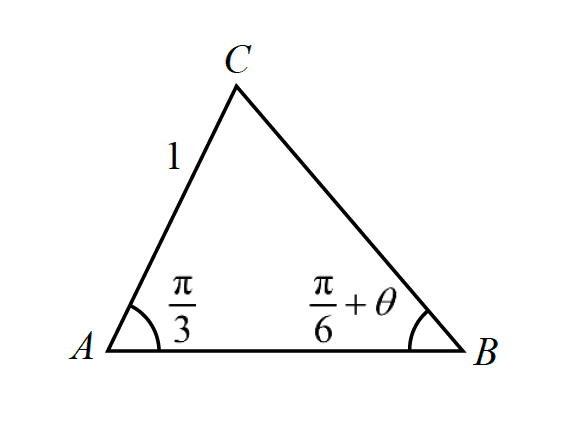
(b) Since \(\theta\) is small, \(\cos\theta \approx 1 - \dfrac{\theta^2}{2}\) and \(\sin\theta \approx \theta\): \[ BC \approx \frac{\sqrt{3}}{\left(1 - \dfrac{\theta^2}{2}\right) + \sqrt{3}\,\theta} = \sqrt{3}\left[1 + \left(\sqrt{3}\,\theta - \frac{\theta^2}{2}\right)\right]^{-1} \] \[ \approx \sqrt{3}\left[1 - \left(\sqrt{3}\,\theta - \frac{\theta^2}{2}\right) + \left(\sqrt{3}\,\theta - \frac{\theta^2}{2}\right)^{\!2}\right] \] \[ \approx \sqrt{3}\left[1 - \sqrt{3}\,\theta + \frac{\theta^2}{2} + 3\theta^2\right] = \sqrt{3}\left(1 - \sqrt{3}\,\theta + \frac{7\theta^2}{2}\right) \]