
Hypothesis Testing: Multi-part hypothesis test — DHS 2025 H2 Math Prelim Paper 2
What this question tests
Question
Mr Dough's factory produces packets of flour for sale in local supermarkets packed in 2 sizes — Regular-sized packets and Large-sized packets. Automated machines weigh and pack the flour. A recent major power outage resulted in all his machines being needed to be recalibrated upon restarting.
Regular-sized packets are supposed to have a mean mass of 1 kg. Mr Dough suspects that his machines now pack Regular-sized packets that are underweight. He took a sample of his Regular-sized packets and measured their masses, \(x\) g (correct to nearest 5 g). The results are recorded as follows:
| Mass, \(x\) (g) | No. of Regular-sized packets |
|---|---|
| 980 | 5 |
| 985 | 6 |
| 990 | 7 |
| 995 | 7 |
| 1000 | 9 |
| 1005 | 6 |
| 1010 | 5 |
| 1015 | 3 |
| 1020 | 2 |
- Determine the unbiased estimate of the population variance of the mass of Regular-sized packets.
- Explain whether Mr Dough should conduct a one-tail or a two-tail test.
- Carry out the test at 5% level of significance and give your conclusion in context. Explain whether it is necessary to assume that the mass of Regular-sized packets of flour follow a normal distribution.
Large-sized packets of flour are known to have a normal distribution with a mean mass of 2 kg. Mr Dough also suspects that his machines are now not packing the Large-sized packets according to the required mass correctly. A sample of 15 Large-sized packets of flour gave a total mass of 30075 g.
Assuming Large-sized packets of flour have a population variance of \(\sigma^2\,\mathrm{g}^2\), an appropriate test was carried out which gave a \(p\)-value of 0.0529.
- Showing all necessary workings, prove that \(\sigma = 10.0\) correct to 3 significant figures.
- Another packet of Large-sized packet of flour with mass \(h\) g is then added to the sample of 15. The combined sample of Large-sized packets resulted in a rejection of the claim that the mean mass of a Large-sized packet of flour is 2 kg at 4% level of significance.
Using \(\sigma = 10.0\), find the possible range of values of \(h\), giving your answer to the nearest gram.
Show full worked solution▾
(a)
Using GC, unbiased estimate of the population variance:
\(s^2 = 123\) g\(^2\) (3 s.f.)
(b)
A one-tail (lower-tail) test, as \(H_1: \mu < 1000\).
(c)
Let \(\mu\) be the population mean mass (g) of a Regular-sized packet of flour.
\(H_0: \mu = 1000\) \(H_1: \mu < 1000\)Perform 1-tail test at 5% level of significance.
Under \(H_0\), by Central Limit Theorem (since \(n = 50\) is large): \[\bar{X} \sim \mathrm{N}\!\left(1000,\,\frac{122.69}{50}\right) \text{ approximately}\]
\(\bar{x} = 997.4\) (exact), \(n = 50\).
\(p\)-value \(= 0.0485\) (3 s.f.).
Since \(p\)-value \(= 0.0485 < 0.05\), we reject \(H_0\).
There is sufficient evidence at 5% level of significance to conclude that the mean mass of a Regular-sized packet of flour is less than 1000 g.
(d)
Let \(Y\) g be the mass of a Large-sized packet, \(\mu_Y\) be the population mean.
\(H_0: \mu_Y = 2000\) \(H_1: \mu_Y \neq 2000\)Under \(H_0\): \(\bar{Y} \sim \mathrm{N}\!\left(2000,\,\dfrac{\sigma^2}{15}\right)\).
\(\bar{y} = \dfrac{30075}{15} = 2005\).
Since \(2005 > 2000\), \(p\)-value \(= 2\mathrm{P}(\bar{Y} \ge 2005) = 0.0529\).
\[\mathrm{P}(\bar{Y} \ge 2005) = 0.0529/2\] \[\frac{2005 - 2000}{\sigma/\sqrt{15}} = z_{\text{cal}}\] \[\frac{5\sqrt{15}}{\sigma} = 1.935736\ldots\](e)
\(\text{H}_0\): \(\mu_Y = 2000\)
\(\text{H}_1\): \(\mu_Y \neq 2000\)
Perform 2-tail test at 4% level of significance
Under \(\text{H}_0\), \(\bar{Y}_{\text{new}} \sim \mathrm{N}\!\left(2000,\ \dfrac{10.0^2}{16}\right)\)
\[ \bar{y}_{\text{new}} = \frac{\sum y + h}{16} = \frac{30075 + h}{16} \]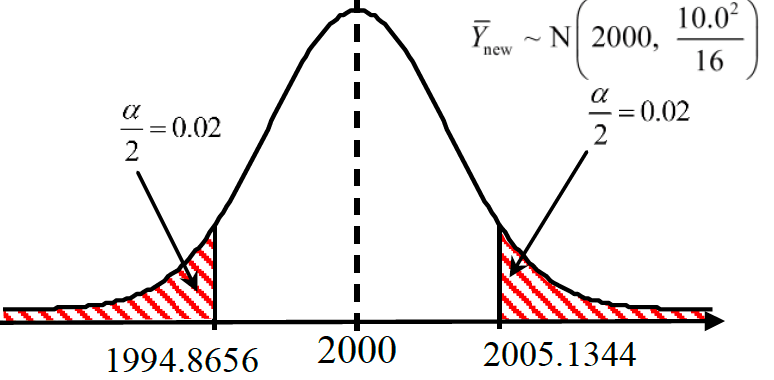
Since \(\text{H}_0\) is rejected: \(\bar{y}_{\text{new}}\) lies in critical region
| p{0.45\linewidth} l p{0.45\linewidth}@{}} \(\bar{y}_{\text{new}} \leq 1994.8656\) | or | \(\bar{y}_{\text{new}} \geq 2005.1344\) [6pt] \(\dfrac{30075+h}{16} \leq 1994.8656\) | or | \(\dfrac{30075+h}{16} \geq 2005.1344\) [10pt] \(h \leq 1842.85\) | or | \(h \geq 2007.15\) [6pt] \(\therefore h \leq 1842\) (nearest g) | or | \(h \geq 2008\) (nearest g) |
|---|