
Permutations & Combinations: Circular glasses; at-least — EJC 2025 H2 Math Prelim Paper 2
What this question tests
Question
Mary is setting up a tabletop display using 6 glasses, arranged around a circular tray, as shown in the diagram below. There are 4 different colours of glasses — Red, Blue, Green and Yellow. For each colour, Mary owns one tall and one short glass, so she has 8 glasses in total.
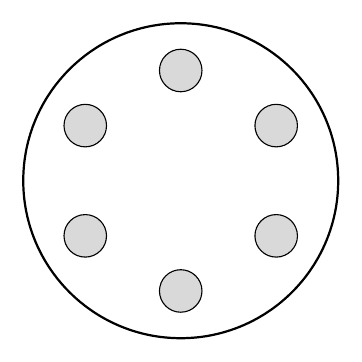
- In how many ways can Mary arrange 6 of the 8 glasses around the circular tray, such that at least one glass of each colour is used?
- Mary decides to give away one tall glass and one short glass to support a charity drive. In how many ways can she choose the two glasses to give away?
- Mary decides to give away the red tall glass and green short glass. She now wants to arrange the remaining 6 glasses in a straight row, such that no two adjacent glasses are of the same colour. Find the number of different arrangements.
Show full worked solution▾
(a) The number of ways to choose \(6\) glasses from \(8\), such that all four colours appear, is computed via complementary counting: \[ \text{(ways to choose 6 of 8)} - \text{(ways with exactly one colour missing)} = \binom{8}{6} - \binom{4}{1} = 28 - 4 = 24. \]
Each choice of \(6\) glasses can be arranged around a circular tray in \((6-1)! = 120\) ways, giving \[ 24 \times 120 = 2880. \]
\(2880\) arrangements.
(b) Mary chooses one tall glass (from \(4\) colours) and one short glass (from \(4\) colours): \[ \text{Number of ways} = 4 \times 4 = 16. \]
\(16\) ways.
(c) The remaining \(6\) glasses are: red short, blue tall, blue short, green tall, yellow tall, yellow short. Only blue and yellow have two same-colour glasses.
Let \(A\) be the event that the two blue glasses are adjacent, and \(B\) the event that the two yellow glasses are adjacent. We want \(n(A' \cap B')\).
\(n(A')\) — blues not adjacent: arrange the four non-blue glasses (\(4!\) ways), then slot the two distinguishable blue glasses into \(2\) of the \(5\) gaps (\(\binom{5}{2}\!\times\!2!\)): \[ n(A') = 4! \times \binom{5}{2} \times 2! = 24 \times 10 \times 2 = 480. \]
\(n(A' \cap B)\) — blues not adjacent, yellows adjacent: glue the yellows into one block (\(2!\) internal), arrange this block with red and green (\(3!\)), then slot the blues into \(2\) of the \(4\) gaps (\(\binom{4}{2}\!\times\!2!\)): \[ n(A' \cap B) = 3! \times 2! \times \binom{4}{2} \times 2! = 6 \times 2 \times 6 \times 2 = 144. \]
Hence (blue not adjacent AND yellow not adjacent): \[ n(A' \cap B') = n(A') - n(A' \cap B) = 480 - 144 = 336. \]