Sec 1 Maths Head Start: A Free Starter Pack for the P6 to Sec 1 Jump
By the Math Academy teachers, all NUS Mathematics graduates · Updated November 2026
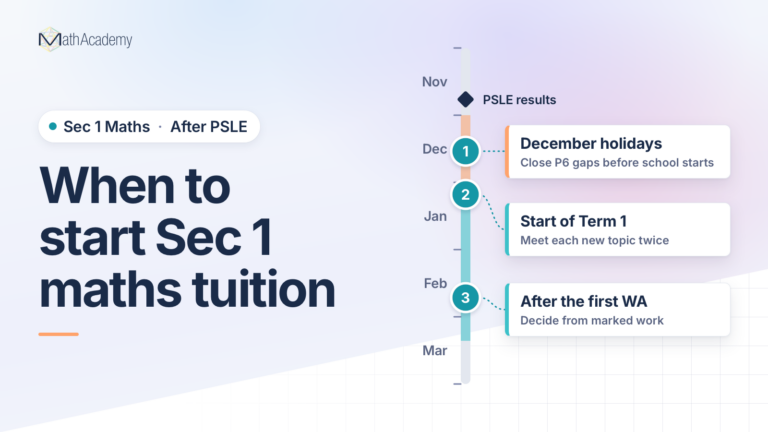
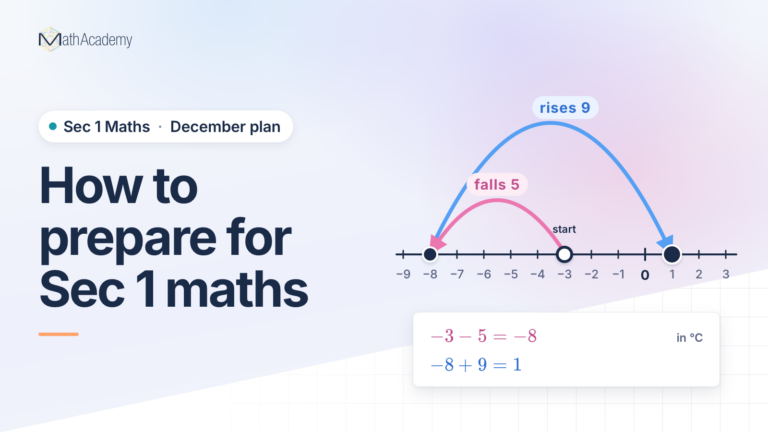
A free self-study starter pack for children moving from Primary 6 to Sec 1, made from our existing study guides and practice questions. It covers five ideas that make the jump hard, in about 8 to 10 sessions of 20 to 30 minutes. No sign-up, no payment: every guide and worked solution is open on this site. For the reasons and a dated December plan, read how to prepare for Sec 1 Maths in 2027.
How the pack works
Each step gives one reason it matters, one study guide to read, three to five questions to try from our Sec 1 practice bank, and a you are ready when check we wrote for this pack, with its answer.
The bank questions come from Secondary 1 school examination papers, each with a full worked solution. We picked the gentlest on each page, but some will still feel hard in December. That is expected: try each on paper, then compare with the worked solution line by line.
Step 1: Negative numbers and the kinds of number (2 sessions)
Why it matters. Sec 1 works across zero in almost every topic, so a sign slip made now keeps costing marks later.
Read. Integers and rational numbers: start with “Know which kind of number you are using” and “Add and subtract by thinking about a change”.
Try on Integers and Rational Numbers:
- Q1 (Raffles Girls’, 2016): pick the rational and natural numbers from a list.
- Q7 (Xinmin, 2018): pick the prime and rational numbers from a list.
- Q6 (Xinmin, 2017): put four negative numbers in ascending order.
- Q2 (Raffles Girls’, 2019): a fraction calculation with a negative cube. This is the stretch question.
You are ready when your child can work out −7 + 12 − (−3) × 2 without a calculator.
Answer: (−3) × 2 = −6 first, then −7 + 12 − (−6) = 5 + 6 = 11.
Step 2: Algebra with brackets (2 sessions)
Why it matters. P6 algebra has no brackets; Sec 1 brings them in early, and a minus sign before a bracket changes every term inside.
Read. Basic algebra: “Collect like terms” and “Expand by multiplying every term”.
Try on Basic Algebra: Expansion and Factorisation:
- Q18 (Temasek Secondary, 2023), parts (a) and (b): simplify, with a minus before a bracket.
- Q2 (Raffles Girls’, 2019): substitute negative values into a formula.
- Q17 (Temasek Secondary, 2023): factorise two expressions.
- Q21 (Xinmin, 2018), part (b): expand a bracket inside a bracket.
You are ready when your child can simplify 4(2y − 3) − 3(y − 5).
Answer: 8y − 12 − 3y + 15 = 5y + 3. Check with y = 1: 4 × (−1) − 3 × (−4) = −4 + 12 = 8, and 5 + 3 = 8.
Step 3: Solving equations, one line at a time (2 sessions)
Why it matters. Sec 1 wants the thinking behind a model written as an equation, one step per line.
Read. Linear equations in one unknown: “The balance principle” and “Brackets and negative signs”.
Try on Linear Equations and Inequalities:
- Q1 (Fairfield Methodist, 2024): solve 3(3a + 1) = 5 + 4a.
- Q13 (Raffles Girls’, 2021): solve an equation with a minus sign before a bracket.
- Q5 and Q6 (Fairfield Methodist, 2024): turn a sentence into an equation, then solve it.
- Q7 (Fairfield Methodist, 2024): use a temperature formula backwards.
You are ready when your child can solve 7 − 2(x − 4) = 3x and check the answer.
Answer: 7 − 2x + 8 = 3x, so 15 = 5x and x = 3. Check: 7 − 2 × (−1) = 9 and 3 × 3 = 9.
Step 4: Ratio and percentage, refreshed (2 sessions)
Why it matters. These lean hardest on P6, and Sec 1 questions often combine them.
Read. Ratio, rate and proportion: “A ratio compares equal-sized parts” and “Share a total, or use a difference”.
Try on Ratio, Rate and Proportion and Percentage:
- Ratio Q1 (Anglican High, 2025), part (a): a ratio in its simplest form, with different units. Leave part (b) for after Step 5.
- Ratio Q10 (Temasek JC, IP1, 2021): a currency conversion.
- Ratio Q4 and Ratio Q5 (Fairfield Methodist, 2024): join two ratios, then find a total from a difference.
- Percentage Q4 (Raffles Girls’, 2021): a percentage increase, then find the original number.
You are ready when your child can solve this: Ali and Ben share $84 in the ratio 3 : 4. Ben then gives 25% of his share to Ali. How much does each have now?
Answer: Ali $36 and Ben $48 at first. 25% of $48 is $12, so Ali has $48 and Ben has $36.
Step 5: Speed and units (2 sessions)
Why it matters. Speed is not in the 2021 primary syllabus, so it is new for children starting Sec 1 in 2027, and unit changes are where marks go.
Read. Rate, speed and time: “A rate measures change per unit” and “Average speed uses totals”.
Try on Rate, Speed and Time:
- Q3 (Fairfield Methodist, 2024): change m/s to km/h.
- Q8 (Fairfield Methodist, 2024): a distance from a speed and a time in minutes.
- Q24 (Xinmin, 2018): change m/min to km/h, then find a distance.
- Q9 (Fairfield Methodist, 2024): the stretch question, a time difference after a speed increase.
You are ready when your child can solve this: a bus travels 30 km in 40 minutes. Find its average speed in km/h, then in m/s.
Answer: 40 minutes is 2/3 of an hour, so 30 ÷ 2/3 = 45 km/h. Then 45 000 m ÷ 3600 s = 12.5 m/s.
For parents: how to use the pack
- Keep it short. About three sessions a week. Stop on time, even mid-question.
- Paper first. Your child writes the working, then finds the first line that differs from our worked solution.
- Use the check as the gate. Right with clear working: move on. Wrong: reread the guide section and try one more bank question.
What not to do. Do not race through the Sec 1 textbook or add chapters to this pack. Half-learnt methods are harder to fix than new ones.
When to ask for help. If the same check goes wrong twice after rereading the guide, note the step and raise it with your child’s teacher once term starts.
Our Sec 1 Maths classes
This pack has no marking or feedback. If your child needs regular support once Sec 1 starts, our Sec 1 Maths tuition classes are taught by Ms Jolyn Ang and Ms Raine Ang, have at most 7 students, and meet for 1.5 hours a week at our centre opposite Bukit Gombak MRT. Our tutors personally mark every worksheet. Class times and fees are on the timetable, or WhatsApp us on 8859 1092.
Frequently asked questions
Is the Sec 1 head start pack free?
Yes. No sign-up and nothing to pay. It uses our study guides and Sec 1 practice questions, all open on this site.
Does my child need tuition before Sec 1 starts?
Not as a rule. A light December review of P6 fractions, ratio, percentage and algebra, with a first look at negative numbers, brackets and speed, is enough for many children. Decide after the first few weeks of Term 1.
What if my child is posted to G2 Maths?
The pack follows our G3 guides; G3 has the longest Sec 1 list, so a G2 child can go at a gentler pace and skip the stretch questions. Under MOE’s rules, a pupil whose usual level is G2 can take G3 Mathematics from the start of Sec 1 with PSLE Mathematics AL 5 or better. See the difference between G2 and G3 Mathematics.
How long should the pack take?
About 8 to 10 sessions of 20 to 30 minutes: three to four weeks at three sessions a week. There is no deadline. For a routine after that, read how to study Secondary 1 maths.